Joseph L. Mundy – författare
Visar alla böcker från författaren Joseph L. Mundy. Handla med fri frakt och snabb leverans.
3 produkter
3 produkter
E-bok
PDF, Engelska, 2003708 kr
Läs direkt efter köp
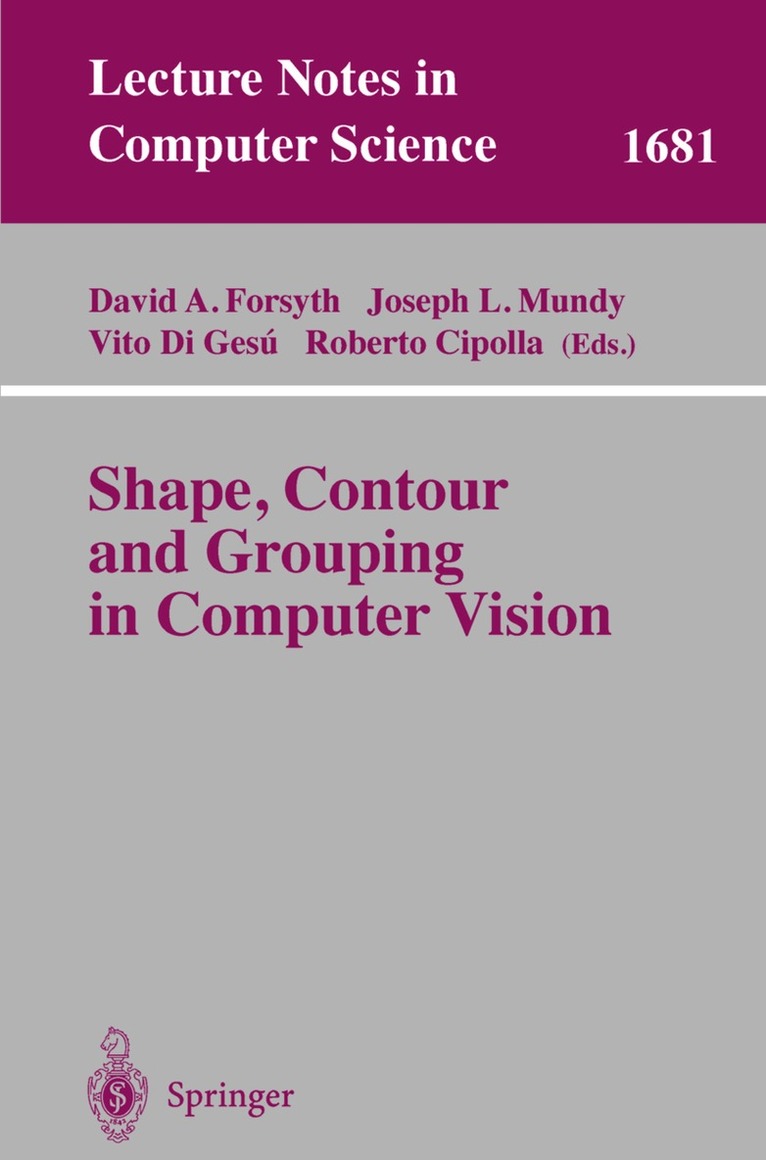
Computer vision has been successful in several important applications recently. Vision techniques can now be used to build very good models of buildings from pictures quickly and easily, to overlay operation planning data on a neuros- geon’s view of a patient, and to recognise some of the gestures a user makes to a computer. Object recognition remains a very di cult problem, however. The key questions to understand in recognition seem to be: (1) how objects should be represented and (2) how to manage the line of reasoning that stretches from image data to object identity. An important part of the process of recognition { perhaps, almost all of it { involves assembling bits of image information into helpful groups. There is a wide variety of possible criteria by which these groups could be established { a set of edge points that has a symmetry could be one useful group; others might be a collection of pixels shaded in a particular way, or a set of pixels with coherent colour or texture. Discussing this process of grouping requires a detailed understanding of the relationship between what is seen in the image and what is actually out there in the world.
Häftad, Engelska, 1994
565 kr
Skickas inom 10-15 vardagar
This book is the proceedings of the Second Joint European-US Workshop on Applications of Invariance to Computer Vision, held at Ponta Delgada, Azores, Portugal in October 1993.The book contains 25 carefully refereed papers by distinguished researchers. The papers cover all relevant foundational aspects of geometric and algebraic invariance as well as applications to computer vision, particularly to recovery and reconstruction, object recognition, scene analysis, robotic navigation, and statistical analysis. In total, the collection of papers, together with an introductory survey by the editors, impressively documents that geometry, in its different variants, is the most successful and ubiquitous tool in computer vision.
Häftad, Engelska, 1999
565 kr
Skickas inom 10-15 vardagar
Computer vision has been successful in several important applications recently. Vision techniques can now be used to build very good models of buildings from pictures quickly and easily, to overlay operation planning data on a neuros- geon’s view of a patient, and to recognise some of the gestures a user makes to a computer. Object recognition remains a very di cult problem, however. The key questions to understand in recognition seem to be: (1) how objects should be represented and (2) how to manage the line of reasoning that stretches from image data to object identity. An important part of the process of recognition { perhaps, almost all of it { involves assembling bits of image information into helpful groups. There is a wide variety of possible criteria by which these groups could be established { a set of edge points that has a symmetry could be one useful group; others might be a collection of pixels shaded in a particular way, or a set of pixels with coherent colour or texture. Discussing this process of grouping requires a detailed understanding of the relationship between what is seen in the image and what is actually out there in the world.