Joseph Rosa - Böcker
Visar alla böcker från författaren Joseph Rosa. Handla med fri frakt och snabb leverans.
4 produkter
4 produkter
122 kr
Skickas inom 7-10 vardagar
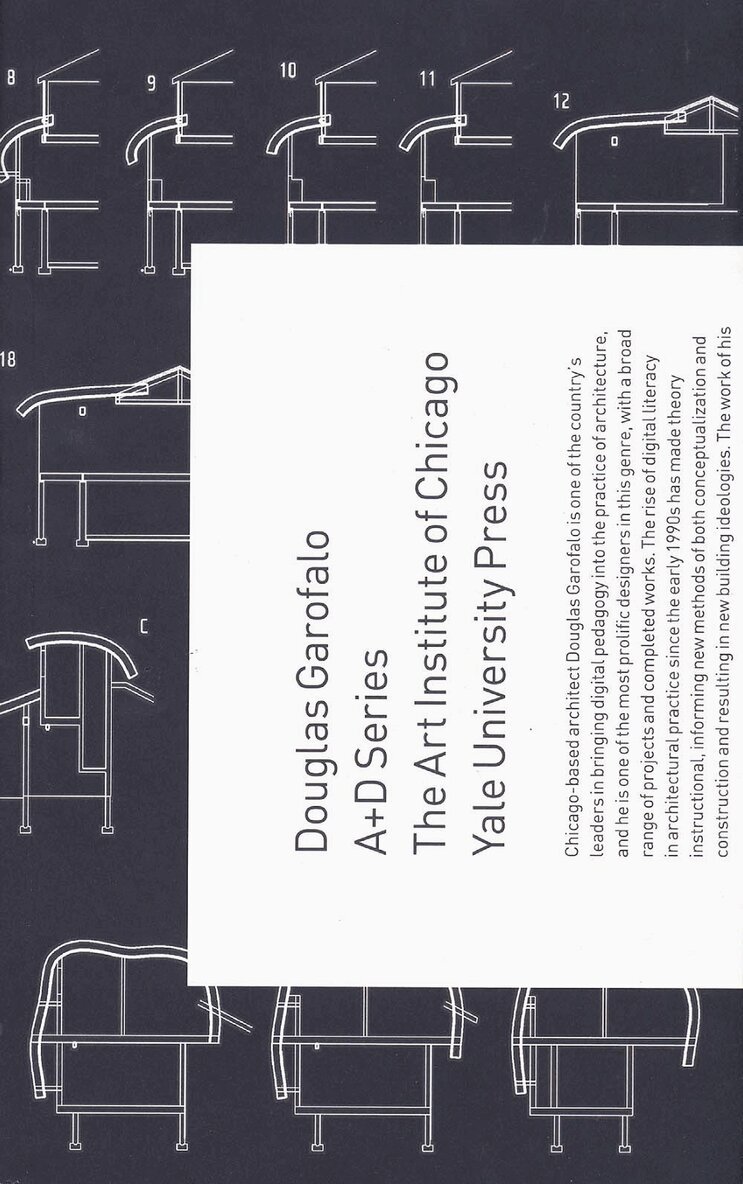
Announcing A+D (Architecture and Design), a new series from the Art Institute of Chicago, which highlights the work of important architects and designers from around the world. Innovatively designed by the New York firm 2x4, the titles are either historical in nature or investigate current critical thinking and practice in architecture and design.This handsome book presents the oeuvre of Douglas Garofalo, principal of Garofalo Architects, internationally renowned for its innovative residential, commercial, institutional, and public building projects. With an impressive list of clients that includes the Art Institute of Chicago, the Museum of Contemporary Art, Chicago, the Hyde Park Art Center, and the Smart Museum of Art at the University of Chicago, the firm has also designed a number of private residences and played a significant role in Chicago’s urban design and public planning.Douglas Garofalo looks at the architect’s work to date, drawing from the full spectrum of his built work, theoretical and visionary projects (including the Camouflage House outside Chicago), and competition entries (including those for the Chicago Housing Authority and the Chicago Public Schools). Illustrations of and informative entries on the drawings, models, and digital media that showcase this work are featured.Distributed for the Art Institute of ChicagoExhibition Schedule:The Art Institute of Chicago (June 15 – October 8, 2006)
408 kr
Skickas inom 7-10 vardagar
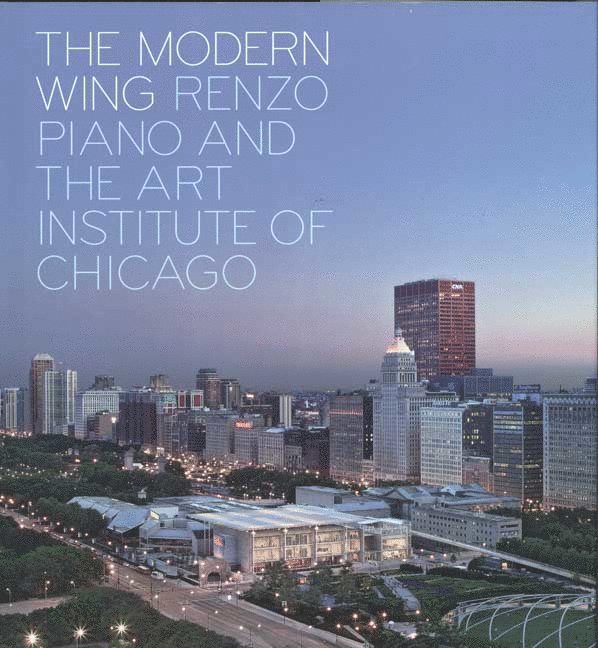
This handsome book examines the remarkable new addition to the Art Institute of Chicago, designed by Renzo Piano and scheduled to open in May 2009. This expansion to the Art Institute of Chicago, already one of the largest museums in the country, will provide new galleries for modern and contemporary painting and sculpture, as well as for photography, film and video, and architecture and design. The structure is Piano’s largest art museum building to date. The museum’s director, James Cuno, discusses the history of the commission, and Paul Goldberger writes on how this building fits into the larger context of Piano's work—especially his many museum designs—as well as considers its positioning in a city celebrated for its architecture. Judith Turner provides exquisite architectural photographs, showing many nuanced details and views of the structure, while Joseph Rosa comments on her images and how they convey the beauty and sophistication of the building. Photographs by New York-based architectural photographer Paul Warchol complete the bookDistributed for the Art Institute of Chicago
476 kr
Tillfälligt slut
Adolf Loos not only was part of the first wave of modern architecture but also served as an important source of inspiration for all architects who followed. He is emblematic of the turn-of-the-century generation that was torn between the traditional culture of the nineteenth century and the innovative modernism of the twentieth. Loos’s masterful “astylistic architecture” is captured in this volume by the esteemed photographer Roberto Schezen in over one hundred exceptional photographs.Starting with the refurbishment of his own apartment in 1903, twenty of Loos’s most significant buildings are beautifully displayed: Villa Karma, the Kärntner Bar, the Goldman & Salatsch Michaelerplatz Building, the Zentralsparkasse Bank, and the Steiner, Scheu, Moller, and Müller houses. Schezen’s vivid color and luminous black-and-white photographs display each building in detail, showing both the formal characteristics and the rich textures and materials Loos most frequently used.Complementing this remarkable visual material is Kenneth Frampton’s perceptive essay, which places Loos within the context of Viennese intellectuals of the time. His circle, which included Arnold Schönberg, Ludwig Wittgenstein, and at the center, Karl Kraus, explored the essential nature of architecture, and the other arts and sciences, through linguistic structures. Frampton identifies the hallmarks that Loos derived from these structures and with which he created his work: the blank, “degree-zero” exterior with its luxurious interior; his commentary on architecture’s position between art and function, plus subtle recollections of both the classic and the vernacular. All these ploys were to subvert typical architectural expectations. Joseph Rosa’s accompanying descriptions comprehensively discuss each building, from the circumstances surrounding the realization of the projects to the use of Loos’s architectural conventions.
258 kr
Skickas inom 3-6 vardagar
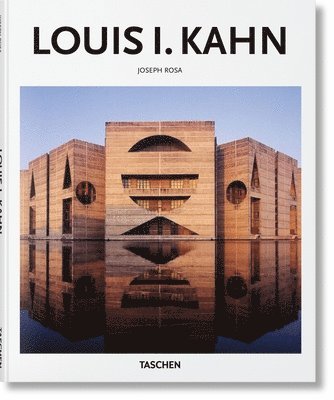
Louis Isadore Kahn (1901–1974) treated each building like a temple. Across the United States, in India, Bangladesh, Pakistan, and Israel, his designs combined the sleek, utilitarian surfaces of modernism with a devotion to geometric forms and a reverence for natural light that suffused his stuctures with a monumental and breathtaking spirituality.This essential introduction brings together 17 of Kahn’s most important buildings across his cultural, governmental, religious, and residential repertoire. Plans, views, descriptions, and quality photographs trace the context and development of each project, while an introductory essay explores Kahn’s unique architectural ideology and his legacy as one of the most important 20th-century American architects since Frank Lloyd Wright.Through Kahn masterworks, such as the National Assembly Building in Dhaka, Bangladesh, or Kimbell Art Museum in Fort Worth, Texas, we’ll explore Kahn’s his “back to basics” grammar inspired by ancient sites in Italy, Greece, and Egypt; and his unique vocabulary of mass, void, and light that suffused the International Style with a near-celestial luminescence.