Jozef Niznik - Böcker
Visar alla böcker från författaren Jozef Niznik. Handla med fri frakt och snabb leverans.
3 produkter
3 produkter
488 kr
Skickas inom 10-15 vardagar
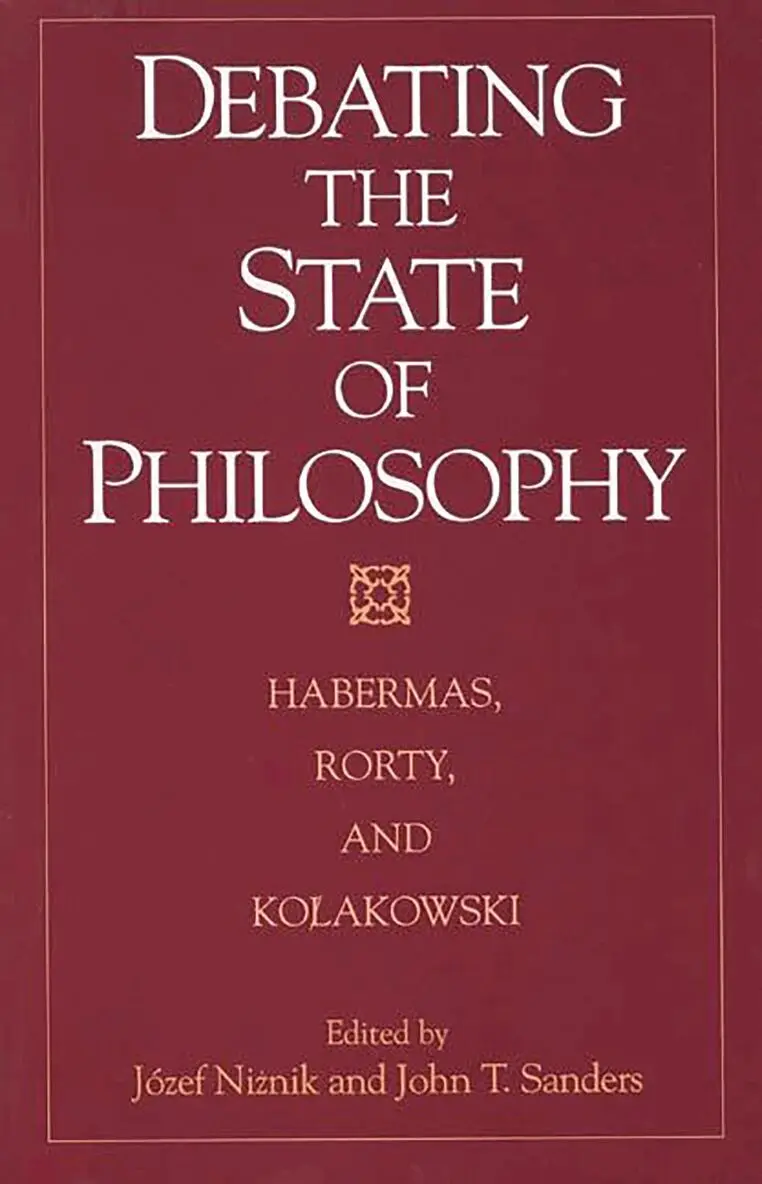
Do we still need philosophical discourse as part of communication within our culture? Is philosophical endeavor still valid? This book offers the views of some of the most popular, distinguished contemporary philosophers who have placed their mark on philosophy. Durgen Habermas, Richard Rorty, Leszek Kolakowski, and Ernest Gellner bring their ideas into confrontation in a unique debate devoted to the present state of philosophy.Habermas begins with a comprehensive account of contextualism. According to him, contextualism is a new form of historicism. What are the merits of an approach that takes into account both a historical and a cultural context? Is the pragmatism promoted by Richard Rorty an acceptable criticism of our platonic heritage? If so, does this mean the end of rationality as a regulative ideal of the human universe? Rorty's answer is Yes. This world-renowned American thinker recommends putting a full stop at the end of a narrative which was useful in pursuit of our ancestors' purposes but is no longer useful for ours. Leszek Ko^D/lakowski attempts to undermine the alleged pragmatic merits of pragmatism from the position of an analytic philosopher who continues to value classical elements of philosophical tradition. Ernest Gellner also turns against Rorty's pragmatism, which he denounces as a product of the Enlightenment roots of American culture and its centuries of political and economic stability. The future of Western culture may depend on the answers to the questions asked by these authors.
Del 1 - Studies in Philosophy, Culture and Contemporary Society
Twentieth Century Wars in European Memory
Inbunden, Engelska, 2013
731 kr
Skickas inom 5-8 vardagar
In various European countries the two world wars are remembered in very different ways, although everywhere one can find monuments which serve as material objectification of the memory of war. However, such objectifications not only determine certain patterns of remembrance and a specific perception of the past: they also contribute to local and/or national identity and create the basis for attitudes toward the other participants of war. As it happens, instruments of memory live their own life and the meanings they attach to particular events may be changed by historical and political processes. The question remaining in the background of this publication is whether we can «make Europeans» without European collective memory transgressing national perspectives. The memory of war, which inevitably shows the overall absurdity and tragedy of war no matter where and against whom fought, may be the primary candidate for such Europeanization.
Del 1 - Studies in European Integration, State and Society
Democracy versus Solidarity in the EU Discourse
Inbunden, Engelska, 2012
389 kr
Skickas inom 5-8 vardagar
It is hard to find another two concepts which would be more significant in the European integration discourse than «democracy» and «solidarity» and at the same time more ambiguous in the political practice of integration. Currently European integration discourse is being organized around the concept of democracy. Analyzing European integration discourse the author argues that the situation is quite paradoxical because in order to secure democracy in the EU, European integration discourse must be organized not around the concept of democracy but around the concept of solidarity. The book attempts to show in more details the context of the clash of these fundamental values which serve also as the leading political principles of European integration. Therefore several further concepts and problems have been discussed such as the issue of identity, the concept of citizenship and the problem of nationalism. Since the theoretical framework of the analysis have been built around the idea of discourse the inevitable consequence was to look at some aspects of communication and the links between conceptual and normative development of the European integration.