Judith F. Kroll - Böcker
Visar alla böcker från författaren Judith F. Kroll. Handla med fri frakt och snabb leverans.
4 produkter
4 produkter
1 738 kr
Skickas inom 7-10 vardagar
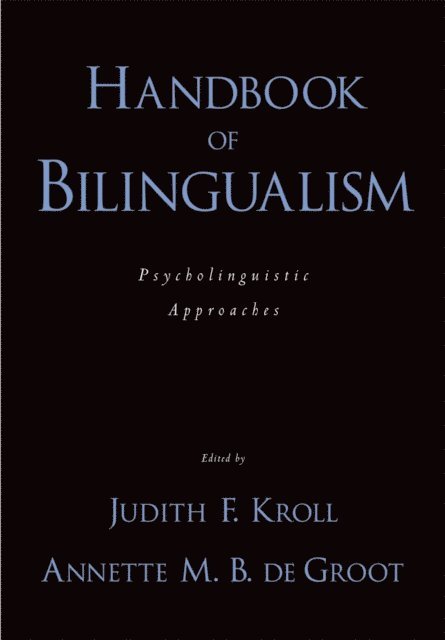
Until recently, cognitive science virtually ignored the fact that most people of the world are bilingual. During the past ten years this situation has changed markedly. There is now an appreciation that learning and using more than one language is the more natural circumstance of cognition. As a result, there is a wealth of new research on second-language learning and bilingualism that provides not only crucial evidence for the universality of cognitive principles, but also an important tool for revealing constraints within the cognitive architecture.In this volume, Judith Kroll and Annette de Groot have brought together the scientists at the forefront of research on second-language learning and bilingualism to present chapters that, rather than focusing simply on their own research, provide the first comprehensive overviews of this emerging field. Bilingualism provides a lens through which each of the central questions about language and cognition can be viewed. The five sections of this book focus on different facets of those questions: How is language acquired when infants are exposed to multiple-language input from birth, and how is it acquired when adults are required to learn a second language after early childhood? How do adult bilinguals comprehend and produce words and sentences when their two languages are potentially always active and in competition with one another? What are the neural mechanisms that underlie proficient bilingualism? What are the general consequences of bilingualism for cognition and for language and thought? This handbook will be essential reading for cognitive psychologists, linguists, applied linguists, and educators who wish to better understand the cognitive basis of bilingualism and the logic of experimental and formal approaches to language science.
910 kr
Skickas inom 7-10 vardagar
How is language acquired when infants are exposed to multiple language input from birth and when adults are required to learn a second language after early childhood? How do adult bilinguals comprehend and produce words and sentences when their two languages are potentially always active and in competition with one another? What are the neural mechanisms that underlie proficient bilingualism? What are the general consequences of bilingualism for cognition and for language and thought? This handbook will be essential reading for cognitive psychologists, linguists, applied linguists, and educators who wish to better understand the cognitive basis of bilingualism and the logic of experimental and formal approaches to language science.
2 053 kr
Skickas inom 10-15 vardagar
The past fifteen years have witnessed an increasing interest in the cognitive study of the bilingual. A major reason why psychologists, psycholinguists, applied linguists, neuropsychologists, and educators have pursued this topic at an accelerating pace presumably is the acknowledgment by increasingly large numbers of language researchers that the incidence of monolingualism in individual language users may be lower than that of bilingualism. This alleged numerical imbalance between monolinguals and bilinguals may be expected to become larger due to increasing international travel through, for instance, tourism and trade, to the growing use of international communication networks, and to the fact that in some parts of the world (i.e., Europe), the borders between countries are effectively disappearing. In addition to the growing awareness that bilinguals are very common and may even outnumber monolinguals, there is the dawning understanding that the bilingual mind is not simply the sum of the cognitive processes associated with each of the two monolingual modes, and that the two languages of bilingual may interact with one another in complicated ways. To gain a genuinely universal account of human cognition will therefore require a detailed understanding of language use by both pure monolinguals as well as bilinguals, unbalanced and balanced, and of the representations and processes involved. These two insights, that bilingualism is a common human condition and that it may influence cognition, were presumably instrumental in putting bilingualism on the agendas of many researchers of cognition and language in recent years. But other reasons may have played a role too: The study of bilingualism also provides a unique opportunity to study the relation between language and thought. A final reason for the growing interest in this area of research is the awareness that bilingualism may confer the benefit of broadening one's scope beyond the limits of one's own country and culture. This book serves as an excellent introduction to the important topics in the psycholinguistic study of bilingualism. The chapters represent a comprehensive and interrelated set of topics that form the core of contemporary research on the psycholinguistics of bilingualism. The issues raised within this perspective not only increase our understanding of the nature of language and thought in bilinguals but also of the basic nature of the mental architecture that supports the ability to use more than one language.
799 kr
Skickas inom 10-15 vardagar
The past fifteen years have witnessed an increasing interest in the cognitive study of the bilingual. A major reason why psychologists, psycholinguists, applied linguists, neuropsychologists, and educators have pursued this topic at an accelerating pace presumably is the acknowledgment by increasingly large numbers of language researchers that the incidence of monolingualism in individual language users may be lower than that of bilingualism. This alleged numerical imbalance between monolinguals and bilinguals may be expected to become larger due to increasing international travel through, for instance, tourism and trade, to the growing use of international communication networks, and to the fact that in some parts of the world (i.e., Europe), the borders between countries are effectively disappearing. In addition to the growing awareness that bilinguals are very common and may even outnumber monolinguals, there is the dawning understanding that the bilingual mind is not simply the sum of the cognitive processes associated with each of the two monolingual modes, and that the two languages of bilingual may interact with one another in complicated ways. To gain a genuinely universal account of human cognition will therefore require a detailed understanding of language use by both pure monolinguals as well as bilinguals, unbalanced and balanced, and of the representations and processes involved. These two insights, that bilingualism is a common human condition and that it may influence cognition, were presumably instrumental in putting bilingualism on the agendas of many researchers of cognition and language in recent years. But other reasons may have played a role too: The study of bilingualism also provides a unique opportunity to study the relation between language and thought. A final reason for the growing interest in this area of research is the awareness that bilingualism may confer the benefit of broadening one's scope beyond the limits of one's own country and culture. This book serves as an excellent introduction to the important topics in the psycholinguistic study of bilingualism. The chapters represent a comprehensive and interrelated set of topics that form the core of contemporary research on the psycholinguistics of bilingualism. The issues raised within this perspective not only increase our understanding of the nature of language and thought in bilinguals but also of the basic nature of the mental architecture that supports the ability to use more than one language.