Julian Franks - Böcker
Visar alla böcker från författaren Julian Franks. Handla med fri frakt och snabb leverans.
5 produkter
5 produkter
1 756 kr
Skickas inom 5-8 vardagar
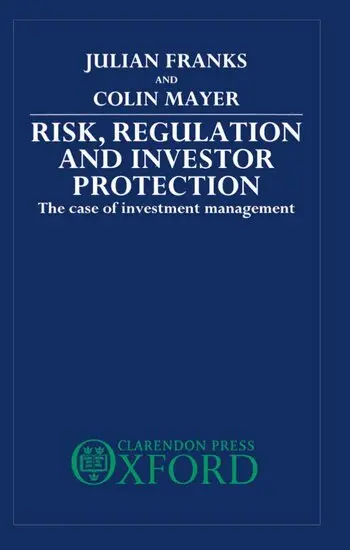
This unique and authoritative study of the investment management business focuses on the use of capital requirements for investment managers as a means of investor protection. Commissioned by the Investment Management Regulatory Organization and drawing on extensive discussions with investment managers themselves, it provides an account of this burgeoning sector that is both comprehensive in its coverage and penetrating in its analysis. The authors review the way in which the investment management business is organized and its inherent risks; they examine the causes and incidence of market failures as well as the dangers to investors through mismanagement and malpractice. The book includes an extensive treatment of fraud, with a full listing of fraud cases in the UK since the early 1970s.The report concludes with a summary of the evidence on the nature and scale of the risks faced by investors and recommendations for appropriate forms of protection; and, on the basis of existing regulatory structures in the UK and USA, sets out a proposed structure in accordance with the thrust of the authors' analysis.While specific in its coverage, much of the argument presented here is closely applicable to other financial sectors in which regulation is a crucial issue; and it is especially pertinent to current debates on financial regulation in the run-up to the completion of the European internal market in 1992.
1 288 kr
Skickas inom 3-6 vardagar
Scandals in financial institutions, weakness in the world economy, and volatility in financial markets bring to the fore issues of regulation and consumer protection. This comparative survey of how investors are currently protected in a range of European countries and the USA is set in an accessible theoretical framework. It will be invaluable for academics and students involved in the analysis of financial markets and regulation as well as practitioners in financial institutions and regulatory authorities.
828 kr
Skickas inom 3-6 vardagar
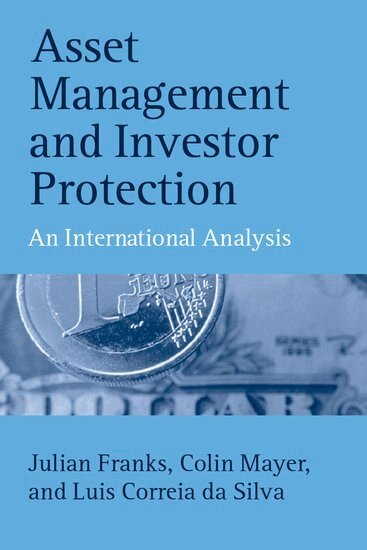
Asset management is a major industry playing an increasingly important role in economic activity around the world. Asset managers provide services to individuals, governments, public agencies, banks, pension funds, insurance companies, and charities, to name a few. Traditionally, asset management has been primarily associated with the 'stock market' economies of the UK and the USA, but, as this book shows, some of the most spectacular growth in activity of recent years has occurred in Continental Europe.This has presented opportunities and challenges. New forms of financial instruments and institutions have emerged in countries that have traditionally relied on debt and non-market forms of intermediation. Competition has intensified, and entry has occurred both within and across national markets. However, this growth has been accompanied by potential problems: while investors enjoy a wider range of products and services, they face more complex instruments and transactions. Therefore, the potential for failures, such as misdealing and fraud, may have increased. The natural response is to strengthen regulation, but there is a fine balance to be struck between inadequate and excessive regulation of asset managers.This is particularly complicated in the context of European capital markets. European countries have traditionally had very different financial systems and asset management businesses, therefore it is no surprise to discover many different approaches to regulating asset managers. How should the European Commission respond to this diversity? Should it seek to create greater uniformity via common regulatory rules?The particular focus of this book is financial resource requirements. There is currently an active debate about the role capital requirements should play in asset management, particularly in the European context. In order to address this issue, the authors argue that it is necessary to understand the nature of the asset management business in different countries and the risks that it faces. They therefore discuss how the asset management business operates; how it is organized; the nature and size of risks in the business, who bears them, and how they are financed; and what the alternative forms of investor protection are, together with their associated costs and benefits.
428 kr
Skickas inom 7-10 vardagar
This book was originally published in 1986. During the decade preceding publication there were a number of significant developments in financial economics and major contributions made both by individuals who could be classified as conventional financial economists and by others who do not fit easily into this category - theoretical microeconomists, public and industrial economists. This volume contains a selection from the papers presented at a conference in Oxford in September 1985 which aimed to bring together a number of the leading participants in this field. The papers in the volume cover a wide range of topics - the efficiency of financial markets, new equity issues, asymmetric corporate taxation and investment, credit rationing, international investment, the foundations of banking theory - but they clearly reflect the main themes in financial economics at the time: the importance of informational asymmetries and of taxation.
1 363 kr
Skickas inom 7-10 vardagar
This book was originally published in 1986. During the decade preceding publication there were a number of significant developments in financial economics and major contributions made both by individuals who could be classified as conventional financial economists and by others who do not fit easily into this category - theoretical microeconomists, public and industrial economists. This volume contains a selection from the papers presented at a conference in Oxford in September 1985 which aimed to bring together a number of the leading participants in this field. The papers in the volume cover a wide range of topics - the efficiency of financial markets, new equity issues, asymmetric corporate taxation and investment, credit rationing, international investment, the foundations of banking theory - but they clearly reflect the main themes in financial economics at the time: the importance of informational asymmetries and of taxation.