Junidah Lamaming - Böcker
Visar alla böcker från författaren Junidah Lamaming. Handla med fri frakt och snabb leverans.
4 produkter
4 produkter
2 203 kr
Skickas inom 7-10 vardagar
Research and development advancements in the treatment and recovery of nutrients and colored compounds in wastewater, including green remediation, membrane separation, adsorption, and advanced chemical reaction.Nutrients and Colored Compounds in Wastewater: Treatment and Recovery reviews and highlights recent advances in nutrients and colored compounds in terms of their treatments, recovery processes, advanced systems, and new materials. This book comprehensively covers topics in wastewater management including phytoremediation, phycoremediation, microbial fuel cell process, membrane hybrid system, membrane distillation, forward osmosis, adsorption, electrocatalytic, photocatalytic, and organic metal framework reaction. It provides a useful agenda to help take advantage of the latest research conducted in this rapidly advancing field of wastewater treatment enabling you to develop and commercialize your own products quickly and more successfully.Reviews recent advances in nutrients and colored compounds in terms of their treatments, recovery processes, advanced systems, and new materials.Offers the most recent research and technology in advanced techniques for wastewater decolorization and nutrient recovery. Critically reviews green remediation, membrane separation, adsorption, and advanced chemical reactions.Evaluates and implements potential wastewater recoveries and discoveries on the quality of the treatment
2 300 kr
Skickas inom 10-15 vardagar
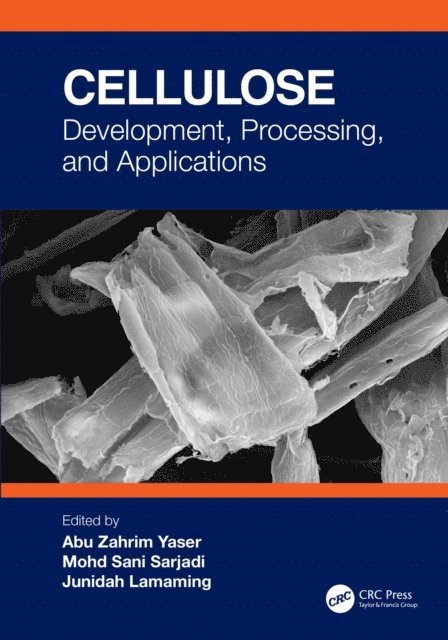
Cellulose: Development, Processing, and Applications covers topics related to advanced cellulose development and processing, as well as the utilization of major agricultural and biomass waste. It discusses the utilization of cellulose from other agricultural and biomass materials, including oil palm biomass, bamboo, and other non-wood forest products in emerging areas. It covers the treatments used to improve the quality of cellulosic materials in specific applications. Following that, the book delves into the use of cellulosic materials in the application of composting science and technology. Features:Delves into the specific agriculture waste/biomass waste materials used for the advanced cellulose-based productionOutlines the potential use of the covered materials for energy production and other emerging applicationsIncludes composting technology and processes using the cellulosic materialsOverviews industrial applications of cellulose from agricultural waste/biomass waste and composting technologyDiscusses the main agricultural waste/biomass in the Asian regionThis book is aimed at researchers and graduate students in chemical engineering, bioprocessing, composites, and biotechnology.
851 kr
Skickas inom 10-15 vardagar
Cellulose: Development, Processing, and Applications covers topics related to advanced cellulose development and processing, as well as the utilization of major agricultural and biomass waste. It discusses the utilization of cellulose from other agricultural and biomass materials, including oil palm biomass, bamboo, and other non-wood forest products in emerging areas. It covers the treatments used to improve the quality of cellulosic materials in specific applications. Following that, the book delves into the use of cellulosic materials in the application of composting science and technology. Features:Delves into the specific agriculture waste/biomass waste materials used for the advanced cellulose-based productionOutlines the potential use of the covered materials for energy production and other emerging applicationsIncludes composting technology and processes using the cellulosic materialsOverviews industrial applications of cellulose from agricultural waste/biomass waste and composting technologyDiscusses the main agricultural waste/biomass in the Asian regionThis book is aimed at researchers and graduate students in chemical engineering, bioprocessing, composites, and biotechnology.
2 491 kr
Skickas inom 10-15 vardagar
Combating climate change and securing water for future generations requires rethinking waste as opportunity. This book presents a timely and accessible roadmap for transforming agro-industrial effluent from an environmental liability into a suite of value-added, sustainable resources.At its core, the volume systematically covers the science and technology of effluent valorization: recovering inherent energy for bioenergy, extracting phosphorus for cleaner fertilizer production, and purifying water to standards suitable for irrigation or non-potable reuse. It goes further, detailing the conversion of effluent into biofertilizers, liquid nutrient formulations, and microalgae biomass, and exploring its use as a plant growth stimulant. Each pathway is framed within a circular water economy, emphasizing operational efficiency, alignment with SDG 6,7 and 12, and the integration of environmental, societal, and economic impact assessments. Practical processing methods, resource recovery strategies, and quality upgrading techniques are presented so that reuse is both technically viable and environmentally responsible.Original and actionable, this book offers an integrated framework that reframes effluent as a multipurpose resource rather than waste. It demonstrates advantages like phosphorus retrieval without relying on sewage sludge, and provides clear guidance for researchers, engineers, technologists, policymakers, and agro-industry stakeholders seeking to implement sustainable effluent management at scale.Salient Features to stress in promotion include:This book’s uniqueness lies in its holistic and practical reframing of agro-industrial effluent, from environmental burden to a diversified resource portfolio. It integrates cutting-edge recovery technologies including energy, nutrients, and biomass with water purification, framed explicitly against global sustainability goals (SDG 6, 7 and 12), and evaluates outcomes across environmental, societal, and economic dimensions. Promotion should stress its interdisciplinary utility (researchers, engineers, industry, policy), its real-world applicability with actionable processing pathways, and its novel comparison of resource recovery strategies within a circular economy paradigm.