Jurg Keller – författare
Visar alla böcker från författaren Jurg Keller. Handla med fri frakt och snabb leverans.
3 produkter
3 produkter
Inbunden, Engelska, 2015
1 871 kr
Skickas
In a world where there is a growing awareness of the possible effects of human activities on climate change, there is a need to identify the emission of greenhouse gases (GHG) from wastewater treatment plants (WWTPs). As a result of this growing awareness, governments started to implement regulations that require water authorities to report their GHG emissions. With these developments there exists a strong need for adequate insight into the emissions of N2O and CH4. With this insight water authorities would be able to estimate and finally reduce their emissions. The overall objectives of the different research programs performed by partners of the GWRC members WERF (United States of America), WSAA (Australia), CIRSEE-Suez (France) and STOWA (the Netherlands) were: To define the origin of N2O emission. To understand the formation processes of N2O.To identify the level of CH4 emissions from wastewater collection and treatment systems. To evaluate the use of generic emission factors to estimate the emission of N2O from individual plants
Inbunden, Engelska, 2009
1 871 kr
Skickas
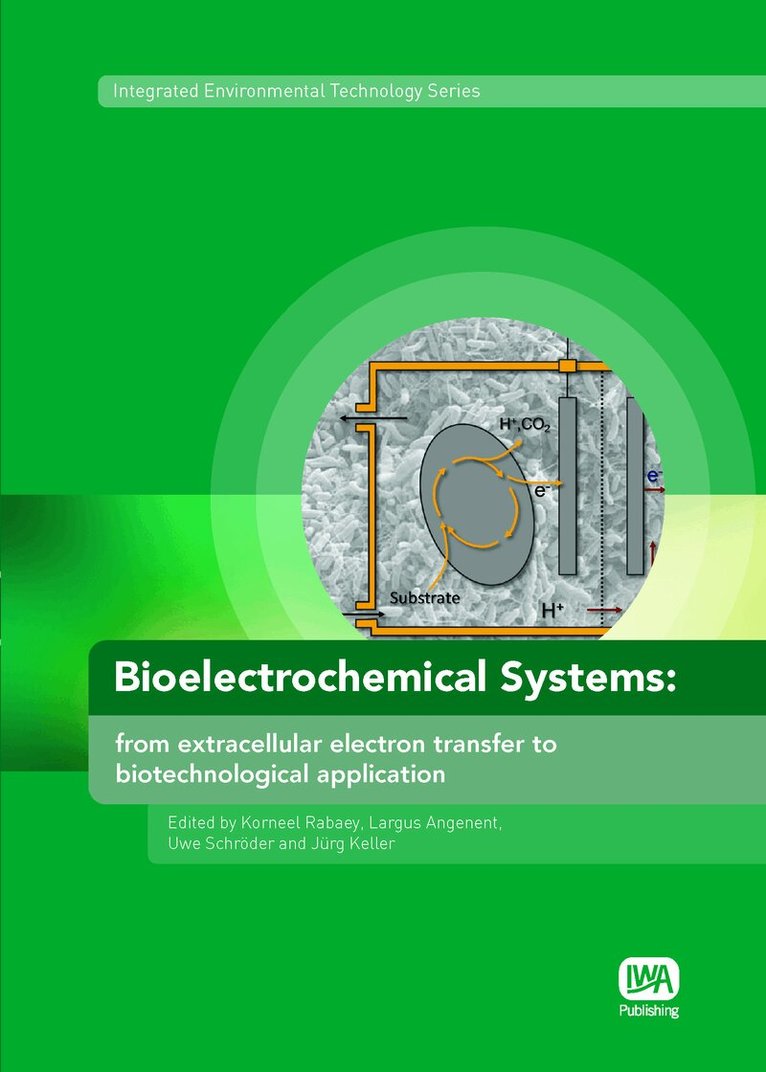
In the context of wastewater treatment, Bioelectrochemical Systems (BESs) have gained considerable interest in the past few years, and several BES processes are on the brink of application to this area. This book, written by a large number of world experts in the different sub-topics, describes the different aspects and processes relevant to their development. Bioelectrochemical Systems (BESs) use micro-organisms to catalyze an oxidation and/or reduction reaction at an anodic and cathodic electrode respectively. Briefly, at an anode oxidation of organic and inorganic electron donors can occur. Prime examples of such electron donors are waste organics and sulfides. At the cathode, an electron acceptor such as oxygen or nitrate can be reduced. The anode and the cathode are connected through an electrical circuit. If electrical power is harvested from this circuit, the system is called a Microbial Fuel Cell; if electrical power is invested, the system is called a Microbial Electrolysis Cell. The overall framework of bio-energy and bio-fuels is discussed. A number of chapters discuss the basics – microbiology, microbial ecology, electrochemistry, technology and materials development. The book continues by highlighting the plurality of processes based on BES technology already in existence, going from wastewater based reactors to sediment based bio-batteries. The integration of BESs into existing water or process lines is discussed. Finally, an outlook is provided of how BES will fit within the emerging biorefinery area.
Häftad, Tyska, 2021
267 kr
Skickas inom 5-8 vardagar