Jurgen Neyer – författare
Visar alla böcker från författaren . Handla med fri frakt och snabb leverans.
6 produkter
6 produkter
E-bok
PDF, Engelska, 20121 442 kr
Läs direkt efter köp
The debate on the EU''s legitimacy has long suffered from a number of serious misunderstandings. Supranational politics, Jurgen Neyer argues, is not about the making of public order in Europe but about internalizing external effects and fostering the individual right to justification. The concepts of ''state'' and ''democracy'', he suggests, are essentially useless for understanding and justifying the EU''s structures and practices. The European Union is a dualistic politythat is not replacing but supplementing its member states. Its modus of operation is the joint exercise of pooled competencies on the normative basis of the principle of mutual recognition.He goes on to show that the EU provides an important cure to many of the problems that modern democracies are facing in a globalizing world. Legal integration internalizes external effects and democratizes democracies by transforming strategic international bargaining into a justificatory transnational discourse. The EU promotes the cause of justice by providing an effective remedy to horizontal and vertical power asymmetries, and to the arbitrariness of untamed anarchy.The EU is far from perfect, however. European politics is still deeply embedded in a culture of integration by stealth and closely connected to a deep mistrust in the capacity of ordinary citizens to understand politics. A major change in the constitutional set up of the EU is required. It should build on a new understanding of the EU''s institutions as catering to the individual right to justification and give national parliaments a strategic role in further developing its constitutionaldesign.
Inbunden, Engelska, 2010
2 362 kr
Skickas inom 3-6 vardagar
Debate about the theory underpinning the nature, workings, and development of the European (EU) has in many ways been hampered in recent years by an intellectual divergence in the two main ways that the EU is conceptualized. On the one hand is a political science and comparative government oriented strand that sees the EU as a political system in its own right. On the other is the international relations tradition which conceptualizes it as another international organization. Alongside this, the EU itself has developed a significant constitutional dimension. Indeed, the debate surrounding the 'Constitutional Treaty' presented several challenges to our capacity to grasp the normative change of this non-state polity. Despite the eventual contestation of the EU's 'constitutional turn' through the French and Dutch no-votes and the cumbersome procedure of ratifying the Lisbon Treaty in their aftermath, debates about the EU's constitutional quality have not ceased. In the light of these developments, the editors of this volume, along with their distinguished contributors, have attempted to create a more decisively interdisciplinary theoretical approach to studying the EU within the wider world-political context. The volume brings together scholars in a range of disciplines across the social sciences to offer, not a complete theory, but rather a theoretical approach combining different stands of political and legal theory. The book's aim is to inspire further engagement with the central tenets of political authority and world order, sovereignty and constitutional change and democracy and justice, in the context of the EU's political development.
Inbunden, Engelska, 2012
1 279 kr
Skickas inom 5-8 vardagar
The debate on the EU's legitimacy has long suffered from a number of serious misunderstandings. Supranational politics, Jurgen Neyer argues, is not about the making of public order in Europe but about internalizing external effects and fostering the individual right to justification. The concepts of 'state' and 'democracy', he suggests, are essentially useless for understanding and justifying the EU's structures and practices. The European Union is a dualistic polity that is not replacing but supplementing its member states. Its modus of operation is the joint exercise of pooled competencies on the normative basis of the principle of mutual recognition. He goes on to show that the EU provides an important cure to many of the problems that modern democracies are facing in a globalizing world. Legal integration internalizes external effects and democratizes democracies by transforming strategic international bargaining into a justificatory transnational discourse. The EU promotes the cause of justice by providing an effective remedy to horizontal and vertical power asymmetries, and to the arbitrariness of untamed anarchy. The EU is far from perfect, however. European politics is still deeply embedded in a culture of integration by stealth and closely connected to a deep mistrust in the capacity of ordinary citizens to understand politics. A major change in the constitutional set up of the EU is required. It should build on a new understanding of the EU's institutions as catering to the individual right to justification and give national parliaments a strategic role in further developing its constitutional design.
E-bok
PDF, Tyska, 2019863 kr
Läs direkt efter köp
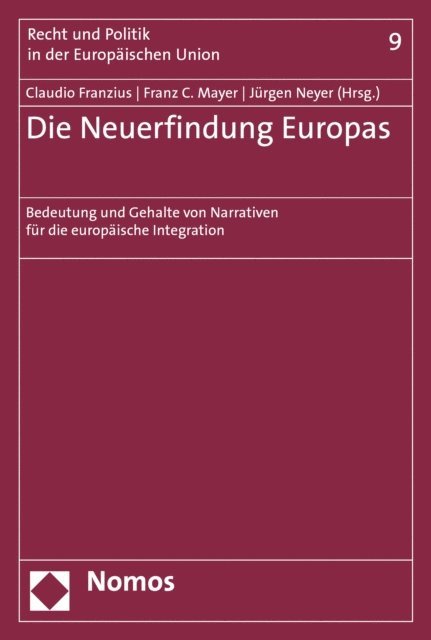
Der Band fasst die Beiträge der vierten Tagung des Gesprächskreises "Recht und Politik in der Europäischen Union" zusammen, die gemeinsam mit der Friedrich-Ebert-Stiftung im April 2017 in Berlin veranstaltet wurde. Ausgangspunkt war die These, dass es Sinn macht, der Frage nachzugehen, wie ein Narrativ entsteht und welche Funktion es im Integrationsprozess hat. Führt uns das "Europa der Vaterländer" in eine Union, die stärker als bisher durch die nationale Identität der Mitgliedstaaten geprägt ist? Was bleibt von der Rechtsgemeinschaft? Ist "Frieden" ein überholtes Narrativ? Warum fällt es so schwer, das "Europa der Wohlfahrtsstaaten" unter einem sozialen Narrativ zu reformieren? Vieles spricht dafür, das traditionelle Leitbild der "ever closer union" zu hinterfragen und den europäischen Rechtsraum differenzierter, flexibler und pluralistischer zu denken. Daran schließen sich Fragen an: Wie könnte das Narrativ für ein demokratisches Europa aussehen? Schließlich aber auch: Was bedeutet das alles für Recht und Politik?Mit Beiträgen vonArmin v. Bogdandy, Sigrid Boysen, Claudio Franzius, Sylvie Goulard, Peter M. Huber, Albrecht Koschorke, Thorsten Kingreen, Gertrude Lübbe-Wolff, Franz C. Mayer, Martin Nettesheim, Angelika Nußberger, Jörn Reinhardt, Lars Viellechner, Mattias Wendel
Del 5 - Schriften Des Collegium Pontes
Der Fremde ALS Bereicherung
Inbunden, Tyska, 2010
753 kr
Tillfälligt slut
Del 6 - Schriften Des Collegium Pontes
Minderheiten ALS Mehrwert
Inbunden, Tyska, 2010
1 123 kr
Tillfälligt slut