Jürgen Valldorf – författare
Visar alla böcker från författaren Jürgen Valldorf. Handla med fri frakt och snabb leverans.
14 produkter
14 produkter
Inbunden, Engelska, 2005
1 620 kr
Skickas inom 10-15 vardagar
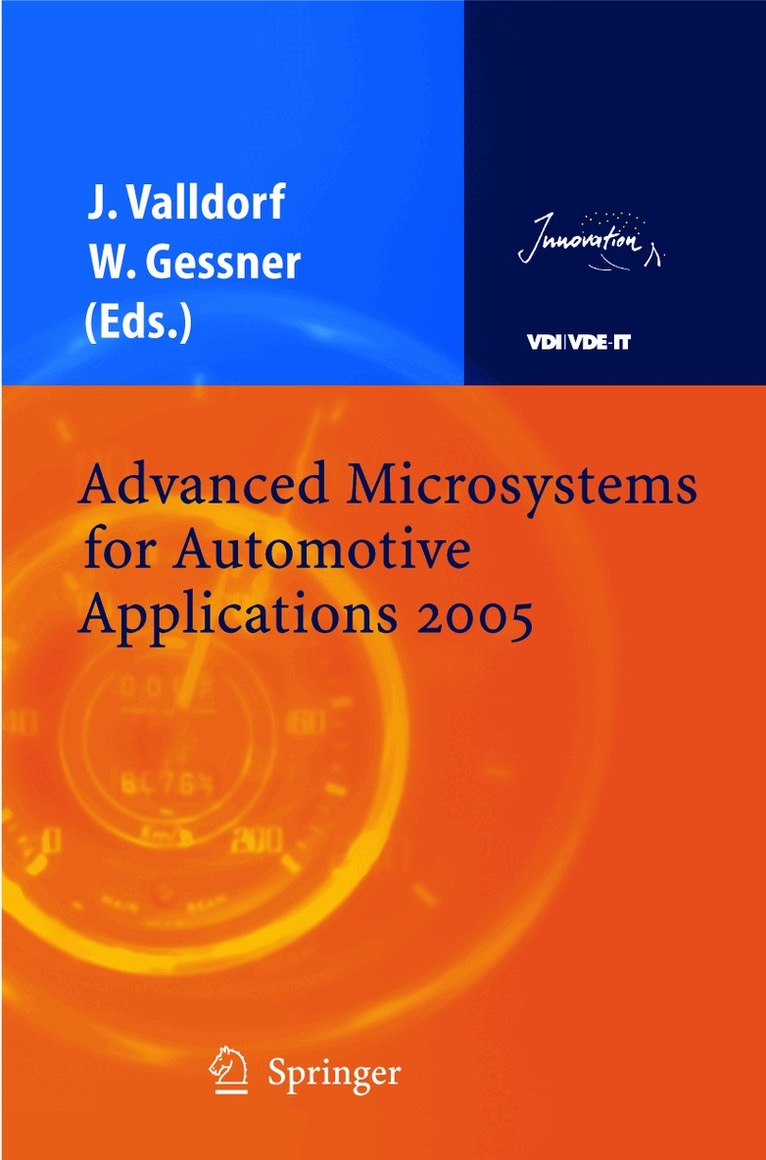
Since 1995 the annual international forum on Advanced Microsystems for Automotive Applications (AMAA) has been held in Berlin. The event offers a unique opportunity for microsystems component developers, system suppliers and car manufacturers to show and to discuss competing technological approaches of microsystems based solutions in vehicles.The book accompanying the event has demonstrated to be an efficient instrument for the diffusion of new concepts and technology results. The present volume including the papers of the AMAA 2005 gives an overview on the state-of-the-art and outlines imminent and mid-term R&D perspectives. The 2005 publication reflects - as in the past - the current state of discussions within industry. More than the previous publications, the AMAA 2005 "goes back" to the technological requirements and indispensable developments for fulfilling the market needs. The large part of contributions dealing with sensors as well as "sensor technologies and data fusion" is exemplary for this tendency.In this context a paradigm shift can be stated.In the past the development focused predominantly on the detection and processing of single parameters originating from single sensors. Today, the challenge increasingly consists in getting information of complex situations with a series of variables from different sensors and in evaluating this information. Smart integrated devices using the information deriving from the various sensor sources will be able to describe and assess a traffic situation or behaviour much faster and more reliable than a human being might be able to do.Additional information is available on www amaa.de
Inbunden, Engelska, 2007
1 083 kr
Skickas inom 10-15 vardagar
Looking back when the International Forum on Advanced Microsystems for Automotive Application (AMAA) started, enormous progress has been made in reducing casualties, emissions and in increasing comfort and performance. Microsystems in many cases provided the key functions for this progress. Although the issues the event concentrated on didn’t change significantly (safety, powertrain, comfort, etc.), considerable shifts of technological paradigms and approaches can be stated. The future of microsystems will consist of integrated smart systems which are able to diagnose a situation, to describe and to qualify it. They will be able to identify and mutually address each other. They will be predictive and therefore they will be able to decide and help to decide. Smart systems will enable the automobile to interact with the environment, they will perform multiple tasks and assist a variety of activities. Smart systems will be highly reliable, often networked and energy autonomous. There is a coincidence of the AMAA objectives and those of EPoSS, the European Technology Platform on Smart Systems Integration, contributing intensively to the development of automotive-specific smart systems. You will find a series of the EPoSS items in the programme of the 11th AMAA, which continues to be a unique exchange forum for companies in the automotive value chain.The publication in hand also reflects these issues. It is a cut-out of new technological priorities in the area of microsystems-based smart devices and opens up a mid-term perspective of future smart systems applications in automobiles.Additional information is available on www.amaa.de
Inbunden, Engelska, 2009
1 083 kr
Skickas inom 10-15 vardagar
The current economic crisis is cutting the automotive sector to the quick. Public authorities worldwide are now faced with requests for providing loans and accepting guarantees and even for putting large automotive companies under state control. Assessing the long-term benefits of such help and wei- ing the needs of different sectors against each other poses a major challenge for the national policies. Given the upcoming change of customer preferences and state regulations towards safety, sustainability and comfort of a car, the automotive industry is particularly called to prove its ability to make nec- sary innovations available in order to accelerate its pace to come out of the crisis. Consequently the Green Car is assuming a prominent role in the current debate. Various power train concepts are currently under discussion for the Green Car including extremely optimised internal combustion engines, hybrid drives and battery-electric traction. Electrical cars are the most appealing option because they are free of local emissions and provide the opportunity to use primary energy from sources other than crude oil for transport. Well to wheel analysis show that their green-house gas emissions can be rated negligibly small if electricity from renewable sources like wind and solar is used.
Häftad, Engelska, 2010
1 190 kr
Skickas inom 10-15 vardagar
Since 1995 the annual international forum on Advanced Microsystems for Automotive Applications (AMAA) has been held in Berlin. The event offers a unique opportunity for microsystems component developers, system suppliers and car manufacturers to show and to discuss competing technological approaches of microsystems based solutions in vehicles. The book accompanying the event has demonstrated to be an efficient instrument for the diffusion of new concepts and technology results. The present volume including the papers of the AMAA 2005 gives an overview on the state-of-the-art and outlines imminent and mid-term R&D perspectives. The 2005 publication reflects -- as in the past -- the current state of discussions within industry. More than the previous publications, the AMAA 2005 "goes back" to the technological requirements and indispensable developments for fulfilling the market needs. The large part of contributions dealing with sensors as well as "sensor technologies and data fusion" is exemplary for this tendency. In this context a paradigm shift can be stated.In the past the development focused predominantly on the detection and processing of single parameters originating from single sensors. Today, the challenge increasingly consists in getting information of complex situations with a series of variables from different sensors and in evaluating this information. Smart integrated devices using the information deriving from the various sensor sources will be able to describe and assess a traffic situation or behaviour much faster and more reliable than a human being might be able to do. Additional information is available on www.amaa.de
Häftad, Engelska, 2013
2 218 kr
Skickas inom 10-15 vardagar
Looking back 10 years when the International Forum on Advanced Microsystems for Automotive Application (AMAA) started, enormous progress has been made in reducing casualties, emissions and in increasing comfort and performance. Microsystems in many cases provided the key functions for this progress. Although the issues the event concentrated on didn’t change significantly (safety, powertrain, comfort, etc.), considerable shifts of technological paradigms and approaches can be stated. The future of microsystems will consist of integrated smart systems which are able to diagnose a situation, to describe and to qualify it. They will be able to identify and mutually address each other. They will be predictive and therefore they will be able to decide and help to decide. Smart systems will enable the automobile to interact with the environment, they will perform multiple tasks and assist a variety of activities. Smart systems will be highly reliable, often networked and energy autonomous. There is a coincidence of the AMAA objectives and those of EPoSS, the European Technology Platform on Smart Systems Integration, contributing intensively to the development of automotive-specific smart systems. You will find a series of the EPoSS items in the programme of the 10th AMAA, which continues to be a unique exchange forum for companies in the automotive value chain.The publication in hand also reflects these issues. It is a cut-out of new technological priorities in the area of microsystems-based smart devices and opens up a mid-term perspective of future smart systems applications in automobiles.Additional information is available on www.amaa.de
Häftad, Engelska, 2010
1 620 kr
Skickas inom 10-15 vardagar
Looking back when the International Forum on Advanced Microsystems for Automotive Application (AMAA) started, enormous progress has been made in reducing casualties, emissions and in increasing comfort and performance. Microsystems in many cases provided the key functions for this progress. Although the issues the event concentrated on didn’t change significantly (safety, powertrain, comfort, etc.), considerable shifts of technological paradigms and approaches can be stated. The future of microsystems will consist of integrated smart systems which are able to diagnose a situation, to describe and to qualify it. They will be able to identify and mutually address each other. They will be predictive and therefore they will be able to decide and help to decide. Smart systems will enable the automobile to interact with the environment, they will perform multiple tasks and assist a variety of activities. Smart systems will be highly reliable, often networked and energy autonomous. There is a coincidence of the AMAA objectives and those of EPoSS, the European Technology Platform on Smart Systems Integration, contributing intensively to the development of automotive-specific smart systems. You will find a series of the EPoSS items in the programme of the 11th AMAA, which continues to be a unique exchange forum for companies in the automotive value chain.The publication in hand also reflects these issues. It is a cut-out of new technological priorities in the area of microsystems-based smart devices and opens up a mid-term perspective of future smart systems applications in automobiles.Additional information is available on www.amaa.de
Häftad, Engelska, 2010
1 405 kr
Skickas inom 10-15 vardagar
With the total number of vehicles steadily increasing and soon approaching one billion, the world is facing serious challenges in terms of both safety of road transport and sustainability. Consequently the two major persistent issues for the automotive industry are improved safety and reduced emissions. The estimated number of road fatalities is about one million per year. Fast growth of mobility in the developing world and an accelerated urbanisation pose high demands to the automotive industry. Thanks to smart systems anticipating dangerous traffic situations road fatalities will have dropped by more than 30% from 2001 to 2010. Beyond intensive stock-rearing – with 30% the major contributor to climate change – road traffic is one of the main sectors contributing to climate change: exhaust gases from vehicle engines account for about 20% of the greenhouse gas emissions. Car industry is bearing this challenge and enormous progress has been achieved particularly during the last decade.
Häftad, Engelska, 2010
1 414 kr
Skickas inom 10-15 vardagar
The current economic crisis is cutting the automotive sector to the quick. Public authorities worldwide are now faced with requests for providing loans and accepting guarantees and even for putting large automotive companies under state control. Assessing the long-term benefits of such help and wei- ing the needs of different sectors against each other poses a major challenge for the national policies. Given the upcoming change of customer preferences and state regulations towards safety, sustainability and comfort of a car, the automotive industry is particularly called to prove its ability to make nec- sary innovations available in order to accelerate its pace to come out of the crisis. Consequently the Green Car is assuming a prominent role in the current debate. Various power train concepts are currently under discussion for the Green Car including extremely optimised internal combustion engines, hybrid drives and battery-electric traction. Electrical cars are the most appealing option because they are free of local emissions and provide the opportunity to use primary energy from sources other than crude oil for transport. Well to wheel analysis show that their green-house gas emissions can be rated negligibly small if electricity from renewable sources like wind and solar is used.
Advanced Microsystems for Automotive Applications 2010
Smart Systems for Green Cars and Safe Mobility
Inbunden, Engelska, 2010
2 520 kr
Skickas inom 10-15 vardagar
The automobile of the future has to meet two primary requirements: the super-efficient use of energy and power and the ultra-safe transportation of people and goods. Both features are increasingly enabled by smart, adaptive and context aware information and communication technologies (ICT), elect- cal or electronic components and systems rather than solely by the mecha- cal means of classic automotive engineering. The most advanced example of this trend is the electrified vehicle combining a full electric powertrain with completely electronic controls like smart power and energy managers, ste- by-wire technologies and intelligent networking capabilities allowing all p- viders and consumers of energy to work in efficient synergy. In the course of this year the first series production electric vehicles will finally come into the market. Automakers – unsure if electric vehicles would really sell – have long time been hesitant to make the necessary changes of their product portfolios. In the coincidence of economic crisis and growing concerns about global warming and energy security companies and public authorities jointly succeeded to overcome many obstacles on the path towards electrifi- tion.
Häftad, Engelska, 2014
1 943 kr
Skickas inom 10-15 vardagar
Microsystems are an important factor that contribute to an automobile model's success. To meet the customers's desire for safety, convenience and vehicle economy, and to satisfy environmental standards, microsystems are the critical factor. Microsystems applications (MST) have already resulted in improved performance and better value for money. But the advances implemented reveal only the beginning of a revolution in the vehicle sector, which aims at a complete transition from the mechanically driven automobile system to a mechanically based but ICT-driven system. The selected contributions from AMAA 2003 treat safety (both preventive and protective), powertrain (online measurement and control of engine and transmission subsystems), comfort and HMI (systems to enhance the comfort of passengers and human machine interface issues), and networked Vehicle (all aspects of intra car systems and ambient communication networks). Selected proceedings for the seventh conference on microsystems in the automotive sector, a regular event now with an increasing number of participants on a modern and promising field taking place in Berlin in May 2003.
Engelska, 2014
625 kr
Skickas inom 5-8 vardagar
Häftad, Engelska, 2014
545 kr
Skickas inom 10-15 vardagar
Microsystems applications (MST) in automobiles have become commonplace: they enable the introduction of a series of new functions and at the same time the replacement of existing technologies offering improved performance and better value for money. Microsystems are indispensable for fulfilling a complete transition from the mechanically driven automobile system to a mechanically based but ICT-driven system as part of a likewise complex environment. With the introduction of micro-systems a series of challenges arise regarding complexity, systems design, reliability, serviceability, etc. These challenges have to be addressed in order to meet high customer expectations concerning performance and price.
Häftad, Engelska, 2016
2 017 kr
Skickas inom 10-15 vardagar
Fundamental transformations are imminent for the automobile today: propulsion technologies are going to shift from combustion engines to electric motors; cars and roads will soon be as safe and convenient as never before; and traffic will flow increasingly efficient. Many of these advancements are due to innovative information and communication technologies, controls and smart systems, both in the vehicle and at its interfaces with the systems for power supply, mobility and data communication.The papers published in this book are selected from the submissions to the 15th International Forum on Advanced Microsystems for Automotive Applications (AMAA 2011) “Smart Systems for Electric, Safe and Networked Mobility”. They cover components, architectures and smart systems enabling the following functionalities: electric driving, safe cars and roads, and connected vehicles.Additional information is available at www.amaa.de
Advanced Microsystems for Automotive Applications 2010
Smart Systems for Green Cars and Safe Mobility
Häftad, Engelska, 2016
1 782 kr
Skickas inom 10-15 vardagar
The most advanced example of this trend is the electrified vehicle combining a full electric powertrain with completely electronic controls like smart power and energy managers, ste- by-wire technologies and intelligent networking capabilities allowing all p- viders and consumers of energy to work in efficient synergy.