Kaitlyn Johnson – författare
Visar alla böcker från författaren Kaitlyn Johnson. Handla med fri frakt och snabb leverans.
6 produkter
6 produkter
E-bok
Engelska, 2016681 kr
Läs direkt efter köp
As the current U.S. defense budget drawdown has progressed, numerous analysts have expressed concern about the ability of the United States to retain technological superiority, particularly given how research and development (R&D) contracting appears to be in serious decline. To examine what has happened within the federal R&D contracting portfolio, CSIS has analyzed trends in federal contracting. Using federal contract data from the publicly available Federal Procurement Data System, this study explains what has happened to federal R&D contracting and the industrial base that supports it.
Häftad, Engelska, 2017
545 kr
Skickas inom 10-15 vardagar
Since the advent of the space age, a primary constraint on military, commercial, and civil space missions has been the cost of launch. Launching objects into space requires substantial investments in launch systems and infrastructure, which has restricted the market to only a handful of national governments and several large private companies. This study explores the possibility of a space industry significantly less constrained by the cost of access to space.
E-bok
Engelska, 2017570 kr
Läs direkt efter köp
Since the advent of the space age, a primary constraint on military, commercial, and civil space missions has been the cost of launch. Launching objects into space requires substantial investments in launch systems and infrastructure, which has restricted the market to only a handful of national governments and several large private companies. This study explores the possibility of a space industry significantly less constrained by the cost of access to space.
E-bok
Engelska, 2017810 kr
Läs direkt efter köp
This report is the second in an annual series examining trends in what the U.S. Department of Defense (DoD) is buying, how DoD is buying it, and from whom DoD is buying. This year’s study looks in depth at issues in research and development, acquisition reform in the FY2017 National Defense Authorization Act (NDAA), performance of the defense acquisition system, the future of cooperative International Joint Development Programs, and major trends apparent in the activities of the major defense components. By combining detailed policy and data analysis, the study provides a comprehensive overview of the current and future outlook for defense acquisition.
E-bok
Engelska, 2017681 kr
Läs direkt efter köp
On October 4, 1957, the Soviet Union launched Sputnik 1, the first human-made object to orbit the Earth. Six decades later, space-faring nations face a much different space environment, one that’s more diverse, disruptive, disordered, and dangerous. Today’s space domain presents a number of asymmetries that differ from other domains, creating a deterrence environment with unique policy implications. Escalation and Deterrence in the Second Space Age, a report from the CSIS Aerospace Security Project, discusses the evolution of space as a contested domain, the changing threats to U.S. space systems, deterrence theory and its applications to the space domain, and findings from a space crisis exercise administered by CSIS in late 2016.
E-bok
Engelska, 2021570 kr
Läs direkt efter köp
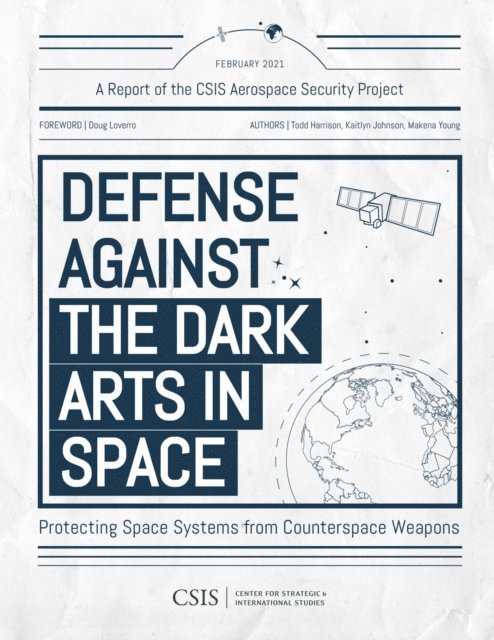
The proliferation of counterspace weapons across the globe often calls into question what can be done to best protect satellites from attack. This analysis from the CSIS Aerospace Security Project addresses different methods and technologies that can be used by the United States government, and others, to deter adversaries from attack. A wide range of active and passive defenses are available to protect space systems and the ground infrastructure they depend upon from different types of threats. This report captures a range of active and passive defenses that are theoretically possible and discusses the advantages and limitations of each. A group of technical space and national security experts supported the analysis by working through several plausible scenarios that explore a range of defenses that may be needed, concepts for employing different types of defenses, and how defensive actions in space may be perceived by others. These scenarios and the findings that resulted from subsequent conversations with experts are reported in the penultimate chapter of the report. Finally, the CSIS Aerospace Security Project team offers conclusions drawn from the analysis, actionable recommendations for policymakers, and additional research topics to be explored in future work.