Karin Buhmann - Böcker
Visar alla böcker från författaren Karin Buhmann. Handla med fri frakt och snabb leverans.
7 produkter
7 produkter
Power, Procedure, Participation and Legitimacy in Global Sustainability Norms
A Theory of Collaborative Regulation
Häftad, Engelska, 2019
433 kr
Skickas inom 10-15 vardagar
Globalisation of the market, law and politics contributes to a diversity of transnational sustainability problems whose solutions exceed the territorial jurisdictional limits of nation states in which their effects are generated or occur. The rise of the business sector as a powerful global actor with a claim to participation and potential contributions as well as adverse impacts sustainability complicates the regulatory challenge. Recent decades’ efforts to govern transitions towards sustainability through public or hybrid regulation display mixed records of support and results. In combination, these issues highlight the need for insights on what conditions multi-stakeholder regulation for a process that balances stakeholder power and delivers results perceived as legitimate by participants and broader society. This book responds to that need. Based on empirical experience on public-private regulation of global sustainability concerns and theoretical perspectives on transnational regulation, the book proposes a new theory on collaborative regulation. This theory sets out a procedural approach for multi-stakeholder regulation of global sustainability issues in a global legal and political order to provide for legitimacy of process and results. It takes account of the claims to participation of the private sector as well as civil society organisations and the need to balance power disparities.
1 935 kr
Skickas inom 10-15 vardagar
Human rights is an interdisciplinary subject as well as a foundational aspect of the law. The importance of human rights at the intersection of business and society is central, yet under-analyzed. This book provides an accessible understanding of what human rights are, how business enterprises may impact human rights for better or for worse, and how such impacts can or should be managed.Human Rights: A Key Idea for Business and Society equips readers interested in the relationship between business and society with the foundational knowledge for engaging in debates and operational tasks related to the roles and responsibilities of business with regard to human rights. It covers human rights aspects relevant to common management tasks, including supply chain management, human resource management, risk management, non-financial reporting, finance, and stakeholder engagement. It covers opportunities and challenges related to the Sustainable Development Goals (SDGs) and climate change mitigation. The book explains the foundations for human rights, social expectations, and legal requirements on businesses to respect human rights and how business enterprises should identify and manage their human rights impacts.A concise introduction to a complex topic, this book is perfect reading for students of corporate social responsibility, business ethics, and international business, as well as an illuminating guide for researchers, managers, civil society organizations, government officials, and reflective practitioners.
509 kr
Skickas inom 10-15 vardagar
Human rights is an interdisciplinary subject as well as a foundational aspect of the law. The importance of human rights at the intersection of business and society is central, yet under-analyzed. This book provides an accessible understanding of what human rights are, how business enterprises may impact human rights for better or for worse, and how such impacts can or should be managed.Human Rights: A Key Idea for Business and Society equips readers interested in the relationship between business and society with the foundational knowledge for engaging in debates and operational tasks related to the roles and responsibilities of business with regard to human rights. It covers human rights aspects relevant to common management tasks, including supply chain management, human resource management, risk management, non-financial reporting, finance, and stakeholder engagement. It covers opportunities and challenges related to the Sustainable Development Goals (SDGs) and climate change mitigation. The book explains the foundations for human rights, social expectations, and legal requirements on businesses to respect human rights and how business enterprises should identify and manage their human rights impacts.A concise introduction to a complex topic, this book is perfect reading for students of corporate social responsibility, business ethics, and international business, as well as an illuminating guide for researchers, managers, civil society organizations, government officials, and reflective practitioners.
3 210 kr
Skickas inom 10-15 vardagar
Meaningful Stakeholder Engagement (MSE) is both a concept and a management approach, drawing on a combination of theoretical and applied knowledge areas (e.g., impact assessment, business and human rights, and stakeholder theory). MSE has become a key element of corporate sustainability risk-based due diligence as a process that responsible business enterprises are expected to apply to identify and manage harmful impacts on the environment and society.Despite the obvious and growing relevance of meaningful stakeholder engagement, few publications have tried to synthesize the knowledge, academic literature, and practical experience within and around the concept and practices. This volume responds to that knowledge gap through the provision of comprehensive interdisciplinary perspectives. Embodying a rights-holder orientation, The Routledge Handbook on Meaningful Stakeholder Engagement emphasizes the importance of MSE for stakeholders who are or can be affected by activities driven by external actors, such as natural resource extraction or processing; infrastructure; development proposals, planning and implementation; and production for industry or consumption.This handbook offers four thematic sections, all interdisciplinary in character, seeking to explore the multiple aspects of MSE. Moreover, a comprehensive introductory chapter explains key elements of the concept and causes for the current surge in expectations of MSE, including a rise in demands of risk-based due diligence. More than 40 international contributors combine theory and practice in chapters that discuss and elaborate the theory and practice of MSE. Uniquely, each section includes short practice notes based on experiences or dilemmas lived by practitioners or affected people, placing real-life situations into theoretical context. The concluding chapter draws up key insights from the chapters and practice notes, and casts a path for the future of MSE integrating values, norms, and practice.Cutting across multiple disciplines including stakeholder theory, natural resource management, impact assessment, project management, ESG, responsible business, and global value chains, The Routledge Handbook on Meaningful Stakeholder Engagement will be an essential resource for scholars, researchers, developers, investors, affected people, civil society organizations, students, and others.The Open Access version of this book, available at http://www.taylorfrancis.com, has been made available under a Creative Commons Attribution-Non Commercial-No Derivatives (CC-BY-NC-ND) 4.0 license.
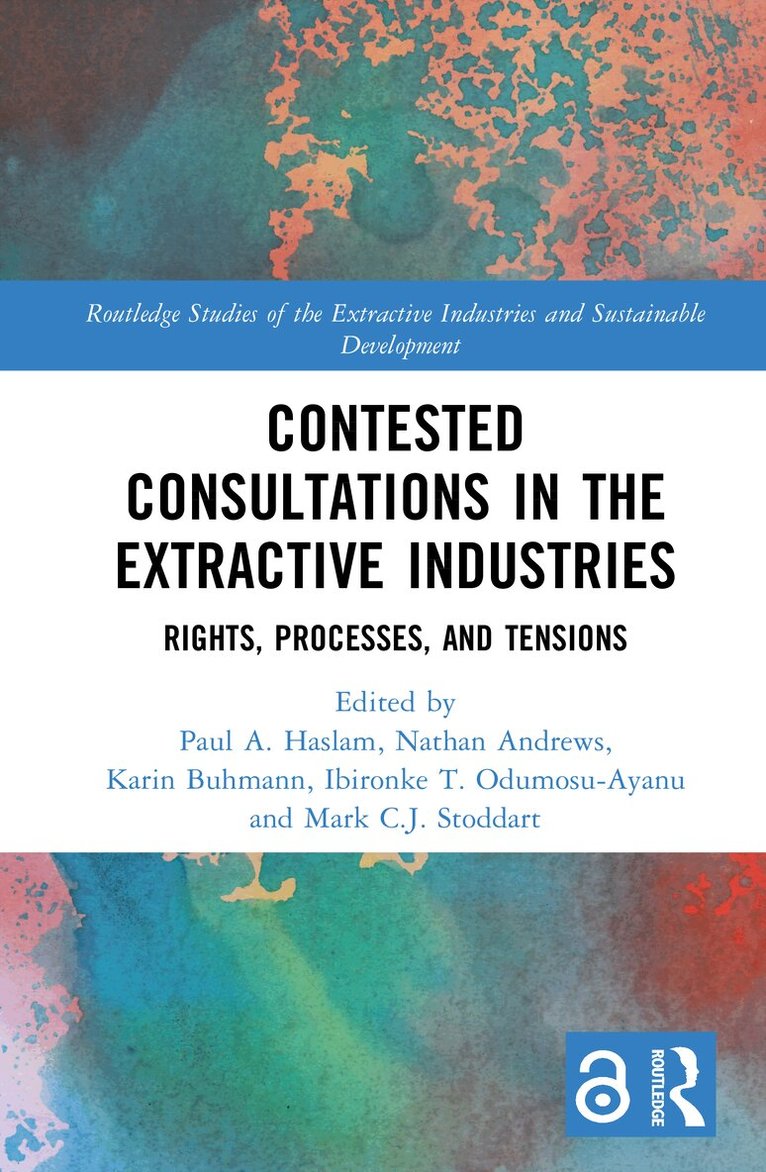
Contested Consultations in the Extractive Industries
Rights, Processes, and Tensions
Inbunden, Engelska, 2025
2 103 kr
Skickas inom 10-15 vardagar
This volume examines how communities, companies, and governments contest and contribute to the evolution of norms, rules and decision-making procedures that govern stakeholder consultation in the extractive industries. In recent years international organisations, governments and companies around the world have dramatically reformed the regime that governs consultations with community stakeholders about proposed extractive projects. However, the characteristics of this consultation regime are often contested, with diverse stakeholders seeking to defend their interests by drawing on different authoritative interpretations of the rules, norms and decision-making procedures that govern stakeholder consultation. Contestation over the meaning, governance and practice of stakeholder consultation is the central thread that ties this book together. Within this overarching concern, the volume takes a global and comparative perspective that examines the complexity of these intersecting and overlapping consultation requirements, with a particular focus on Indigenous Peoples, using cases from the Global North and Global South, including Argentina, Australia, Brazil, Canada, The Central African Republic, The Democratic Republic of Congo, Iceland, Ghana, Greenland, Guyana, Norway, and Peru. The book highlights the tensions associated with the application of this contested regime and identifies possible solutions from best practices around the world. From a theoretical perspective the book unpacks the maze of overlapping consultation requirements and practices that highlights the normative disagreements between key stakeholders and the overlapping rules and procedures that govern the implementation of consultation. A unique contribution of this collection is the commentary from practitioners, who reflect on the same issues addressed by the academic contributors, but based on their own vast practical experience.This book will be of great interest to students and scholars researching public participation and stakeholder consultation in the extractive industries as well as natural resource governance and sustainable development more broadly.The Open Access version of this book, available at http://www.taylorfrancis.com, has been made available under a Creative Commons Attribution-Non Commercial-No Derivatives (CC BY-NC-ND) 4.0 license.
Power, Procedure, Participation and Legitimacy in Global Sustainability Norms
A Theory of Collaborative Regulation
Inbunden, Engelska, 2017
1 935 kr
Skickas inom 10-15 vardagar
Globalisation of the market, law and politics contributes to a diversity of transnational sustainability problems whose solutions exceed the territorial jurisdictional limits of nation states in which their effects are generated or occur. The rise of the business sector as a powerful global actor with a claim to participation and potential contributions as well as adverse impacts sustainability complicates the regulatory challenge. Recent decades’ efforts to govern transitions towards sustainability through public or hybrid regulation display mixed records of support and results. In combination, these issues highlight the need for insights on what conditions multi-stakeholder regulation for a process that balances stakeholder power and delivers results perceived as legitimate by participants and broader society. This book responds to that need. Based on empirical experience on public-private regulation of global sustainability concerns and theoretical perspectives on transnational regulation, the book proposes a new theory on collaborative regulation. This theory sets out a procedural approach for multi-stakeholder regulation of global sustainability issues in a global legal and political order to provide for legitimacy of process and results. It takes account of the claims to participation of the private sector as well as civil society organisations and the need to balance power disparities.
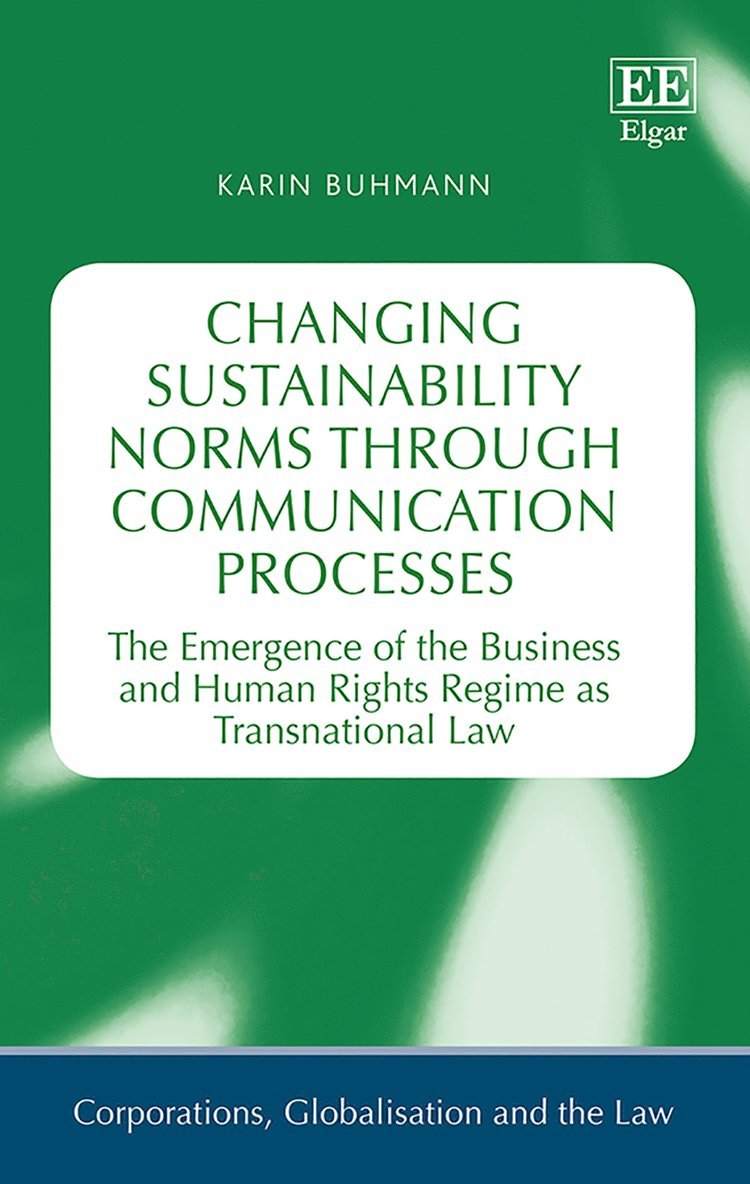
Changing Sustainability Norms through Communication Processes
The Emergence of the Business and Human Rights Regime as Transnational Law
Inbunden, Engelska, 2017
2 015 kr
Skickas inom 7-10 vardagar
Applying the emergent Business and Human Rights (BHR) regime as a case, this book analyses regulatory strategies, communicative approaches and public-private processes to develop new sustainability-related norms, particularly for business, for maintaining and promoting public policy objectives and societal needs. Karin Buhmann sets out the concerns of public regulators and businesses that both inform debates and create power struggles in the construction of sustainability norms between public policy interests and the market. The author focuses on three trends in argumentative strategies applied in the BHR context and considers the use, impact and complementarity of these for sustainability regulation. Through analysis of selected transnational regulatory processes, the book identifies argumentative and negotiation strategies that led to agreement on BHR despite conflicting interests across public, private and not-for-profit (NGO) stakeholders, and develops insights for future multi-stakeholder sustainability regulation, focusing both on the regulatory process and the outcome. Changing Sustainability Norms through Communication Processes will be a valuable read for NGOs, regulators, managers and academics with a concern for sustainability regulation by helping to enhance their understanding of how to influence normative change in organisations, in support of sustainability and responsible business conduct.