Karl L. Brockmann – författare
Visar alla böcker från författaren Karl L. Brockmann. Handla med fri frakt och snabb leverans.
5 produkter
5 produkter
Häftad, Engelska, 1996
544 kr
Skickas inom 10-15 vardagar
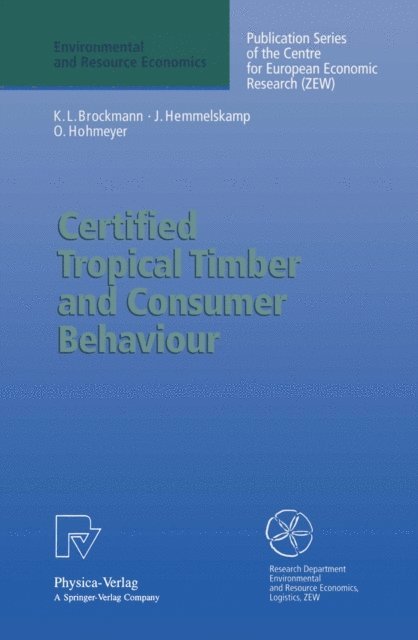
Boycotting tropical timber reduces its economic value, and provides for subsequent agricultural use or livestock farming. In contrast, a certification scheme for sustainably produced timber (tropical or non-tropical) protects the forests by raising their economic value. This volume examines the impact of a certification scheme on German demand for tropical timber. A partial-equilibrium model is developed for the German tropical timber market, as a whole as well as for five important submarkets representing 50 per cent of the total demand. The results reveal that a credible certification scheme can induce a significant expansion of demand for sustainably produced tropical timber. This holds true for a scheme restricted to Germany as well as for an OECD-wide approach.
576 kr
Skickas inom 10-15 vardagar
Als Leitbild der internationalen Umwelt- und Entwicklungspolitik hat sich der Begriff einer nachhaltigen Entwicklung spätestens seit der Rio-Konferenz 1992 durchgesetzt. Zunehmend wird anerkannt, daß die wirtschaftliche Entwicklung absolute Belastungsgrenzen der Natur berücksichtigen muß. Dadurch stellt sich die Frage, wie Maßnahmen, die innerhalb eines Konzeptes einer nachhaltigen zukunftsverträglichen Entwicklung vorgeschlagen werden, ordnungspolitisch zu bewerten sind. Im ersten Teil wird aus einer ordo-liberalen Perspektive ein allgemeines Prüfraster zur ordnungspolitischen Bewertung umweltpolitischer Maßnahmen entwickelt. Im zweiten Teil wird das Prüfraster auf ein zur Zeit viel und kontrovers diskutiertes umweltpolitisches Instrument - freiwillige Selbstverpflichtung der Wirtschaft - angewendet.
Häftad, Tyska, 1998
559 kr
Skickas inom 10-15 vardagar
Häftad, Tyska, 1999
559 kr
Skickas inom 10-15 vardagar
Häftad, Engelska, 2000
544 kr
Skickas inom 10-15 vardagar
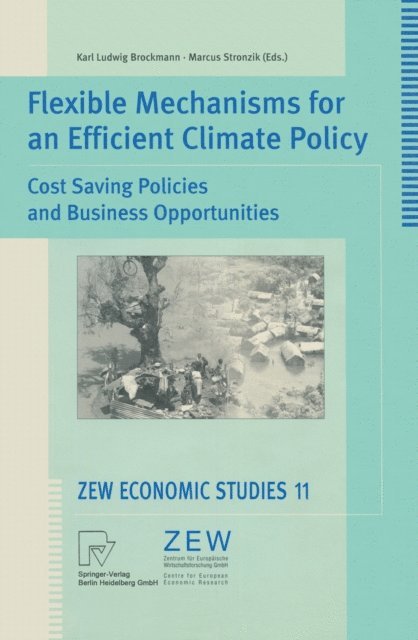
In the Kyoto Protocol to the UN Framework Convention on Climate Change, industrialized countries agreed on binding absolute targets for greenhouse gas emissions and on the admission of flexible market-economy instruments - such as emissions trading, joint implementation and the clean development mechanism - used for reaching the targets. The contributions in this volume reveal that flexible instruments can lower the costs of climate protection considerably - not only in theory, but also in practice. Concerning implementation, it will be necessary to take care of possible loopholes, uncertainties and transaction costs which may be too high if no proper design is chosen.