Karl Menger - Böcker
Visar alla böcker från författaren Karl Menger. Handla med fri frakt och snabb leverans.
11 produkter
11 produkter
1 095 kr
Skickas inom 10-15 vardagar
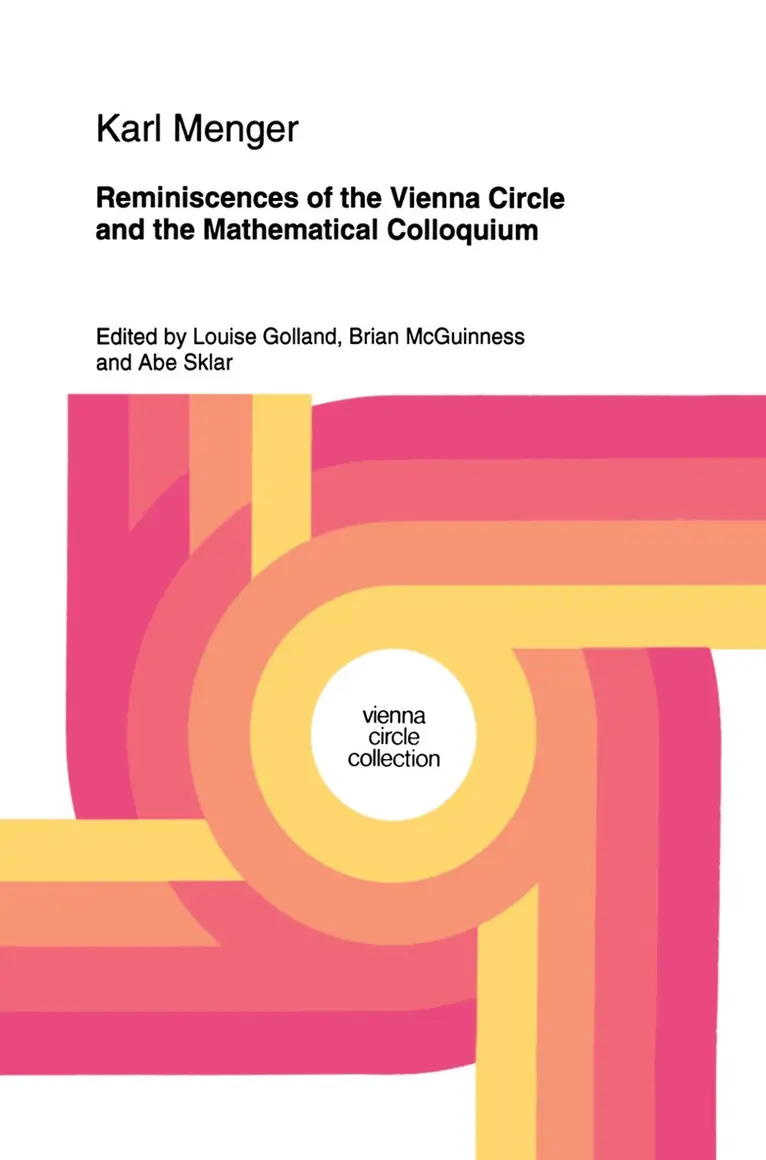
Karl Menger (1902-1985), a pure mathematician, also took an active interest in both philosophy and economics. In this memoir, which he was composing at the time of his death, he relates how all these subjects developed and flourished against the Viennese background (described in depth), and did so despite the political developments of the 20s and 30s, which depressed but did not silence him. He continued his work in the United States. The memoir describes his membership of the Vienna Circle (the scientifically minded philosophers that gathered around Moritz Schlick) for whom he was an intermediary, bringing them into contact with Brouwer's intuitionism, with the work of the Polish logicians, especially that of Tarski, but more generally with rigorous mathematical thinking. Indeed, the other Viennese group described here is the Mathematical Colloquium, which he founded, whose Proceedings show it to have been a powerhouse of ideas. There are also chapters on philosophy and mathematics in the Poland of the 20s and 30s and the United States of the 30s and 40s.The memoir devotes particular attention to Wittgenstein (with whose family Menger was acquainted) and to Goedel, whom he was instrumental in bringing to America. The genesis of Menger's own writings on philosophy is also described and the work features many mathematical examples applied to that subject. This volume gives an impression of the interdisciplinarity of the tradition to which he partly belonged and partly created. A brief account of his life is given in an introduction by the editors (all of whom knew him personally), and his contribution to the social sciences - only touched on in the text - is elucidated by Professor Lionello Punzo.
1 129 kr
Skickas inom 10-15 vardagar
Karl Menger was born in Vienna on January 13, 1902, the only child of two gifted parents. His mother Hermione, nee Andermann (1870-1922), in addition to her musical abilities, wrote and published short stories and novelettes, while his father Carl (1840-1921) was the noted Austrian economist, one of the founders of marginal utility theory. A highly cultured man, and a liberal rationalist in the nine teenth century sense, the elder Menger had witnessed the defeat and humiliation of the old Austrian empire by Bismarck's Prussia, and the subsequent establishment under Prussian leadership of a militaristic, mystically nationalistic, state-capitalist German empire - in effect, the first modern "military-industrial complex. " These events helped frame in him a set of attitudes that he later transmitted to his son, and which included an appreciation of cultural attainments and tolerance and respect for cultural differences, com bined with a deep suspicion of rabid nationalism, particularly the German variety. Also a fascination with structure, whether artistic, scientific, philosophical, or theological, but a rejection of any aura of mysticism or mumbo-jumbo accompanying such structure. Thus the son remarked at least once that the archangels' chant that begins the Prolog im Himmel in Goethe's Faust was perhaps the most viii INTRODUCTION beautiful thing in the German language "but of course it doesn't mean anything.
500 kr
Skickas inom 10-15 vardagar
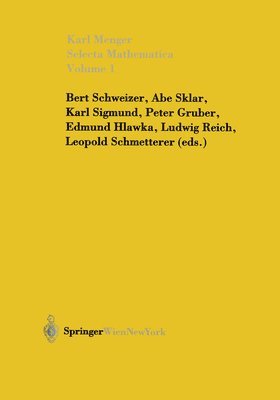
Karl Menger, one of the founders of dimension theory, belongs to the most original mathematicians and thinkers of the twentieth century. He was a member of the Vienna Circle and the founder of its mathematical equivalent, the Viennese Mathematical Colloquium. Both during his early years in Vienna, and after his emigration to the United States, Karl Menger made significant contributions to a wide variety of mathematical fields, and greatly influenced some of his colleagues. The Selecta Mathematica contain Menger's major mathematical papers, based on a personal selection by himself out of his extensive writings. They deal with topics as diverse as topology, geometry, analysis and algebra, as well as writings on economics, sociology, logic, philosophy and mathematical results. The two volumes are a monument to the diversity and originality of Menger's ideas.
535 kr
Skickas inom 10-15 vardagar
Karl Menger, one of the founders of dimension theory, belongs to the most original mathematicians and thinkers of the twentieth century. He was a member of the Vienna Circle and the founder of its mathematical equivalent, the Viennese Mathematical Colloquium. Both during his early years in Vienna and after his emigration to the United States, Karl Menger made significant contributions to a wide variety of mathematical fields, and greatly influenced some of his colleagues. The Selecta Mathematica contain Menger's major mathematical papers, based on a personal selection by himself out of his extensive writings. They deal with topics as diverse as topology, geometry, analysis and algebra, as well as writings on economics, sociology, logic, philosophy and mathematical results. The two volumes are a monument to the diversity and originality of Menger's ideas.
600 kr
Skickas inom 10-15 vardagar
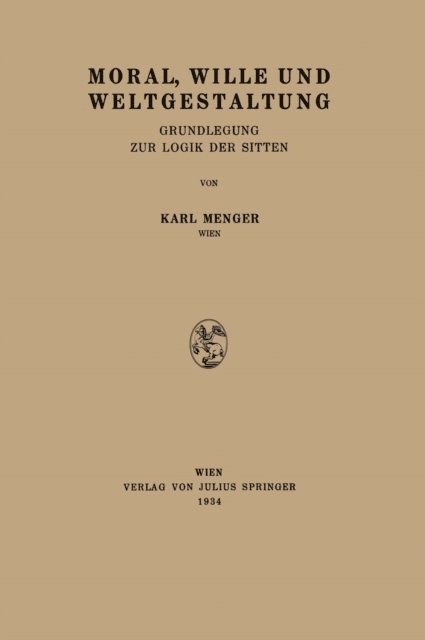
Dieser Buchtitel ist Teil des Digitalisierungsprojekts Springer Book Archives mit Publikationen, die seit den Anfängen des Verlags von 1842 erschienen sind. Der Verlag stellt mit diesem Archiv Quellen für die historische wie auch die disziplingeschichtliche Forschung zur Verfügung, die jeweils im historischen Kontext betrachtet werden müssen. Dieser Titel erschien in der Zeit vor 1945 und wird daher in seiner zeittypischen politisch-ideologischen Ausrichtung vom Verlag nicht beworben.
409 kr
Skickas inom 10-15 vardagar
Karl Menger, one of the founders of dimension theory, is among the most original mathematicians and thinkers of the twentieth century.
535 kr
Skickas inom 10-15 vardagar
Karl Menger, one of the founders of dimension theory, is among the most original mathematicians and thinkers of the twentieth century.
1 064 kr
Skickas inom 10-15 vardagar
1 064 kr
Skickas inom 10-15 vardagar
2 100 kr
Skickas inom 10-15 vardagar
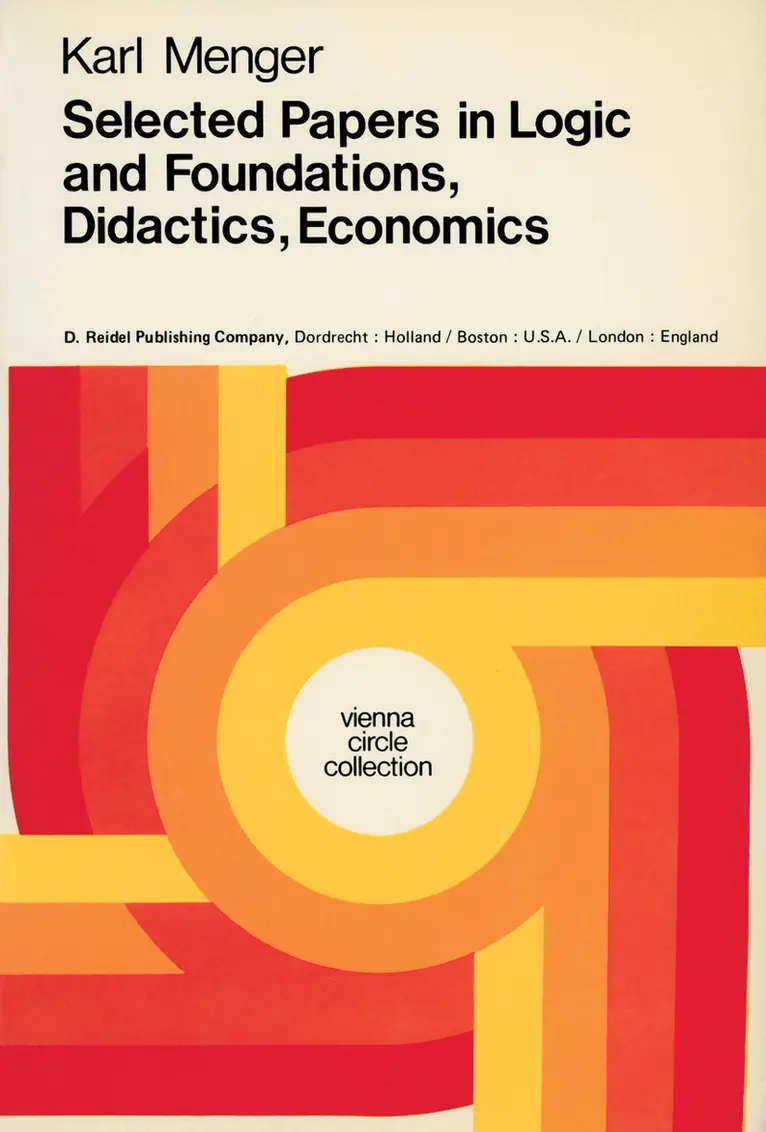
This volume brings together those papers of mine which may be of interest not only to various specialists but also to philosophers. Many of my writings in mathematics were motivated by epistemological considerations; some papers originated in the critique of certain views that at one time dominated the discussions of the Vienna Cirele; others grew out of problems in teaching fundamental ideas of mathematics; sti II others were occasioned by personal relations with economists. Hence a wide range of subjects will be discussed: epistemology, logic, basic concepts of pure and applied mathematics, philosophical ideas resulting from geometric studies, mathematical didactics and, finally, economics. The papers also span a period of more than fifty years. What unifies the various parts of the book is the spirit of searching for the elarification of basic concepts and methods and of articulating hidden ideas and tacit procedures. Part 1 ineludes papers published about 1930 which expound an idea that Carnap, after a short period of opposition in the Cirele, fully adopted ; and, under the name "Princip/e of To/erance", he eloquently formulated it in great generality in his book, Logica/ Syntax of Language (1934), through which it was widely disseminated. "The New Logic" in Chapter 1 furthermore ineludes the first report (I932) to a larger public of Godel's epochal discovery presented among the great logic results of ali time. Chapter 2 is a translation of an often quoted 1930 paper presenting a detailed exposition and critique of intuitionism.
2 100 kr
Skickas inom 10-15 vardagar
This volume brings together those papers of mine which may be of interest not only to various specialists but also to philosophers. Many of my writings in mathematics were motivated by epistemological considerations; some papers originated in the critique of certain views that at one time dominated the discussions of the Vienna Cirele; others grew out of problems in teaching fundamental ideas of mathematics; sti II others were occasioned by personal relations with economists. Hence a wide range of subjects will be discussed: epistemology, logic, basic concepts of pure and applied mathematics, philosophical ideas resulting from geometric studies, mathematical didactics and, finally, economics. The papers also span a period of more than fifty years. What unifies the various parts of the book is the spirit of searching for the elarification of basic concepts and methods and of articulating hidden ideas and tacit procedures. Part 1 ineludes papers published about 1930 which expound an idea that Carnap, after a short period of opposition in the Cirele, fully adopted ; and, under the name "Princip/e of To/erance", he eloquently formulated it in great generality in his book, Logica/ Syntax of Language (1934), through which it was widely disseminated. "The New Logic" in Chapter 1 furthermore ineludes the first report (I932) to a larger public of Godel's epochal discovery presented among the great logic results of ali time. Chapter 2 is a translation of an often quoted 1930 paper presenting a detailed exposition and critique of intuitionism.