Keiki Takadama – författare
Visar alla böcker från författaren Keiki Takadama. Handla med fri frakt och snabb leverans.
11 produkter
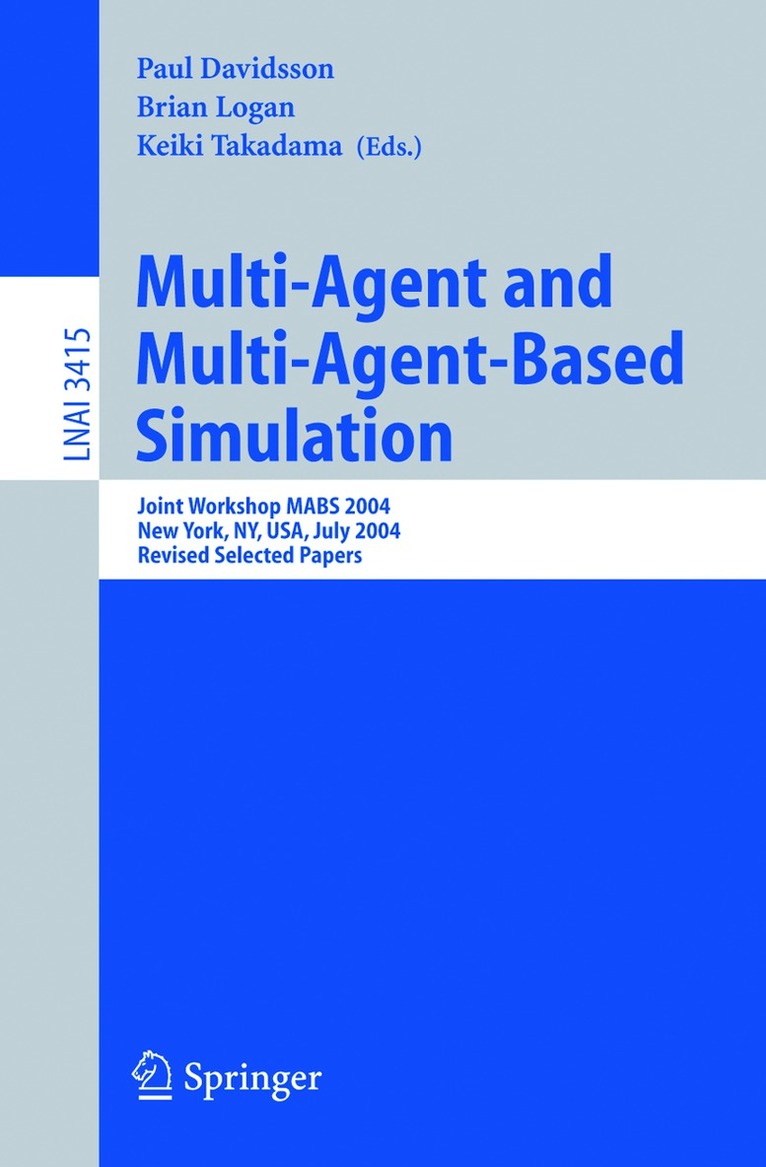
Multi-Agent and Multi-Agent-Based Simulation
Joint Workshop MABS 2004
Av Paul Davidsson, Brian Logan m. fl.
Häftad, 2005
544 kr
Lägg i varukorg
This volume presents revised and extended versions of selected papers presented at the Joint Workshop on Multi-Agent and Multi-Agent-Based Simulation, a workshop federated with the 3rd International Joint Conference on Autonomous Agents and Multiagent Systems (AAMAS 2004), which was held in New …
Multi-Agent and Multi-Agent-Based Simulation
Joint Workshop MABS 2004
Av Keiki Takadama, Brian Logan m. fl.
E-bok, 2005
712 kr
Lägg i varukorg
This volume presents revised and extended versions of selected papers presented at the Joint Workshop on Multi-Agent and Multi-Agent-Based Simulation, a workshop federated with the 3rd International Joint Conference on Autonomous Agents and Multiagent Systems (AAMAS 2004), which was held in New …
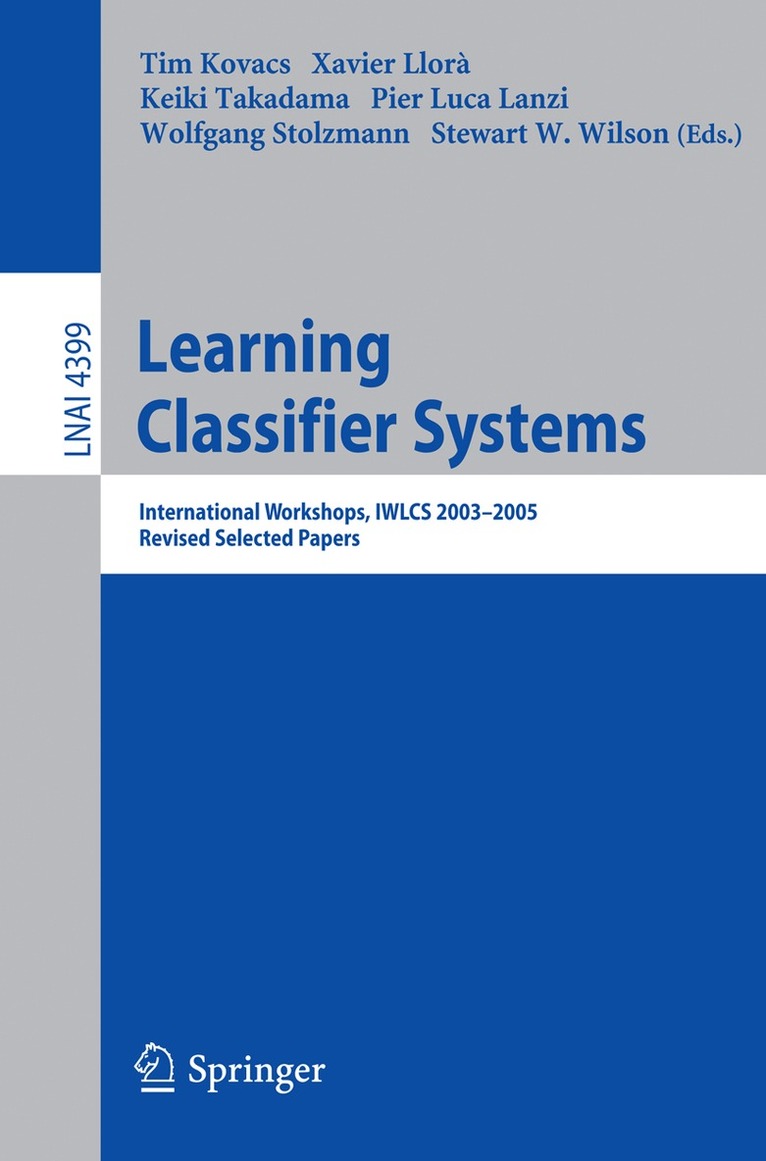
Learning Classifier Systems
International Workshops, IWLCS 2003-2005, Revised Selected Papers
Av Tim Kovacs, Xavier Llorà m. fl.
Häftad, 2007
568 kr
Lägg i varukorg
The work embodied in this volume was presented across three consecutive e- tions of the International Workshop on Learning Classi?er Systems that took place in Chicago (2003), Seattle (2004), and Washington (2005). The Genetic and Evolutionary Computation Conference, the main ACM SIGEvo conference, …
Learning Classifier Systems
International Workshops, IWLCS 2003-2005, Revised Selected Papers
Av Stewart W. Wilson, Wolfgang Stolzmann m. fl.
E-bok, 2007
739 kr
Lägg i varukorg
The work embodied in this volume was presented across three consecutive e- tions of the International Workshop on Learning Classi?er Systems that took place in Chicago (2003), Seattle (2004), and Washington (2005). The Genetic and Evolutionary Computation Conference, the main ACM SIGEvo conference, …
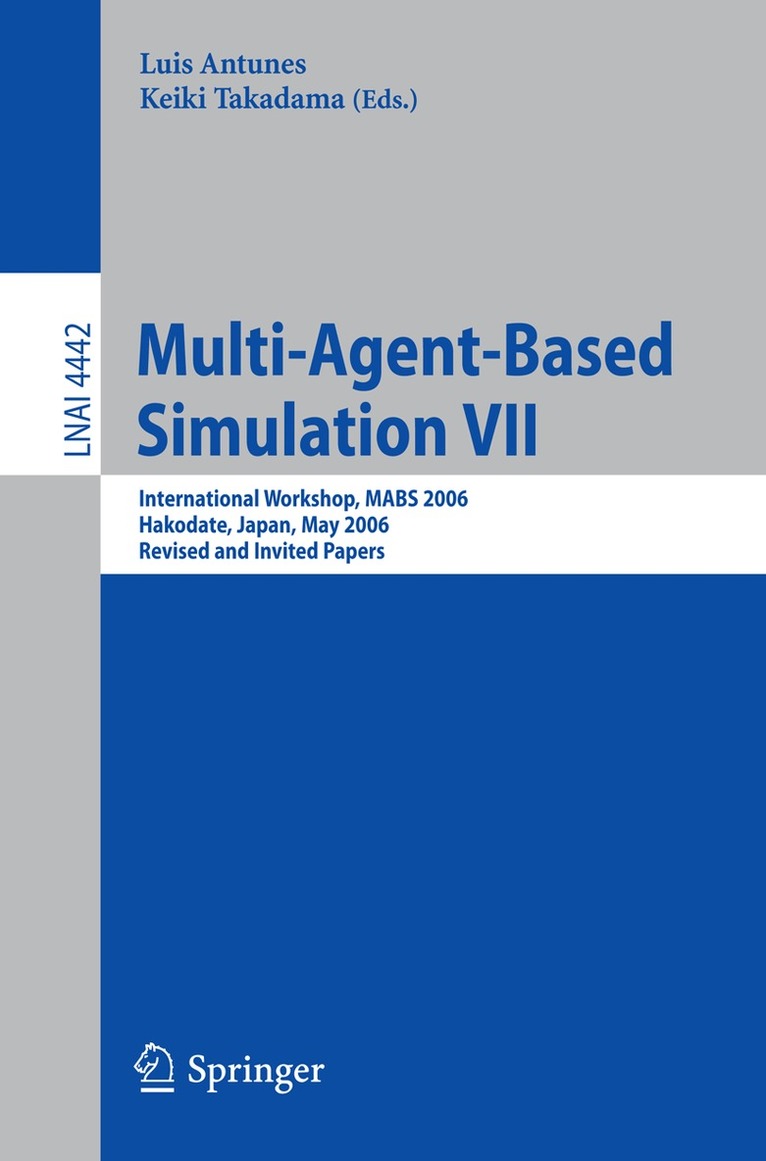
Multi-Agent-Based Simulation VII
International Workshop, MABS 2006, Hakodate, Japan, May 8, 2006, Revised and Invited Papers
Av Luis Antunes, Keiki Takadama
Häftad, 2007
568 kr
Lägg i varukorg
This book constitutes the thoroughly refereed proceedings of the 7th International Workshop on Multi-Agent-Based Simulation, MABS 2006. This was held in Hakodate, Japan, May 8, 2006 as an associated event of AAMAS 2006, the main international conference on autonomous agents and multi-agent systems. …
Multi-Agent-Based Simulation VII
International Workshop, MABS 2006, Hakodate, Japan, May 8, 2006, Revised and Invited Papers
Av Keiki Takadama, Luis Antunes
E-bok, 2007
734 kr
Lägg i varukorg
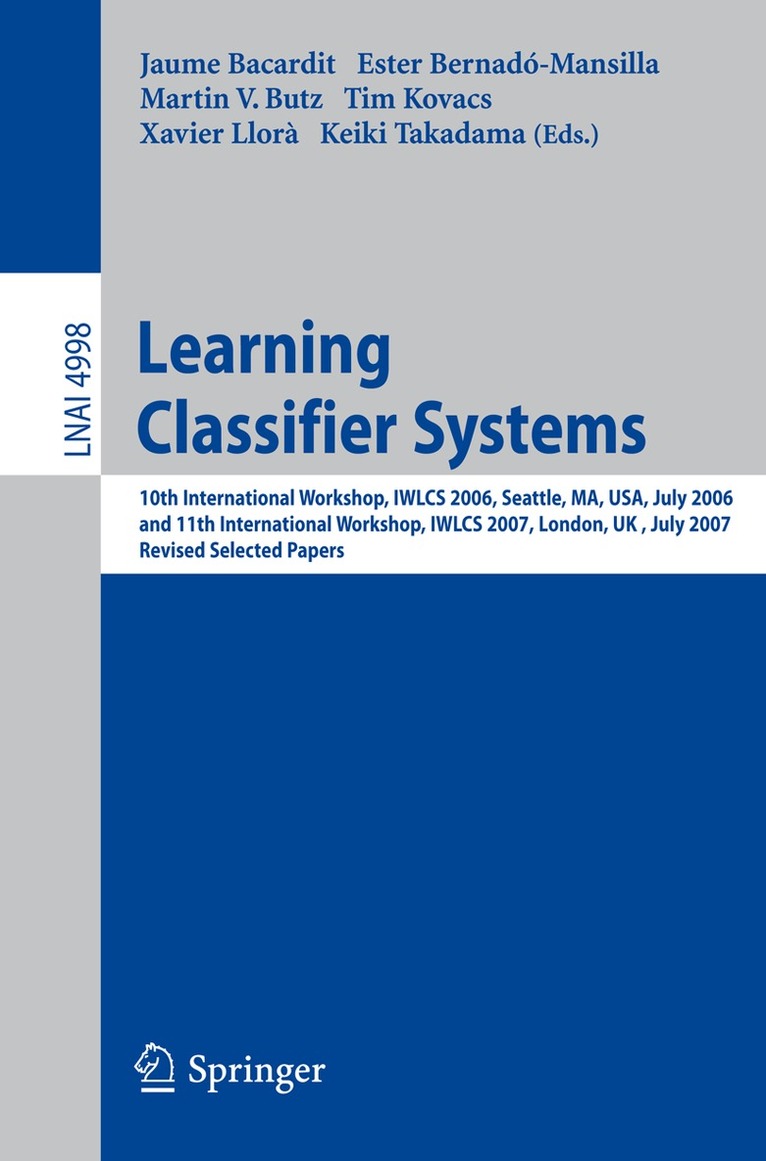
Learning Classifier Systems
10th International Workshop, IWLCS 2006, Seattle, MA, USA, July 8, 2006, and 11th International Workshop, IWLCS 2007, London, UK, July 8, 2007, Revised Selected Papers
Av Jaume Bacardit, Ester Bernadó-Mansilla m. fl.
Häftad, 2008
568 kr
Lägg i varukorg
This book constitutes the thoroughly refereed joint post-conference proceedings of two consecutive International Workshops on Learning Classifier Systems that took place in Seattle, WA, USA in July 2006, and in London, UK, in July 2007 - all hosted by the Genetic and Evolutionary Computation …
Learning Classifier Systems
10th International Workshop, IWLCS 2006, Seattle, MA, USA, July 8, 2006, and 11th International Workshop, IWLCS 2007, London, UK, July 8, 2007, Revised Selected Papers
Av Keiki Takadama, Xavier Llora m. fl.
E-bok, 2008
755 kr
Lägg i varukorg
This book constitutes the thoroughly refereed joint post-conference proceedings of two consecutive International Workshops on Learning Classifier Systems that took place in Seattle, WA, USA in July 2006, and in London, UK, in July 2007 - all hosted by the Genetic and Evolutionary Computation …
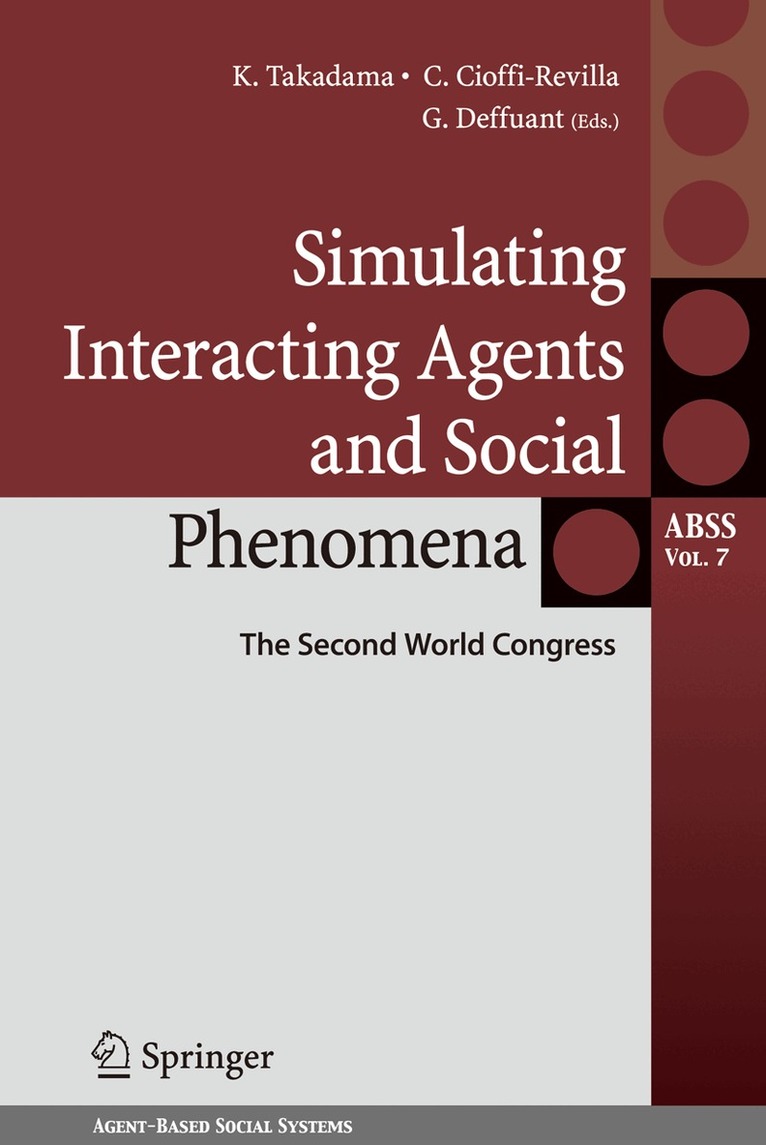
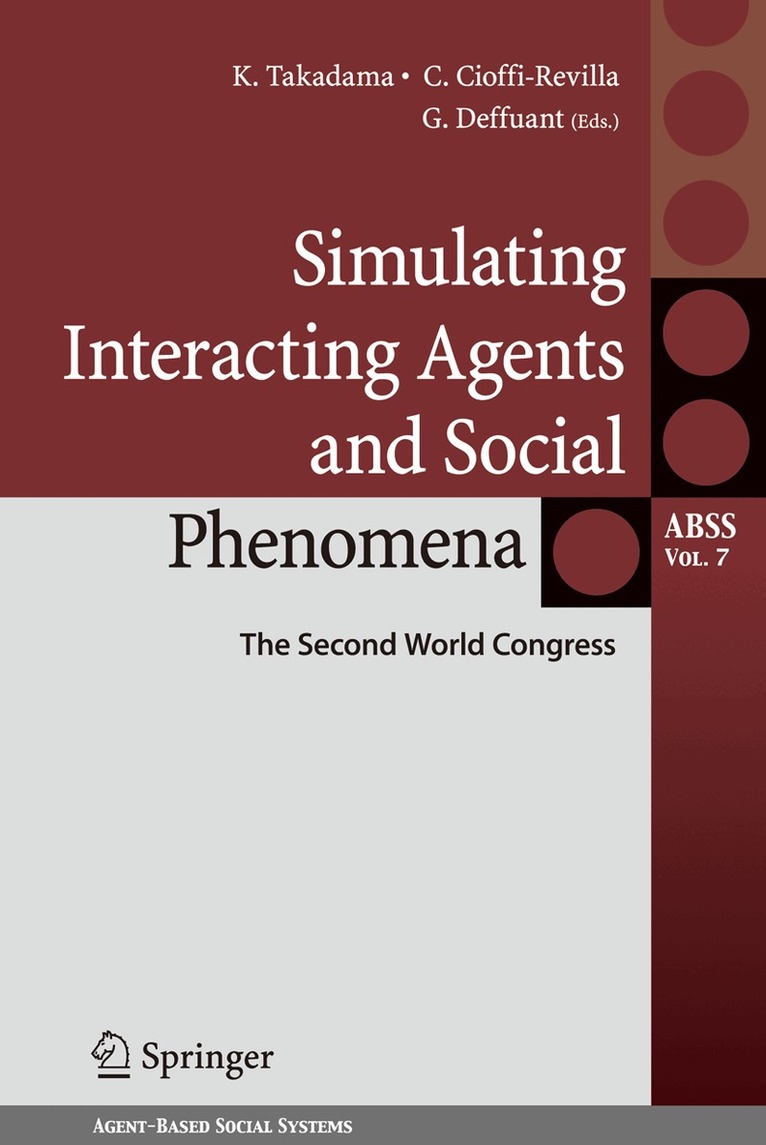
Simulating Interacting Agents and Social Phenomena
The Second World Congress
Av Keiki Takadama, Claudio Cioffi-Revilla m. fl.
Häftad, 2012
1641 kr
Lägg i varukorg
Agent-based modeling and social simulation have emerged as an interdisciplinary area of social science that includes computational economics, organizational science, social dynamics, and complex systems. This area contributes to enriching our understanding of the fundamental processes of social …
Simulating Interacting Agents and Social Phenomena
The Second World Congress
Av Keiki Takadama, Claudio Cioffi-Revilla m. fl.
Inbunden, 2010
1641 kr
Lägg i varukorg
Agent-based modeling and social simulation have emerged as an interdisciplinary area of social science that includes computational economics, organizational science, social dynamics, and complex systems. This area contributes to enriching our understanding of the fundamental processes of social …
Simulating Interacting Agents and Social Phenomena
The Second World Congress
Av Guillaume Deffuant, Claudio Cioffi-Revilla m. fl.
E-bok, 2010
2111 kr
Lägg i varukorg
Agent-based modeling and social simulation have emerged as an interdisciplinary area of social science that includes computational economics, organizational science, social dynamics, and complex systems. This area contributes to enriching our understanding of the fundamental processes of social …