Keith Breckenridge – författare
Visar alla böcker från författaren Keith Breckenridge. Handla med fri frakt och snabb leverans.
5 produkter
5 produkter
Del 182 - Proceedings of the British Academy
Registration and Recognition
Documenting the Person in World History
Inbunden, Engelska, 2012
1 659 kr
Skickas inom 5-8 vardagar
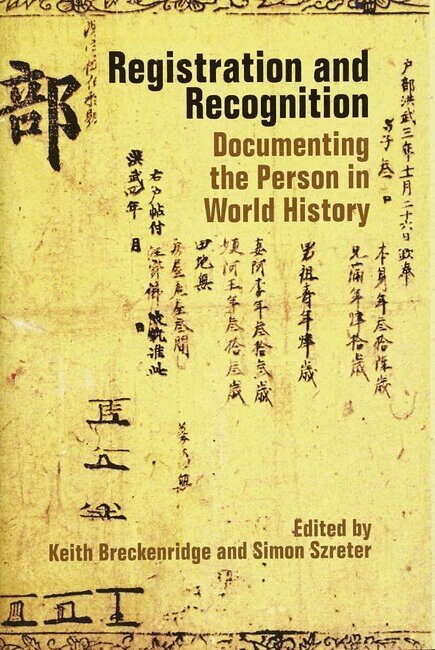
This is a comparative investigation of different regional histories of registration - a feature of societies common across Asia, Europe and the Americas, but poorly understood in contemporary social science. Registration has typically been viewed as coercive, and as a product of the rise of the modern European state. This volume shows that the registration of individuals has taken remarkably similar, and interestingly comparable, forms in very different societies across the world. The volume also suggests that registration has many hitherto neglected benefits for individuals, and that modern states have frequently sought to curtail, or avoid responsibility for, it. The book shows that the close study of practices of registration provides a tool - like class, gender or state - that supports analytical comparisons across time and region, raising a common, limited set of comparative questions that highlight the differences between the forms of state power and the responsibilities and entitlements of individuals and families.
Inbunden, Engelska, 2014
1 330 kr
Skickas inom 7-10 vardagar
Biometric identification and registration systems are being proposed by governments and businesses across the world. Surprisingly they are under most rapid, and systematic, development in countries in Africa and Asia. In this groundbreaking book, Keith Breckenridge traces how the origins of the systems being developed in places like India, Mexico, Nigeria and Ghana can be found in a century-long history of biometric government in South Africa, with the South African experience of centralized fingerprint identification unparalleled in its chronological depth and demographic scope. He shows how empire, and particularly the triangular relationship between India, the Witwatersrand and Britain, established the special South African obsession with biometric government, and shaped the international politics that developed around it for the length of the twentieth century. He also examines the political effects of biometric registration systems, revealing their consequences for the basic workings of the institutions of democracy and authoritarianism.
Häftad, Engelska, 2016
462 kr
Skickas inom 7-10 vardagar
Biometric identification and registration systems are being proposed by governments and businesses across the world. Surprisingly they are under most rapid, and systematic, development in countries in Africa and Asia. In this groundbreaking book, Keith Breckenridge traces how the origins of the systems being developed in places like India, Mexico, Nigeria and Ghana can be found in a century-long history of biometric government in South Africa, with the South African experience of centralized fingerprint identification unparalleled in its chronological depth and demographic scope. He shows how empire, and particularly the triangular relationship between India, the Witwatersrand and Britain, established the special South African obsession with biometric government, and shaped the international politics that developed around it for the length of the twentieth century. He also examines the political effects of biometric registration systems, revealing their consequences for the basic workings of the institutions of democracy and authoritarianism.
E-bok
PDF, Engelska, 2016428 kr
Läs direkt efter köp
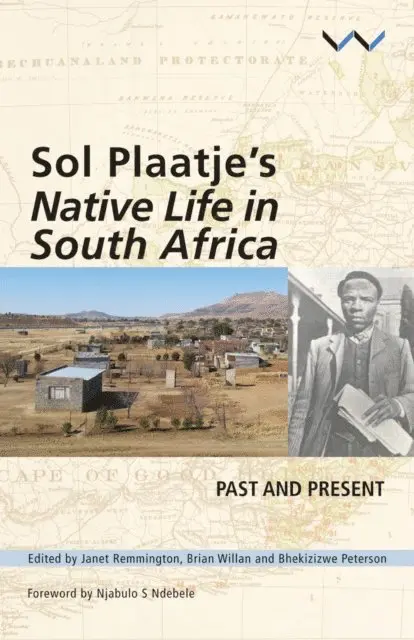
First published in 1916, Sol Plaatje’s Native Life in South Africa was written by one of the South Africa’s most talented early twentieth-century black leaders and journalists. Plaatje’s pioneering book arose out of an early African National Congress campaign to protest against the discriminatory1913 Natives Land Act. Native Life vividly narrates Plaatje’s investigative journeying into South Africa’s rural heartlands to report on the effects of the Act and his involvement in the deputation to the British imperial government. At the same time it tells the bigger story of the assault on black rights and opportunities in the newly consolidated Union of South Africa – and the resistance to it. Originally published in war-time London, but about South Africa and its place in the world, Native Life travelled far and wide, being distributed in the United States under the auspices of prominent African-American W E B Du Bois. South African editions were to follow only in the late apartheid period and beyond. The aim of this multi-authored volume is to shed new light on how and why Native Life came into being at a critical historical juncture, and to reflect on how it can be read in relation to South Africa’s heightened challenges today. Crucial areas that come under the spotlight in this collection include land, race, history, mobility, belonging, war, the press, law, literature, language, gender, politics, and the state.
E-bok
Engelska, 2016432 kr
Läs direkt efter köp
First published in 1916, Sol Plaatje’s Native Life in South Africa was written by one of the South Africa’s most talented early twentieth-century black leaders and journalists. Plaatje’s pioneering book arose out of an early African National Congress campaign to protest against the discriminatory1913 Natives Land Act. Native Life vividly narrates Plaatje’s investigative journeying into South Africa’s rural heartlands to report on the effects of the Act and his involvement in the deputation to the British imperial government. At the same time it tells the bigger story of the assault on black rights and opportunities in the newly consolidated Union of South Africa – and the resistance to it. Originally published in war-time London, but about South Africa and its place in the world, Native Life travelled far and wide, being distributed in the United States under the auspices of prominent African-American W E B Du Bois. South African editions were to follow only in the late apartheid period and beyond. The aim of this multi-authored volume is to shed new light on how and why Native Life came into being at a critical historical juncture, and to reflect on how it can be read in relation to South Africa’s heightened challenges today. Crucial areas that come under the spotlight in this collection include land, race, history, mobility, belonging, war, the press, law, literature, language, gender, politics, and the state.