Keith E. Maskus - Böcker
Visar alla böcker från författaren Keith E. Maskus. Handla med fri frakt och snabb leverans.
8 produkter
8 produkter
1 472 kr
Skickas inom 5-8 vardagar
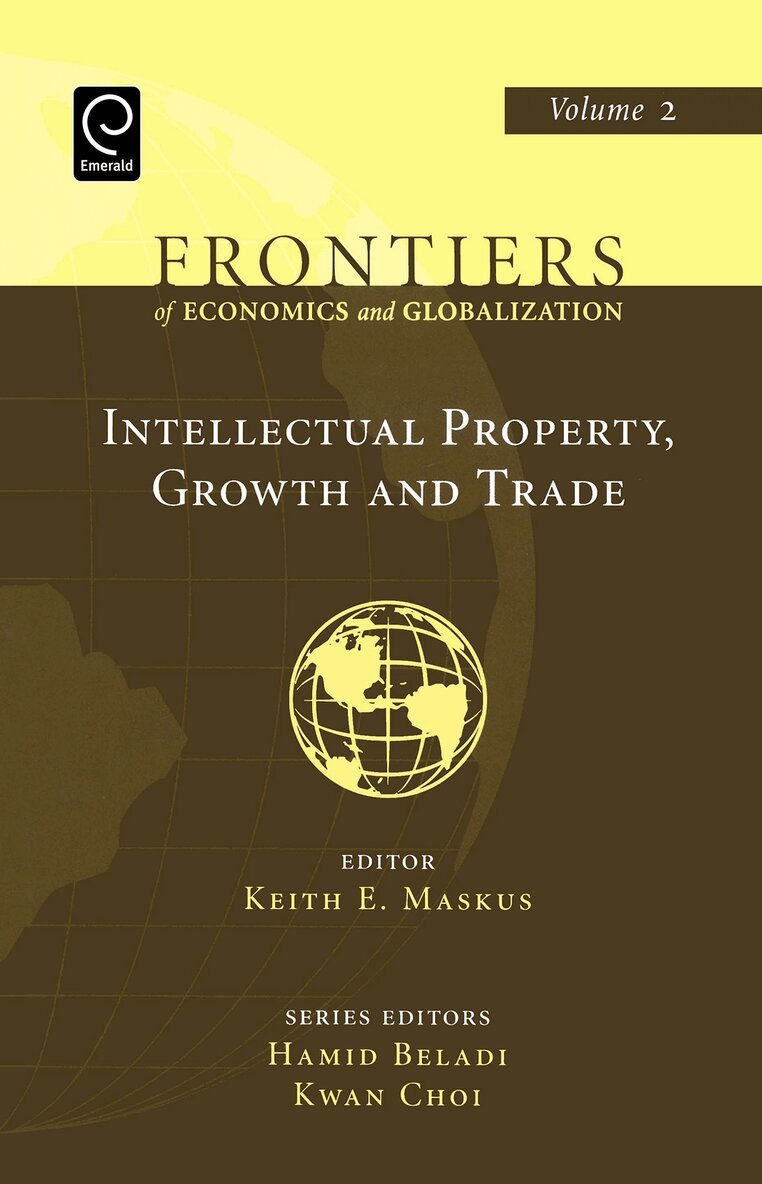
In recent years, Intellectual Property Rights - both in the form of patents and copyrights - have expanded in their coverage, the breadth and depth of protection, and the tightness of their enforcement. Moreover, for the first time in history, the IPR regime has become increasingly uniform at international level by means of the TRIPS agreement, irrespectively of the degrees of development of the various countries.This volume, first, addresses from different angles the effects of IPR on the processes of innovation and innovation diffusion in general, and with respect to developing countries in particular. Contrary to a widespread view, there is very little evidence that the rates of innovation increase with the tightness of IPR even in developed countries. Conversely, in many circumstances, tight IPR represents an obstacle to imitation and innovation diffusion in developing countries.What can policies do then? This is the second major theme of the book which offers several detailed discussions of possible policy measures even within the current TRIPS regime - including the exploitation of the waivers to IPR enforcement that it contains, various forms of development of 'technological commons', and non-patent rewards to innovators, such as prizes. Some drawbacks of the regimes, however, are unavoidable: hence the advocacy in many contributions to the book of deep reforms of the system in both developed and developing countries, including the non-patentability of scientific discoveries, the reduction of the depth and breadth of IPR patents, and the variability of the degrees of IPR protection according to the levels of a country's development.
Del 2 - Frontiers of Economics and Globalization
Intellectual Property, Growth and Trade
Inbunden, Engelska, 2007
1 346 kr
Skickas inom 7-10 vardagar
In recent years intellectual property rights (IPR) took on major significance as an element of global trade regulation. The Agreement on Trade-Related Aspects of Intellectual Property Rights (TRIPS) at the World Trade Organization (WTO) obliges member countries to protect patents, copyrights, trademarks, and trade secrets. This mandate has great impact in developing nations, which had generally weaker IPR standards prior to TRIPS and subsequent agreements. This emerging international regime for protecting IPR raises thorny questions about how the new rules of the game might affect fundamental economic processes, including innovation, trade and economic development. The governments of many developing countries see the new regime as excessively protectionist and an impediment to their development prospects. They perceive potential problems with abusive monopoly practices, high costs for new medicines, and limited access to scientific and educational materials. Indeed, it is ironic that during a time of significant global liberalization of trade and investment barriers, the IPR system may be raising restrictions on access to the very technology flows that could substantiate the gains from greater trading opportunities. However, expansion of the global IPR regime also bears potential for economic gains. It is possible that the new system will encourage additional investments in R&D and innovation. The ongoing internationalization of commercial R&D could be accelerated. Such investments might increasingly meet the medical, agricultural, and educational needs of people in poor countries. The regime could also improve the mechanisms under which new information goods are transferred across borders, expanding the possibilities for fruitful diffusion of technologies. The implications of these reforms will be far-reaching, complex and hard to predict. It is possible, for example, that stronger patents will simply redistribute incomes across nations, generating significant winners and losers without much overall innovation gains. It is also possible that R&D investments could become more concentrated among the developed and newly industrialized economies but bypass the poorer locations. Ultimately, all such questions need close theoretical and empirical scrutiny. In this volume several economists who are closely involved in such analysis offer comprehensive and analytical literature surveys of the central questions regarding the linkages between intellectual property protection, international trade and investment, and economic growth. The authors range widely over their particular areas of inquiry. At the international level the contributions cover such questions as policy coordination in IPR, dispute resolution, markets for technology and technology transfer, international innovation, parallel trade, and economic development. On the regulatory side there are thoughtful reviews of the legal foundations of IPR, knowledge creation and the public domain, networks and standards, competition policy, access to essential medicines, and agricultural research. The contributions are aimed primarily at economists, who will find ambitious and up-to-date treatments of the most central areas of IPR and globalization. The chapters analyze recent literature, discuss shortcomings and key findings, and indicate where additional research is urgently needed. However, scholars of other disciplines, particularly in law, political science, and international relations, will find much of interest as well. The literature reviews also constitute a valuable resource for students in all these fields who wish to learn more about the economics of international IPR. This book brings together fresh insights from top economists. It considers various aspects of IPRs in the global economy from analytical and empirical perspectives. Areas covered include information technology, trade, investment, agriculture, medicine, firm behavior, and development.
550 kr
Skickas inom 7-10 vardagar
New scholarly research in important aspects of international economics is brought together in this volume. The unifying theme is that each chapter is devoted to a fresh analysis of a problem in international economics that had earlier received cogent and prescient attention by Professor Robert Stern of the University of Michigan, one of the major figures in international economic research in the second half of the twentieth century. Each chapter examines a significant issue in international trade or finance, including determinants of comparative advantage, the effects of trade restrictions and the importance of trade liberalization, aspects of international trade institutions, and monetary policy in integrated markets. Three broad areas of international economic analysis are explored. The first part of the volume is devoted to new and sophisticated empirical analyses of important policy questions, such as technical change in trade models, how nontariff barriers are established, and how patent protection affects trade flows. The second part analyzes key areas involving international trade negotiations, including the usefulness of binding tariff commitments, regionalism versus bilateralism in trade liberalization, and strategic competition among international firms in setting negotiating agendas. The final part considers important questions in labor costs, asset pricing, and monetary union in international markets. Professional international economists will find much worth reading in the volume. It also is relevant to those who study international relations and international organizations; political scientists; and government policy analysts. Keith E. Maskus is Professor of Economics, University of Colorado, Boulder. Peter M. Hooper is Assistant Director, Division of International Finance, Board of Governors of the Federal Reserve System. Edward E. Leamer is Professor of Economics and Management, University of California, Los Angeles. J. David Richardson is Professor of Economics, Syracuse University.
Del 1 - Critical Perspectives on the Global Trading System and the WTO series
WTO, Intellectual Property Rights and the Knowledge Economy
Inbunden, Engelska, 2004
4 493 kr
Skickas inom 7-10 vardagar
This comprehensive collection brings together major articles written by leading economists, political scientists and legal scholars to analyse the complexities of the modern global system of intellectual property rights (IPRs) and its relationship with the WTO. The papers selected consider the role of IPRs in the knowledge economy, itself a force for rapid globalisation. They first place IPRs into context as a trade issue and their controversial role within the WTO. Several articles analyse the ability of IPRs to encourage innovation and support markets, emphasising controversial problems in developing countries: special attention is given to the role of patents in biodiversity and essential medicines. Additional contributions provide important theoretical and empirical perspectives on the economics of IPRs in the global economy, including effects on trade, investment, innovation, growth, and technology policies. This authoritative volume will be an important source of reference for scholars and policymakers seeking to understand the development and trade impacts of intellectual property protection.
Del 81 - World Scientific Studies in International Economics
Globalization, Firms, And Workers
Inbunden, Engelska, 2022
1 682 kr
Skickas inom 3-6 vardagar
How has globalization through trade and foreign investment affected labour markets, wages, profits, and inequality? This fundamentally important question is addressed deeply in this volume, with methods ranging from microeconomic theory to econometric studies using detailed firm-level and household data. The primary objective of the volume, a compendium of important research performed by Ann Harrison and co-authors, is to study and understand whether and how workers, in both the United States and major developing and emerging countries, have fared in the recent era of massive globalization. There are plenty of anecdotes about such questions, but this volume develops testable hypotheses, collects essential data, and uses frontier techniques to provide the best and most systematic evidence available. Chapters range widely over standard and current trade theories, frontier thinking about the nature and effects of multinational enterprises and offshoring, and the critical roles of credit markets, international innovation and technology diffusion in driving employment, wage changes, and inequality. The volume also covers critical institutional matters, such as how globalization influences activism in securing labour rights. The analysis in the book is essential for understanding the complex and deep relationships among trade liberalization, foreign direct investment, technical change, and the fortunes of workers in increasingly globalized markets.
Del 18 - World Scientific Lecture Notes In Economics And Policy
International Economics And Policy: An Introduction To Globalization And Inequality
Inbunden, Engelska, 2023
2 360 kr
Skickas inom 3-6 vardagar
Relying on economic theory where necessary, this book emphasizes translating that theory into practical applications that will help students appreciate the clear importance of understanding how countries, businesses, workers, and governments interact with each other. It offers in-depth analysis, empirical evidence, and practical examples arising from all the forms of international exchange: international trade, or the exchange of goods and services across borders; international finance, or the roles that currencies, exchange rates, prices, and monetary systems play in facilitating global investment and trade; global migration, through which workers move from lower-wage countries to higherwage countries; the international flows of capital and knowledge through multinational enterprises and global supply chains; and the global policy architecture underlying these flows. The book pays particular attention to how globalization and technological change affect economic inequality, a primary policy issue today.
Del 18 - World Scientific Lecture Notes In Economics And Policy
International Economics And Policy: An Introduction To Globalization And Inequality
Häftad, Engelska, 2023
1 132 kr
Skickas inom 5-8 vardagar
Relying on economic theory where necessary, this book emphasizes translating that theory into practical applications that will help students appreciate the clear importance of understanding how countries, businesses, workers, and governments interact with each other. It offers in-depth analysis, empirical evidence, and practical examples arising from all the forms of international exchange: international trade, or the exchange of goods and services across borders; international finance, or the roles that currencies, exchange rates, prices, and monetary systems play in facilitating global investment and trade; global migration, through which workers move from lower-wage countries to higherwage countries; the international flows of capital and knowledge through multinational enterprises and global supply chains; and the global policy architecture underlying these flows. The book pays particular attention to how globalization and technological change affect economic inequality, a primary policy issue today.
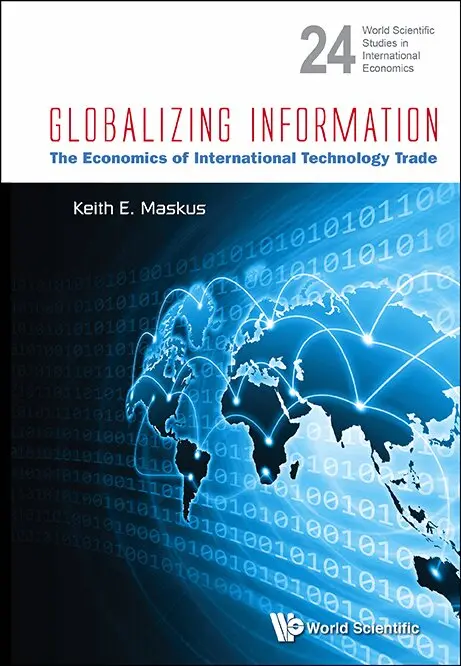
Del 24 - World Scientific Studies in International Economics
Globalizing Information: The Economics Of International Technology Trade
Inbunden, Engelska, 2014
2 294 kr
Skickas inom 5-8 vardagar
This volume presents important analyses of international trade, technology transfer and the global economics of intellectual property rights through selected and key works of Keith E Maskus, spanning his long career. The book includes 17 chapters, ranging from theoretical modeling to empirical and statistical analysis, and policy contributions. Readers will find significant questions addressed in the determinants of trade, foreign direct investment, patents and trade, licensing, parallel imports, and innovation. These chapters span the scope of economic analysis of the globalization of intellectual property and technology transfer, a field in which the author has been a pre-eminent presence.