Kenji Takizawa – författare
1 270 kr
Skickas inom 5-8 vardagar
1 480 kr
Läs direkt efter köp
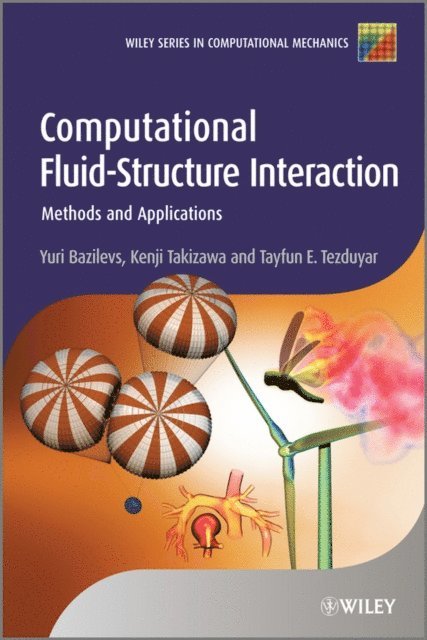
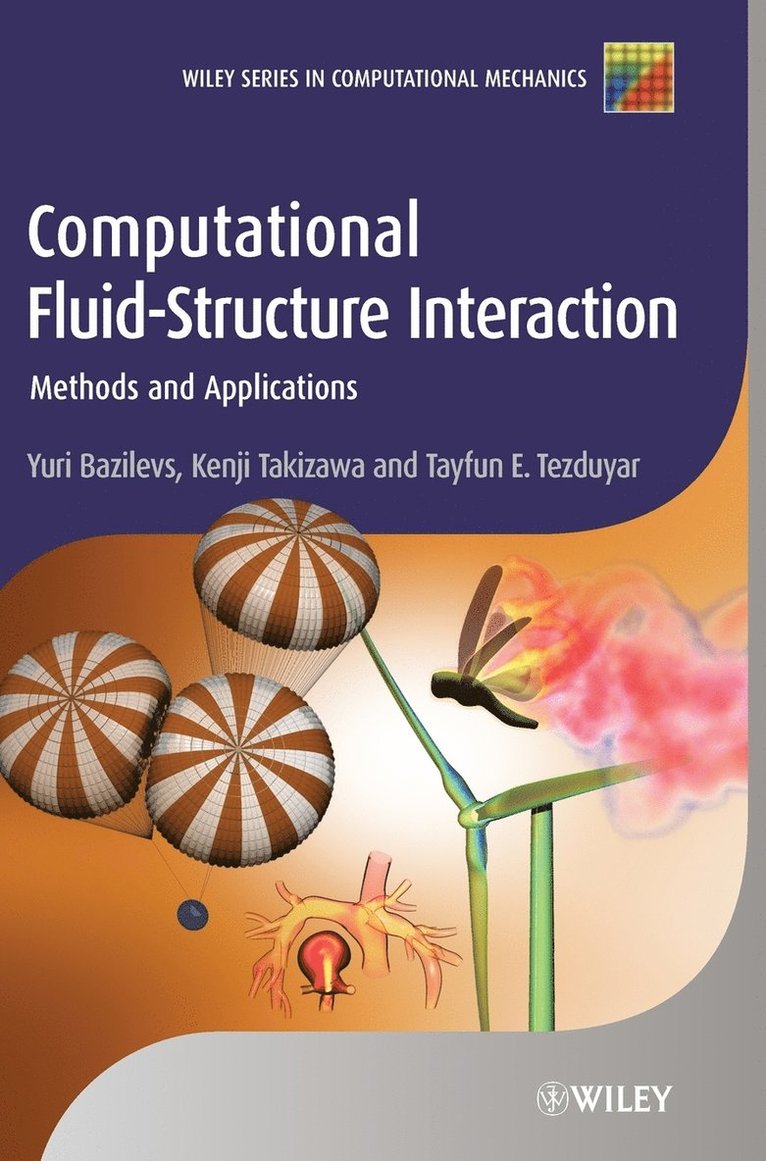
Computational Fluid-Structure Interaction: Methods and Applications takes the reader from the fundamentals of computational fluid and solid mechanics to the state-of-the-art in computational FSI methods, special FSI techniques, and solution of real-world problems. Leading experts in the field present the material using a unique approach that combines advanced methods, special techniques, and challenging applications.
This book begins with the differential equations governing the fluid and solid mechanics, coupling conditions at the fluid–solid interface, and the basics of the finite element method. It continues with the ALE and space–time FSI methods, spatial discretization and time integration strategies for the coupled FSI equations, solution techniques for the fully-discretized coupled equations, and advanced FSI and space–time methods. It ends with special FSI techniques targeting cardiovascular FSI, parachute FSI, and wind-turbine aerodynamics and FSI.
Key features:
First book to address the state-of-the-art in computational FSI Combines the fundamentals of computational fluid and solid mechanics, the state-of-the-art in FSI methods, and special FSI techniques targeting challenging classes of real-world problems Covers modern computational mechanics techniques, including stabilized, variational multiscale, and space–time methods, isogeometric analysis, and advanced FSI coupling methods Is in full color, with diagrams illustrating the fundamental concepts and advanced methods and with insightful visualization illustrating the complexities of the problems that can be solved with the FSI methods covered in the book. Authors are award winning, leading global experts in computational FSI, who are known for solving some of the most challenging FSI problemsComputational Fluid-Structure Interaction: Methods and Applications is a comprehensive reference for researchers and practicing engineers who would like to advance their existing knowledge on these subjects. It is also an ideal text for graduate and senior-level undergraduate courses in computational fluid mechanics and computational FSI.
1 534 kr
Läs direkt efter köp
Computational Fluid-Structure Interaction: Methods and Applications takes the reader from the fundamentals of computational fluid and solid mechanics to the state-of-the-art in computational FSI methods, special FSI techniques, and solution of real-world problems. Leading experts in the field present the material using a unique approach that combines advanced methods, special techniques, and challenging applications.
This book begins with the differential equations governing the fluid and solid mechanics, coupling conditions at the fluid–solid interface, and the basics of the finite element method. It continues with the ALE and space–time FSI methods, spatial discretization and time integration strategies for the coupled FSI equations, solution techniques for the fully-discretized coupled equations, and advanced FSI and space–time methods. It ends with special FSI techniques targeting cardiovascular FSI, parachute FSI, and wind-turbine aerodynamics and FSI.
Key features:
First book to address the state-of-the-art in computational FSI Combines the fundamentals of computational fluid and solid mechanics, the state-of-the-art in FSI methods, and special FSI techniques targeting challenging classes of real-world problems Covers modern computational mechanics techniques, including stabilized, variational multiscale, and space–time methods, isogeometric analysis, and advanced FSI coupling methods Is in full color, with diagrams illustrating the fundamental concepts and advanced methods and with insightful visualization illustrating the complexities of the problems that can be solved with the FSI methods covered in the book. Authors are award winning, leading global experts in computational FSI, who are known for solving some of the most challenging FSI problemsComputational Fluid-Structure Interaction: Methods and Applications is a comprehensive reference for researchers and practicing engineers who would like to advance their existing knowledge on these subjects. It is also an ideal text for graduate and senior-level undergraduate courses in computational fluid mechanics and computational FSI.
1 830 kr
Skickas inom 5-8 vardagar
2 366 kr
Läs direkt efter köp
Space–Time Computational Flow Analysis (STCFA) was developed in 1990 in the context of flows with moving boundaries and interfaces, which is a wide class of problems that includes fluid–particle interactions, fluid–structure interactions (FSI), and free-surface and multi-fluid flows. It is a computational framework made of unconventional methods, which have evolved over the years as more unconventional methods were introduced to increase its scope and accuracy. It brought first-of-its-kind solutions in many classes of problems, including fluid–particle interactions in particle-laden flows, FSI in parachute aerodynamics, flapping-wing aerodynamics of an actual locust, ventricle-valve-aorta flow analysis, and car and tire aerodynamics. With these successes in so many classes of problems, the STCFA has reached a level of remarkable sophistication, scope, and practical value.
This monograph presents, for the first time, a chronological catalog of STCFA methods and solutions from their development to the present. Part I focuses on the STCFA in the context of finite element analysis, and Part II in the context of isogeometric analysis. The methods presented include complementary general-purpose methods that were introduced in the evolution of STCFA. All researchers working on or interested in space–time computations in fluid mechanics, FSI, and solid mechanics, including graduate students, will benefit from the wealth of powerful computational methods and impressive solutions they will find in the book.
2 657 kr
Kommande
1 294 kr
Skickas inom 10-15 vardagar
1 733 kr
Läs direkt efter köp
1 294 kr
Skickas inom 10-15 vardagar