Kevin Zhang - Böcker
Visar alla böcker från författaren Kevin Zhang. Handla med fri frakt och snabb leverans.
4 produkter
4 produkter
576 kr
Skickas inom 10-15 vardagar
First Published in 2006.
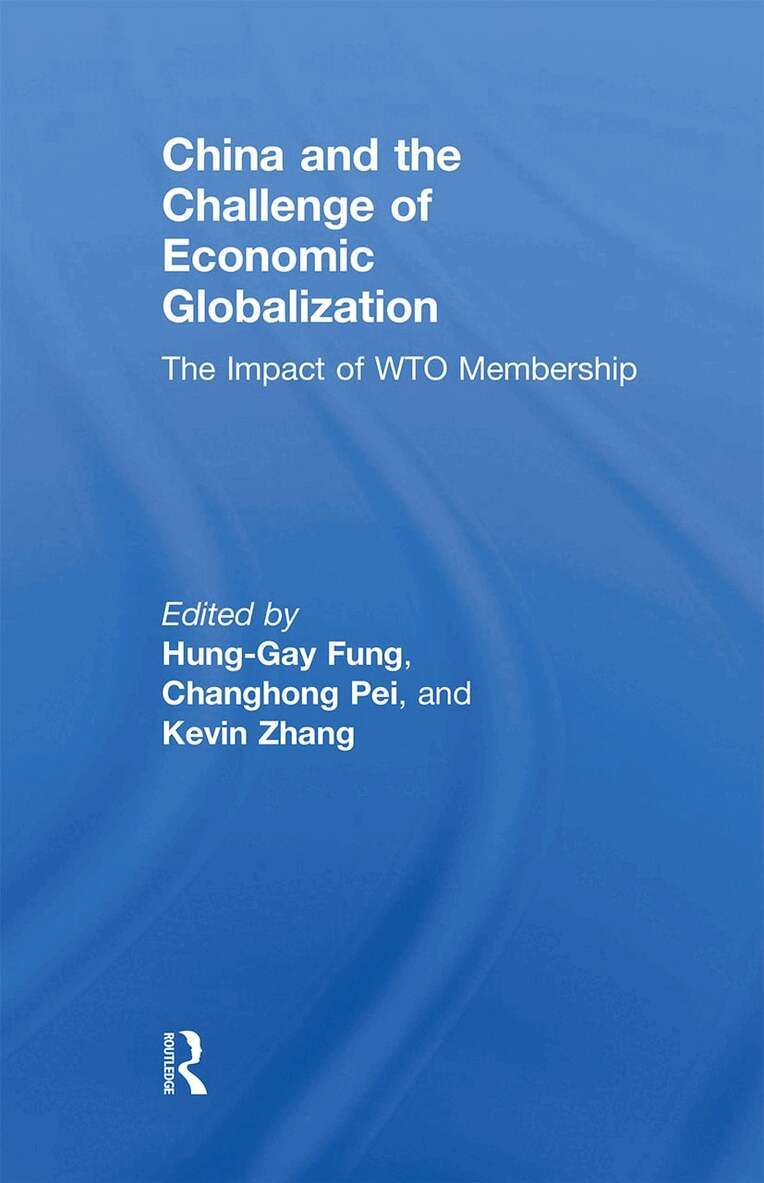
China and the Challenge of Economic Globalization
The Impact of WTO Membership
Inbunden, Engelska, 2015
3 269 kr
Skickas inom 10-15 vardagar
China emerged as the largest recipient of foreign direct investment (FDI) and the fifth largest trading nation in the world in 2002. China’s entry into the World Trade Organization (WTO) represents a huge stride forward in its reform efforts. These reforms include liberalization and modernization of China’s economy (in industrial, services, and agricultural sectors) and trading activities.China’s growing economy, its international trade, and its large inward FDI have significantly affected the growth of global trade, the distribution of global direct investments, and the pace of expansion of global output. There is no other country in history, as a WTO member, to have achieved such expansion in a comparable time period. China is expected to be influential in future rounds of WTO trade negotiations. As the only major trading nation that is not classified as an advanced industrial economy, China is bringing an unparalleled perspective to the negotiations and exerting its power on matters important to its trade. China, as a new WTO member, is posing momentous opportunities and challenges to the United States and other countries.A study of the Chinese economy after entering the WTO should be of importance to practitioners, scholars, and policymakers because of China’s vast size, its rapid growth in foreign trade and FDI inflows, and the unprecedented speed of its integration into the world economy. The high quality of the chapters within this volume and their authors’ expertise unite to make this book a most timely contribution to our understanding of China’s rapidly changing economy and its transformation toward globalization after entering the WTO.This volume is divided into four parts. The first part deals with economic performance after China’s accession to the World Trade Organization. The second part relates to the WTO and China’s economic welfare. The third part deals with China’s financial reforms and capital markets, and the last part discusses China’s industrial and agricultural development. In total, we have eighteen chapters that will shed light on the Chinese economy and the challenges posed by WTO membership.
1 585 kr
Skickas inom 10-15 vardagar
Kevin Zhang Advancement of semiconductor technology has driven the rapid growth of very large scale integrated (VLSI) systems for increasingly broad applications, incl- ing high-end and mobile computing, consumer electronics such as 3D gaming, multi-function or smart phone, and various set-top players and ubiquitous sensor and medical devices. To meet the increasing demand for higher performance and lower power consumption in many different system applications, it is often required to have a large amount of on-die or embedded memory to support the need of data bandwidth in a system. The varieties of embedded memory in a given system have alsobecome increasingly more complex, ranging fromstatictodynamic and volatile to nonvolatile. Among embedded memories, six-transistor (6T)-based static random access memory (SRAM) continues to play a pivotal role in nearly all VLSI systems due to its superior speed and full compatibility with logic process technology. But as the technology scaling continues, SRAM design is facing severe challenge in mainta- ing suf?cient cell stability margin under relentless area scaling. Meanwhile, rapid expansion in mobile application, including new emerging application in sensor and medical devices, requires far more aggressive voltage scaling to meet very str- gent power constraint. Many innovative circuit topologies and techniques have been extensively explored in recent years to address these challenges.
112 kr
Skickas inom 7-10 vardagar
Until approximately two decades ago, the Democratic Action Party (DAP) struggled to make inroads in Johor due to: (1) the unique historical developments in the state, which benefited its primary opponent Barisan Nasional (BN), and (2) the decentralized party structure in Johor with party branches serving as the main player responsible for grassroots mobilization and campaigning, which resulted in an underdeveloped and less cohesive state party structure. Despite Lee Kaw playing a crucial leadership role for the nascent party to take root in the state, Johor remained in the periphery during the initial decades of the party's establishment. The party managed to achieve some electoral success only in central Johor around the Kluang. The party achieved a rare breakthrough in Johor during the 1990 General Election when numerous Chinese educationalists allied with the DAP under the call of then Dong Zong chairman Lim Fong Seng. However, the national alliance frayed soon after, with the DAP losing its momentum in Johor by the next general election. Dr Boo Cheng Hau inherited the decentralized state leadership structure when he became the DAP Johor chairman in 2005. Under Dr Boo's leadership the party prioritized welfare provision and constituency services in several state constituencies, particularly Skudai (in Gelang Patah) and Bentayan (in Bakri).