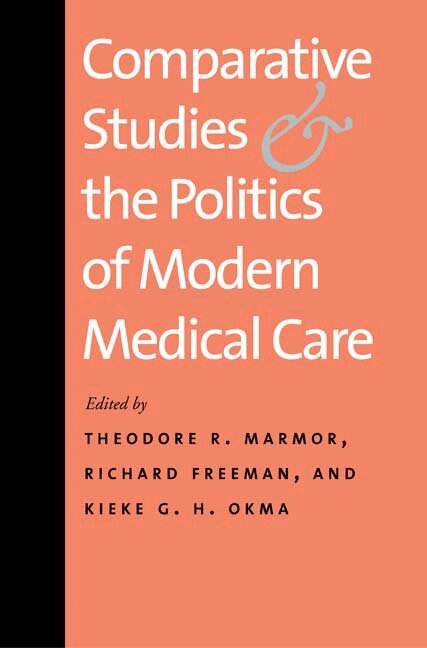
This book offers a timely account of health reform struggles in developed democracies. The editors, leading experts in the field, have brought together a group of distinguished scholars to explore the ambitions and realities of health care regulation, financing, and delivery across countries. These wide-ranging essays cover policy debates and reforms in Canada, Germany, Holland, the United Kingdom, and the United States, as well as separate treatments of some of the most prominent issues confronting policy makers. These include primary care, hospital care, long-term care, pharmaceutical policy, and private health insurance. The authors are attentive throughout to the ways in which cross-national, comparative research may inform national policy debates not only under the Obama administration but across the world.
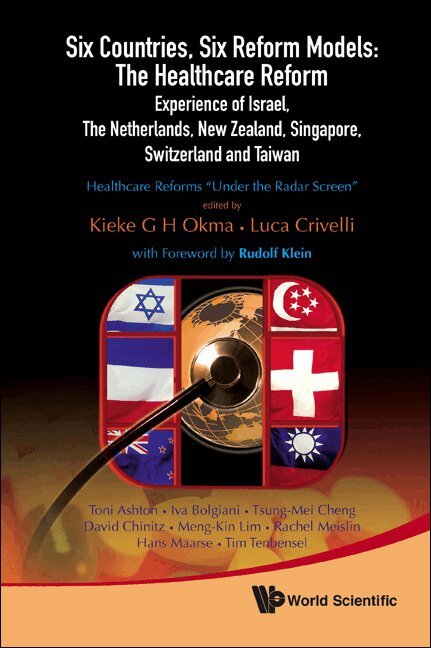
This book presents the healthcare reform experiences of six small- to mid-sized, but dynamic, economies spanning the Asia-Pacific, the Middle East and Europe. Usually not given serious consideration in major international comparisons because of their small size, each in fact provides a fascinating case study that illuminates the understanding of the dynamics of healthcare reform. Although dissimilar in historical and cultural backgrounds, they share some important features: all faced very similar pressures for change in the 1970s and 1980s; all considered a very similar range of policy options; and all did not only discuss but actually implemented fundamental changes in their healthcare funding, organization, contracting and governance structures with strikingly different outcomes.All of the authors have lived and worked in one or more of the countries studied in this volume. The analytic frameworks they use reflect their broad range of professional and disciplinary backgrounds in health economics and political science. Beyond mere descriptions of reform processes and superficial analyses based on aggregate data from the usual OECD or WHO sources, they seek to understand — and explain — the variations in country experiences by examining the politico-socio-economic factors driving health reform as seen through the respective country lenses. In coming together in this unique international collaboration, they make an important contribution to the growing field of international comparative health policy studies.Contributors: Tsung-Mei Cheng (Princeton University, USA), David Chinitz (The Hebrew University of Jerusalem, Israel), Luca Crivelli and Iva Bolgiani (University of Lugano, Switzerland), Meng-Kin Lim (National University of Singapore, Singapore), Kieke G H Okma and Hans Maarse (Maastricht University, The Netherlands), Toni Ashton and Tim Tenbensel (University of Auckland, New Zealand).
This book offers a timely account of health reform struggles in developed democracies. The editors, leading experts in the field, have brought together a group of distinguished scholars to explore the ambitions and realities of health care regulation, financing, and delivery across countries. These wide-ranging essays cover policy debates and reforms in Canada, Germany, Holland, the United Kingdom, and the United States, as well as separate treatments of some of the most prominent issues confronting policy makers. These include primary care, hospital care, long-term care, pharmaceutical policy, and private health insurance. The authors are attentive throughout to the ways in which cross-national, comparative research may inform national policy debates not only under the Obama administration but across the world.
This book presents the healthcare reform experiences of six small- to mid-sized, but dynamic, economies spanning the Asia-Pacific, the Middle East and Europe. Usually not given serious consideration in major international comparisons because of their small size, each in fact provides a fascinating case study that illuminates the understanding of the dynamics of healthcare reform. Although dissimilar in historical and cultural backgrounds, they share some important features: all faced very similar pressures for change in the 1970s and 1980s; all considered a very similar range of policy options; and all did not only discuss but actually implemented fundamental changes in their healthcare funding, organization, contracting and governance structures with strikingly different outcomes.All of the authors have lived and worked in one or more of the countries studied in this volume. The analytic frameworks they use reflect their broad range of professional and disciplinary backgrounds in health economics and political science. Beyond mere descriptions of reform processes and superficial analyses based on aggregate data from the usual OECD or WHO sources, they seek to understand — and explain — the variations in country experiences by examining the politico-socio-economic factors driving health reform as seen through the respective country lenses. In coming together in this unique international collaboration, they make an important contribution to the growing field of international comparative health policy studies.Contributors: Tsung-Mei Cheng (Princeton University, USA), David Chinitz (The Hebrew University of Jerusalem, Israel), Luca Crivelli and Iva Bolgiani (University of Lugano, Switzerland), Meng-Kin Lim (National University of Singapore, Singapore), Kieke G H Okma and Hans Maarse (Maastricht University, The Netherlands), Toni Ashton and Tim Tenbensel (University of Auckland, New Zealand).