Kiene Brillenburg Wurth - Böcker
Visar alla böcker från författaren Kiene Brillenburg Wurth. Handla med fri frakt och snabb leverans.
6 produkter
6 produkter
350 kr
Skickas inom 10-15 vardagar
Musically Sublime rewrites musically the history and philosophy of the sublime. Music enables us to reconsider the traditional course of sublime feeling on a track from pain to pleasure. Resisting the notion that there is a single format for sublime feeling, Wurth shows how, from the mid eighteenth century onward, sublime feeling is, instead, constantly rearticulated in a complex interaction with musicality. Wurth takes as her point of departure Immanuel Kant's Critique of Judgment and Jean-François Lyotard's aesthetic writings of the 1980s and 1990s. Kant framed the sublime narratively as an epic of self-transcendence. By contrast, Lyotard sought to substitute open immanence for Kantian transcendence, yet he failed to deconstruct the Kantian epic. The book performs this deconstruction by juxtaposing eighteenth- and nineteenth-century conceptions of the infinite, Sehnsucht, the divided self, and unconscious drives with contemporary readings of instrumental music. Critically assessing Edmund Burke, James Usher, E.T.A. Hoffmann, Novalis, Friedrich Hölderlin, Arthur Schopenhauer, Richard Wagner, and Friedrich Nietzsche, this book re-presents the sublime as a feeling that defers resolution and hangs suspended between pain and pleasure. Musically Sublime rewrites the mathematical sublime as différance, while it redresses the dynamical sublime as trauma: unending, undetermined, unresolved.Whereas most musicological studies in this area have focused on traces of the Kantian sublime in Handel, Haydn, and Beethoven, this book calls on the nineteenth-century theorist Arthur Seidl to analyze the sublime of, rather than in, music. It does so by invoking Seidl's concept of formwidrigkeit ("form-contrariness") in juxtaposition with Romantic piano music, (post)modernist musical minimalisms, and Lyotard's postmodern sublime. It presents a sublime of matter, rather than form-performative rather than representational. In doing so, Musically Sublime shows that the binary distinction Lyotard posits between the postmodern and romantic sublime is finally untenable.
1 174 kr
Skickas inom 10-15 vardagar
Since the earlier twentieth century, literary genres have traveled across magnetic, wireless, and electronic planes. Literature may now be anything from acoustic poetry and oral performance to verbal–visual constellations in print and on screen, cinematic narratives, or electronic textualities that range from hypertext to Flash.New technologies have left their imprint on literature as a paper-based medium, and vice versa. This volume explores the interactions between literature and screenbased media over the past three decades. How has literature turned to screen, how have screens undone the tyranny of the page as a medium of literature, and how have screens affected the page in literary writing? This volume answers these questions by uniquely integrating perspectives from digital literary studies, on the one hand, and film and literature studies, on the other."Page" and "screen" are familiar catchwords in both digital literary studies and film and literature studies. The contributors reassess literary practice at the edges of paper, electronic media, and film. They show how the emergence of a new medium in fact reinvigorates the book and the page as literary media, rather than signaling their impending death.While previous studies in this field have been restricted to the digitization of literature alone, this volume shows the continuing relevance of film as a cultural medium for contemporary literature. Its integrative approach allows readers to situate current shifts within the literary field in a wider, long-term perspective.
477 kr
Skickas inom 7-10 vardagar
Since the earlier twentieth century, literary genres have traveled across magnetic, wireless, and electronic planes. Literature may now be anything from acoustic poetry and oral performance to verbal–visual constellations in print and on screen, cinematic narratives, or electronic textualities that range from hypertext to Flash.New technologies have left their imprint on literature as a paper-based medium, and vice versa. This volume explores the interactions between literature and screenbased media over the past three decades. How has literature turned to screen, how have screens undone the tyranny of the page as a medium of literature, and how have screens affected the page in literary writing? This volume answers these questions by uniquely integrating perspectives from digital literary studies, on the one hand, and film and literature studies, on the other."Page" and "screen" are familiar catchwords in both digital literary studies and film and literature studies. The contributors reassess literary practice at the edges of paper, electronic media, and film. They show how the emergence of a new medium in fact reinvigorates the book and the page as literary media, rather than signaling their impending death.While previous studies in this field have been restricted to the digitization of literature alone, this volume shows the continuing relevance of film as a cultural medium for contemporary literature. Its integrative approach allows readers to situate current shifts within the literary field in a wider, long-term perspective.
1 808 kr
Skickas inom 10-15 vardagar
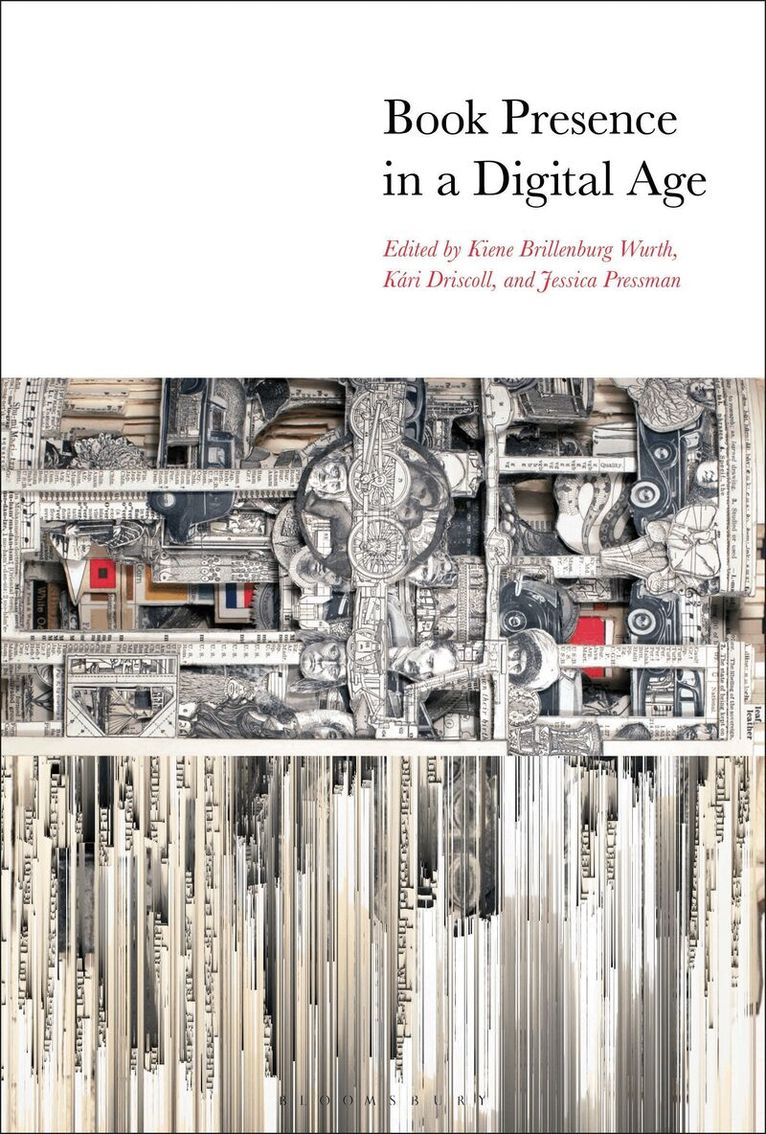
Contrary to the apocalyptic pronouncements of paper media's imminent demise in the digital age, there has been a veritable surge of creative reimaginings of books as bearers of the literary. From typographic experiments (Mark Z. Danielewski’s House of Leaves, Steven Hall’s The Raw Shark Texts) to accordion books (Anne Carson’s Nox), from cut ups (Jonathan Safran Foer’s Tree of Codes) to collages (Graham Rawle’s Woman’s World), from erasures (Mary Ruefle’s A Little White Shadow) to mixups (Simon Morris’s The Interpretations of Dreams), print literature has gone through anything but a slow, inevitable death. In fact, it has re-invented itself materially.Starting from this idea of media plurality, Book Presence in a Digital Age explores the resilience of print literatures, book art, and zines in the late age of print from a contemporary perspective, while incorporating longer-term views on media archeology and media change. Even as it focuses on the materiality of books and literary writing in the present, Book Presence also takes into consideration earlier 20th-century "moments" of media transition, developing the concepts of presence and materiality as analytical tools to perform literary criticism in a digital age. Bringing together leading scholars, artists, and publishers, Book Presence in a Digital Age offers a variety of perspectives on the past, present, and future of the book as medium, the complex relationship of materiality to virtuality, and of the analog to the digital.
546 kr
Skickas inom 10-15 vardagar
Contrary to the apocalyptic pronouncements of paper media's imminent demise in the digital age, there has been a veritable surge of creative reimaginings of books as bearers of the literary. From typographic experiments (Mark Z. Danielewski’s House of Leaves, Steven Hall’s The Raw Shark Texts) to accordion books (Anne Carson’s Nox), from cut ups (Jonathan Safran Foer’s Tree of Codes) to collages (Graham Rawle’s Woman’s World), from erasures (Mary Ruefle’s A Little White Shadow) to mixups (Simon Morris’s The Interpretations of Dreams), print literature has gone through anything but a slow, inevitable death. In fact, it has re-invented itself materially.Starting from this idea of media plurality, Book Presence in a Digital Age explores the resilience of print literatures, book art, and zines in the late age of print from a contemporary perspective, while incorporating longer-term views on media archeology and media change. Even as it focuses on the materiality of books and literary writing in the present, Book Presence also takes into consideration earlier 20th-century "moments" of media transition, developing the concepts of presence and materiality as analytical tools to perform literary criticism in a digital age. Bringing together leading scholars, artists, and publishers, Book Presence in a Digital Age offers a variety of perspectives on the past, present, and future of the book as medium, the complex relationship of materiality to virtuality, and of the analog to the digital.
556 kr
Skickas inom 10-15 vardagar
This innovative introduction to literary studies takes 'the life of texts' as its overarching frame. It provides a conceptual and methodological toolbox for analysing novels, poems, and all sorts of other texts as they circulate in oral, print, and digital form. It shows how texts inspire each other, and how stories migrate across media. It explains why literature has been interpreted in different ways across time. Finally, it asks why some texts fascinate people so much that they are reproduced and passed on to others in the form of new editions, in adaptations to film and theatre, and, last but not least, in the ways we look at the world and act out our lives. The Life of Texts is designed around particular issues rather than the history of the discipline as such. Each chapter concentrates on a different aspect of 'the life of texts' and introduces the key debates and concepts relevant to its study. The issues discussed range from aesthetics and narrative to intertextuality and intermediality, from reading practices to hermeneutics and semiotics, popular culture to literary canonisation, postcolonial criticism to cultural memory. Key concepts and schools in the field have been highlighted in the text and then collected in a glossary for ease of reference. All chapters are richly illustrated with examples from different language areas.