Kim A. Bard - Böcker
Visar alla böcker från författaren Kim A. Bard. Handla med fri frakt och snabb leverans.
5 produkter
5 produkter
416 kr
Tillfälligt slut
1 784 kr
Skickas inom 7-10 vardagar
What special qualities of mind set the great apes apart from other nonhuman primates, and indeed from ourselves? In this book, field and laboratory researchers show that the great apes have high level abilities in both social and ecological domains, including tool use, pretense, self-awareness, deception, consolation, teaching and culture itself. Great apes are also shown to be capable of thinking at symbolic levels, traditionally considered to be uniquely human. Here, the mechanisms involved in building these abilities - especially the lengthy developmental and 'enculturation' processes - are emphasized, showing how new discoveries are changing views on how primates and human intelligence evolved. This book is for anyone interested in current research and theoretical views of great ape cognition.
744 kr
Skickas inom 7-10 vardagar
What special qualities of mind set the great apes apart from other nonhuman primates, and indeed from ourselves? In this book, field and laboratory researchers show that the great apes have high level abilities in both social and ecological domains, including tool use, pretense, self-awareness, deception, consolation, teaching and culture itself. Great apes are also shown to be capable of thinking at symbolic levels, traditionally considered to be uniquely human. Here, the mechanisms involved in building these abilities - especially the lengthy developmental and 'enculturation' processes - are emphasized, showing how new discoveries are changing views on how primates and human intelligence evolved. This book is for anyone interested in current research and theoretical views of great ape cognition.
485 kr
Kommande
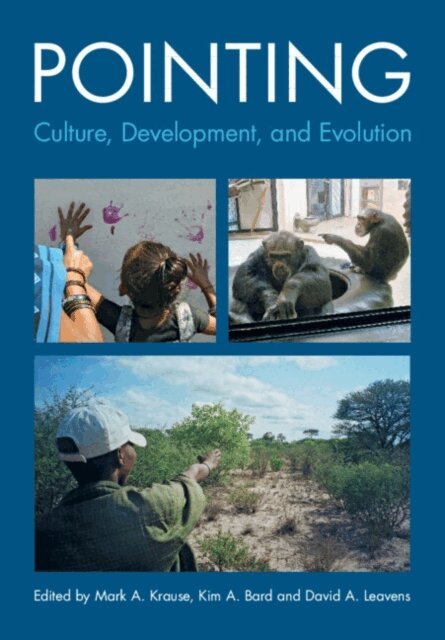
Pointing is a fundamental gesture that connects individuals with their social and physical worlds. Whether communicating information about the external environment or serving to clarify to whom or what someone is referring, pointing may appear to be a uniquely human and universal action. However, it develops in varied social and cultural contexts, and even some nonhuman species point and can understand pointing cues. While there has been substantial research on the cultural, developmental, and evolutionary aspects of pointing, these perspectives remain fragmented. This book bridges this gap by bringing together leading scholars from cognitive psychology, evolutionary anthropology and biology, animal behavior, developmental psychology, and comparative psychology to synthesize current findings, highlight emerging directions, and provide students and researchers with a comprehensive view of the field.
1 521 kr
Kommande
Pointing is a fundamental gesture that connects individuals with their social and physical worlds. Whether communicating information about the external environment or serving to clarify to whom or what someone is referring, pointing may appear to be a uniquely human and universal action. However, it develops in varied social and cultural contexts, and even some nonhuman species point and can understand pointing cues. While there has been substantial research on the cultural, developmental, and evolutionary aspects of pointing, these perspectives remain fragmented. This book bridges this gap by bringing together leading scholars from cognitive psychology, evolutionary anthropology and biology, animal behavior, developmental psychology, and comparative psychology to synthesize current findings, highlight emerging directions, and provide students and researchers with a comprehensive view of the field.