Kjell Havnevik – författare
Visar alla böcker från författaren Kjell Havnevik. Handla med fri frakt och snabb leverans.
7 produkter
7 produkter
Häftad, Engelska, 2011
452 kr
Skickas inom 10-15 vardagar
The issue of biofuels has already been much debated, but the focus to date has largely been on Latin America and deforestation - this highly original work breaks fresh ground in looking at the African perspective. Most African governments see biofuels as having the potential to increase agricultural productivity and export incomes and thus strengthen their national economies, improving energy balances and rural employment. At the same time climate change may be addressed through reduction of green house gas emissions.There are, however, a number of uncertainties mounting that challenge this scenario. Using cutting-edge empirical case studies, this knowledge gap is addressed in a variety of chapters examining the effects of large-scale biofuel production on African agriculture. In particular, 'land grabbing' and food security issues are scrutinised, both of which have become vital topics in regard to the environmental and developmental governance of African countries.A revealing book for anyone wishing to understand the startling impact of biofuels and land grabbing on Africa.
Inbunden, Engelska, 2011
1 259 kr
Skickas inom 10-15 vardagar
The issue of biofuels has already been much debated, but the focus to date has largely been on Latin America and deforestation - this highly original work breaks fresh ground in looking at the African perspective. Most African governments see biofuels as having the potential to increase agricultural productivity and export incomes and thus strengthen their national economies, improving energy balances and rural employment. At the same time climate change may be addressed through reduction of green house gas emissions.There are, however, a number of uncertainties mounting that challenge this scenario. Using cutting-edge empirical case studies, this knowledge gap is addressed in a variety of chapters examining the effects of large-scale biofuel production on African agriculture. In particular, 'land grabbing' and food security issues are scrutinised, both of which have become vital topics in regard to the environmental and developmental governance of African countries.A revealing book for anyone wishing to understand the startling impact of biofuels and land grabbing on Africa.
E-bok
PDF, Engelska, 2011484 kr
Läs direkt efter köp
The issue of biofuels has already been much debated, but the focus to date has largely been on Latin America and deforestation - this highly original work breaks fresh ground in looking at the African perspective. Most African governments see biofuels as having the potential to increase agricultural productivity and export incomes and thus strengthen their national economies, improving energy balances and rural employment. At the same time climate change may be addressed through reduction of green house gas emissions.There are, however, a number of uncertainties mounting that challenge this scenario. Using cutting-edge empirical case studies, this knowledge gap is addressed in a variety of chapters examining the effects of large-scale biofuel production on African agriculture. In particular, 'land grabbing' and food security issues are scrutinised, both of which have become vital topics in regard to the environmental and developmental governance of African countries.A revealing book for anyone wishing to understand the startling impact of biofuels and land grabbing on Africa.
E-bok
Engelska, 2011484 kr
Läs direkt efter köp
The issue of biofuels has already been much debated, but the focus to date has largely been on Latin America and deforestation - this highly original work breaks fresh ground in looking at the African perspective. Most African governments see biofuels as having the potential to increase agricultural productivity and export incomes and thus strengthen their national economies, improving energy balances and rural employment. At the same time climate change may be addressed through reduction of green house gas emissions.There are, however, a number of uncertainties mounting that challenge this scenario. Using cutting-edge empirical case studies, this knowledge gap is addressed in a variety of chapters examining the effects of large-scale biofuel production on African agriculture. In particular, 'land grabbing' and food security issues are scrutinised, both of which have become vital topics in regard to the environmental and developmental governance of African countries.A revealing book for anyone wishing to understand the startling impact of biofuels and land grabbing on Africa.
Del 7 - Africa-Europe Group for Interdisciplinary Studies
African Engagements
Africa Negotiating an Emerging Multipolar World
Häftad, Engelska, 2011
1 318 kr
Skickas inom 5-8 vardagar
With the end of the Cold War, the world seemed to move from a bipolar to a unipolar system, with the neoliberal West globally imposing its laws. However, it has been acknowledged that other actors, such as China, India and Brazil, have become increasingly influential, helping to lead to a new multipolarity at the global level. The question of what this emerging multipolarity means for Africa is important. Will Africa become crushed in a mounting struggle over raw materials and political hegemony between superpowers and fall victim to a new scramble for Africa? Or does this new historic conjuncture offer African countries and groups greater room for negotiation and manoeuvring, eventually leading to stronger democracy and enhanced growth? The chapters in this volume offer food for thought on how Africa’s engagements with the world are currently being reshaped and revalued, and, importantly—on whose terms?
Del 16 - Africa-Europe Group for Interdisciplinary Studies
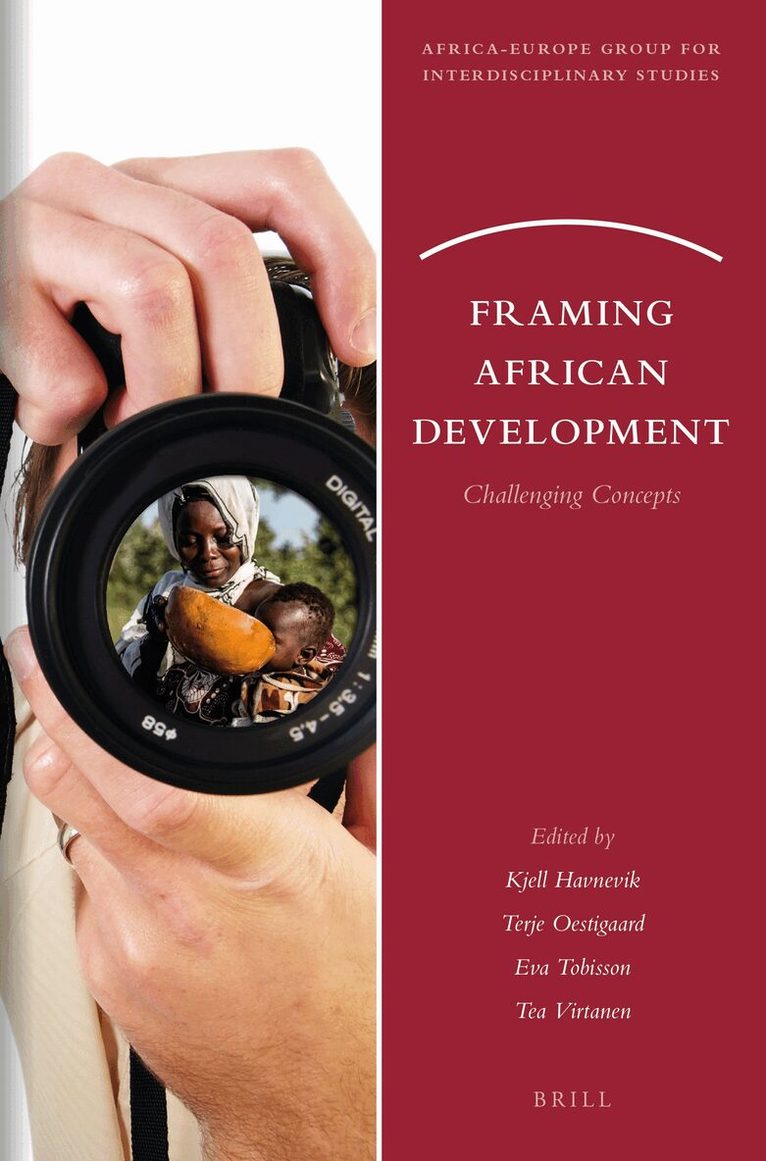
Framing African Development
Challenging Concepts
Häftad, Engelska, 2015
1 306 kr
Skickas inom 5-8 vardagar
This book discusses and challenges concepts that are widely used in research and policy related to development issues in Africa. The main rationale for such an undertaking is that the concepts that are used to understand and define the world in general and Africa in particular are not merely describing social, economic and political processes and events; they are also largely framing these very same processes. Thus, the concepts by which we structure the world will implicitly or explicitly give premises for policies and practices; limiting or favouring certain types of actions and frameworks of interpretation and understanding in various contexts. It is therefore important to challenge commonly held conceptions about framing African development. Contributors include: Deborah Fahy Bryceson, Rosalind Eyben, Amanda Hammar, Kjell Havnevik, Mats Hårsmar, Terje Oestigaard and Rune Skarstein
E-bok
PDF, Engelska, 2010825 kr
Läs direkt efter köp
This book is the first comprehensive contribution to understanding the character of important societal transitions in Tanzania during Benjamin Mkapa's presidency (1995- 2005). The analyses of the trajectory of these transitions are conducted against the background of the development model of Tanzanian's first president, Julius Nyerere (1961-1985), a model with lasting influence on the country. This approach enables an understanding of continuities and discontinuities in Tanzania over time in areas such as development strategy an ideology, agrarian-land, gender and forestry issues, economic liberalization, development assistance, corruption and political change. The period of Mkapa's presidency is particularly important because it represents the first phase of Tanzania's multi- party political system. Mkapa's government initially faced a gloomy economic situation. Although Mkapa's crusade against corruption lost direction, his presidency was characterised by relatively high growth rates and a stable macro-economy. Rural and agrarian transitions were dominated by diversification rather than productivity growth and transformation. Rural attitudes in favour of land markets emerged only slowly but formal land disputes showed more respect for women's rights. Some space emerged for widening local participation in forest management, but rural dynamics was mainly found in trading settlements feeding on economic liberalization and artisanal mining. The transitions documented and analysed of Mkapa's presidency, however, indicate only limited transformational change. Rural poverty is therefore likely to remain deep and the sustainability of economic development to be at risk in the future. Mkapa was, however, able to protect the legacy of peace and political stability of Nyerere, but there were nevertheless important challenges to the first multiparty elections and governance, and particularly in Zanzibar. The post- script (covering 2005 2010), indicates that the incumbent president, Jakaya Kikwete, has yet to prove that he can change this legacy of Mkapa. Co-published with the Nordic Africa Institute and the Sokoine University of Agriculture, the contributions to the eleven chapters of this book are evenly shared between Tanzanian, Nordic and other European researchers with a long-term commitment to Tanzanian development research. he book is dedicated to the youth of Tanzania.