Klaus Kümmerer - Böcker
Visar alla böcker från författaren Klaus Kümmerer. Handla med fri frakt och snabb leverans.
12 produkter
12 produkter
1 738 kr
Skickas inom 5-8 vardagar
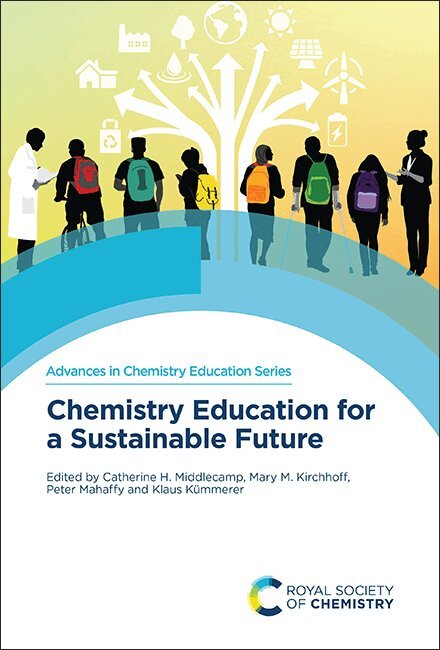
Now and in the years ahead, we need to sustain all life on our planet. How do we do this? Chemistry, the science of materials, provides part of the answer to this question. Practicing chemistry in a green and sustainable manner is essential to achieving a sustainable future. However, sustainability concepts seldom are taught in the chemistry classroom. For example, the connections between chemistry and systems thinking, planetary boundaries, sustainable development goals, and ethics are not widely taught, yet these all can inform how we can sustain life now and in the future.Chemistry Education for a Sustainable Future addresses what our students need to learn today to help all people and the planet thrive. This book provides a logical sequence of topics and offers chemistry educators practical strategies to equip today’s students with the tools needed to become scientists and citizens who can responsibly contribute to a sustainable future.
Del 45 - Handbook of Environmental Chemistry
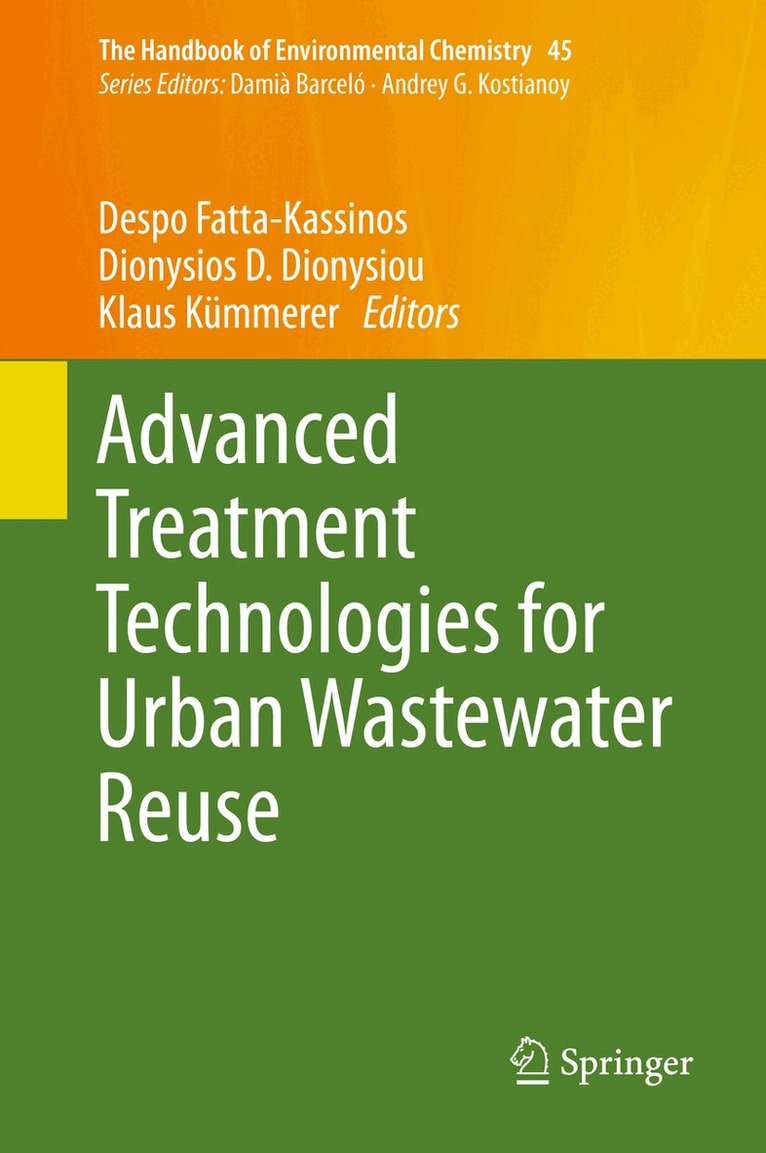
Advanced Treatment Technologies for Urban Wastewater Reuse
Inbunden, Engelska, 2016
2 100 kr
Skickas inom 10-15 vardagar
This volume offers a detailed overview of currently applied and tested wastewater treatment technologies and the integration of advanced processes to remove trace organic contaminants and microorganisms. It discusses the potential of enhanced biological treatment to produce effluent suitable for reuse, new processes for urban wastewater disinfection and the reduction of antibiotic resistant bacteria, as well as the effect of advanced oxidation processes on wastewater microbiome and chemical contaminants. It also presents membrane bioreactors, moving bed bioreactors, light and solar driven technologies, ozonation and immobilised heterogeneous photocatalysis and provides an evaluation of the potential of constructed wetlands integrated with advanced oxidation technologies to produce wastewater safe for reuse. Furthermore, the volume discusses water reuse issues and standards, the status of membrane bioreactors applications, and the treatment of reverse osmosis concentrate for enhancedwater recovery during wastewater treatment. Finally, it presents recent developments in potable water reuse and addresses various important issues in this framework, like the proper protection of public health, reliability and monitoring. This volume is of interest to experts, scientists and practitioners from various fields of research, including analytical and environmental chemistry, toxicology and environmental and sanitary engineering, as well as treatment plant operators and policymakers.
Del 44 - Handbook of Environmental Chemistry
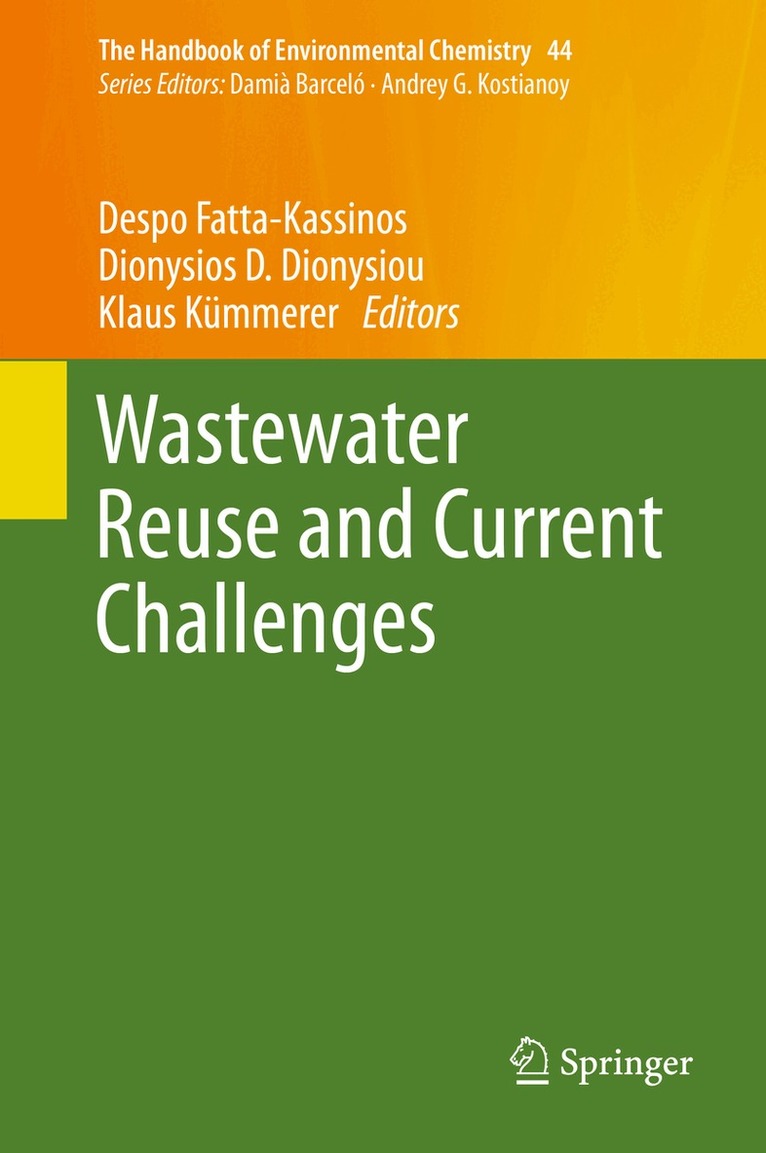
Wastewater Reuse and Current Challenges
Inbunden, Engelska, 2016
3 147 kr
Skickas inom 10-15 vardagar
This volume discusses the current challenges related to the reuse of wastewater. It reviews the analytical methodologies for evaluating emerging contaminants and their transformation products, the sensitivity of various bioassays for assessing the biological effects of treated wastewater, and the bioavailability and uptake of organic contaminants during crop irrigation. It describes in detail the physicochemical and microbiological alterations in soil resulting from irrigation with treated urban wastewater, and discusses our current understanding of antibiotic resistance in wastewater treatment plants and in downstream environments. The book also includes an analysis of the effect of wastewater entering drinking water sources and production, and provides updated information on wastewater reuse for irrigation in North Africa. It presents an important integration tool for water recovery, known as water pinch analysis, and finally showcases two other examples of reuse – one in the paper industry and one in landfill management. It is of interest to experts from various fields of research, including analytical and environmental chemistry, toxicology and environmental and sanitary engineering.
Del 45 - Handbook of Environmental Chemistry
Advanced Treatment Technologies for Urban Wastewater Reuse
Häftad, Engelska, 2018
2 100 kr
Skickas inom 10-15 vardagar
This volume offers a detailed overview of currently applied and tested wastewater treatment technologies and the integration of advanced processes to remove trace organic contaminants and microorganisms.
3 887 kr
Skickas inom 5-8 vardagar
It describes in detail the physicochemical and microbiological alterations in soil resulting from irrigation with treated urban wastewater, and discusses our current understanding of antibiotic resistance in wastewater treatment plants and in downstream environments.
2 163 kr
Skickas inom 10-15 vardagar
When the first green wave appeared in the mid and late 1960s, it was considered a f- sible task to solve pollution problems. The visible problems were mostly limited to point sources, and a comprehensive “end of the pipe technology” (= environmental technology) was available. It was even seriously discussed in the US that what was called “zero d- charge” could be attained by 1985. It became clear in the early 1970s that zero discharge would be too expensive, and that we should also rely on the self purification ability of ecosystems. That called for the development of environmental and ecological models to assess the self purifi- tion capacity of ecosystems and to set up emission standards, considering the re- tionship between impacts and effects in the ecosystems. This idea is illustrated in Fig. 0.1. A model is used to relate an emission to its effect on the ecosystem and its components. The relationship is applied to select a good solution to environmental problems by application of environmental technology.
1 624 kr
Skickas inom 10-15 vardagar
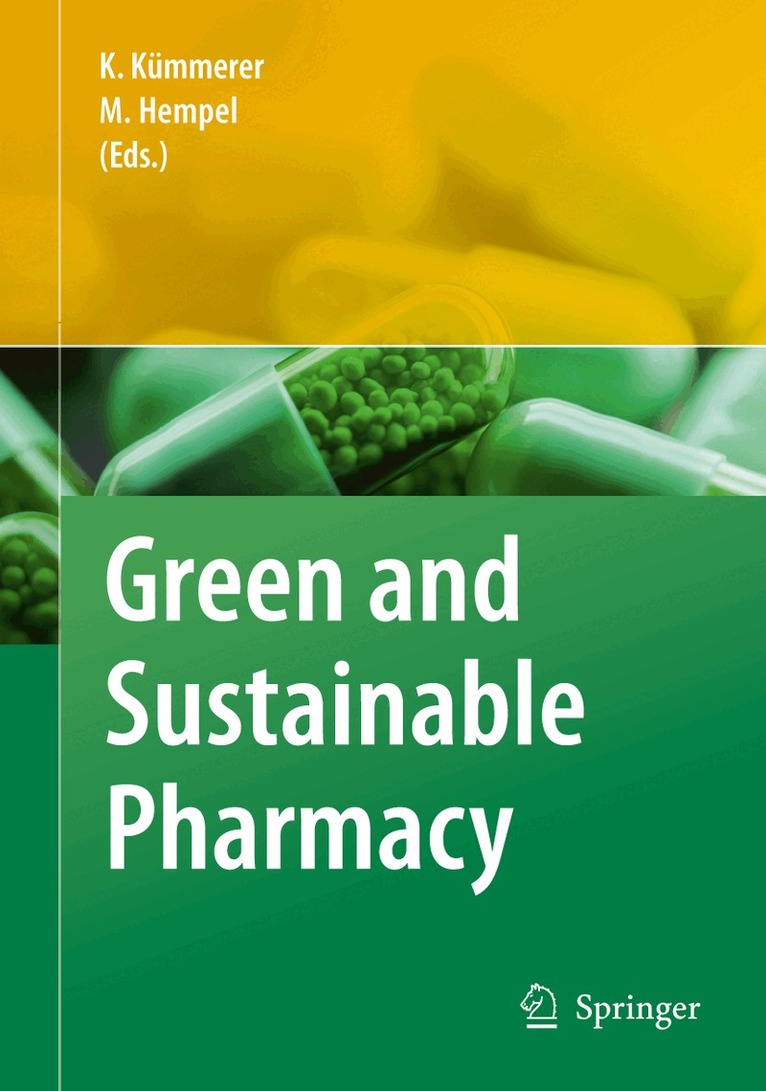
Within recent years pharmaceuticals have come into focus as contaminants of the environment (see for example Kümmerer, K. editor: Pharmaceuticals in the Environment). At the same time the issue of sustainable chemistry gained momentum. Bringing both together would result in sustainable pharmacy. Sustainable pharmacy is a totally new issue and approach. It addresses environmental, economical and social aspects of pharmacy. In the present stage the focus will be on environmental issues along the whole lifecycle of a pharmaceutical entity. That is dealing with resources and energy input but also with waste issues for example during the synthesis and production of an active pharmaceutical ingredient. Furthermore, it would also look on the compounds themselves and will aim to improve the degradability of the compounds after their use in the environment to reduce the environmental risk caused by pharmaceuticals in the environment. Another issue is the people using pharmaceuticals such as pharmacists, medical doctors and patients. How can they contribute to more efficient use of pharmaceuticals with less environmental burden and less risk for drinking water. The book "Sustainable Pharmacy" will address all these issues and will be the first one dealing with this important topic.
2 378 kr
Skickas inom 10-15 vardagar
When the first green wave appeared in the mid and late 1960s, it was considered a f- sible task to solve pollution problems. The visible problems were mostly limited to point sources, and a comprehensive “end of the pipe technology” (= environmental technology) was available. It was even seriously discussed in the US that what was called “zero d- charge” could be attained by 1985. It became clear in the early 1970s that zero discharge would be too expensive, and that we should also rely on the self purification ability of ecosystems. That called for the development of environmental and ecological models to assess the self purifi- tion capacity of ecosystems and to set up emission standards, considering the re- tionship between impacts and effects in the ecosystems. This idea is illustrated in Fig. 0.1. A model is used to relate an emission to its effect on the ecosystem and its components. The relationship is applied to select a good solution to environmental problems by application of environmental technology.
1 624 kr
Skickas inom 10-15 vardagar
Within recent years pharmaceuticals have come into focus as contaminants of the environment (see for example Kümmerer, K. editor: Pharmaceuticals in the Environment). At the same time the issue of sustainable chemistry gained momentum. Bringing both together would result in sustainable pharmacy. Sustainable pharmacy is a totally new issue and approach. It addresses environmental, economical and social aspects of pharmacy. In the present stage the focus will be on environmental issues along the whole lifecycle of a pharmaceutical entity. That is dealing with resources and energy input but also with waste issues for example during the synthesis and production of an active pharmaceutical ingredient. Furthermore, it would also look on the compounds themselves and will aim to improve the degradability of the compounds after their use in the environment to reduce the environmental risk caused by pharmaceuticals in the environment. Another issue is the people using pharmaceuticals such as pharmacists, medical doctors and patients. How can they contribute to more efficient use of pharmaceuticals with less environmental burden and less risk for drinking water. The book "Sustainable Pharmacy" will address all these issues and will be the first one dealing with this important topic.
600 kr
Skickas inom 10-15 vardagar
Das Buch weitet den Blick über die kurzfristige Verfügbarkeit von kritischen Metallen auf die grundlegende Frage: Kritisch für wen? Die Autoren nehmen alle Akteure in den Blick und behandeln geologische, chemische, technische, ökonomische und soziale Aspekte wie auch Fragen des Recyclings und verbinden diese. Auch auf Fragen nach dem guten Leben und des Bergbaus aus der Sicht von Ländern des Südens, Fragen der Ressourcenpolitik und -gerechtigkeit gehen sie ein. Ein weiteres Thema sind das UN-Tiefseebergbauregime und dessen Perspektiven, wie sich zukünftig unkonventionell Erz aus der Tiefsee gewinnen lässt. Kritische Metalle werden in den übergreifenden Zusammenhang der anstehenden Großen Transformation eingeordnet. Das Buch beleuchtet insbesondere die grundlegende Bedeutung der stofflichen Voraussetzungen der Energiewende und die energetischen Voraussetzungen der Stoffwende wie auch der Digitalisierung. Damit lässt sich zeigen, dass nicht nur seltene Erden kritisch sind,sondern ebenso Industriemetalle wie etwa Kupfer.Ressourcenpolitik zielt unter anderem auf Sicherung der Primärversorgung mit Technologiemetallen, auf Ressourceneffizienz, Recycling und Substitution kritischer Stoffe. Trotz erster Erfolge ist die Dynamik in Richtung einer zunehmenden Dissipation wertvoller kritischer Metalle ungebrochen. Nötig ist eine rasche Umsteuerung mit dem Ziel, kritische Metalle nicht länger im großen Stil zu verbrauchen, sondern sie klug zu gebrauchen.
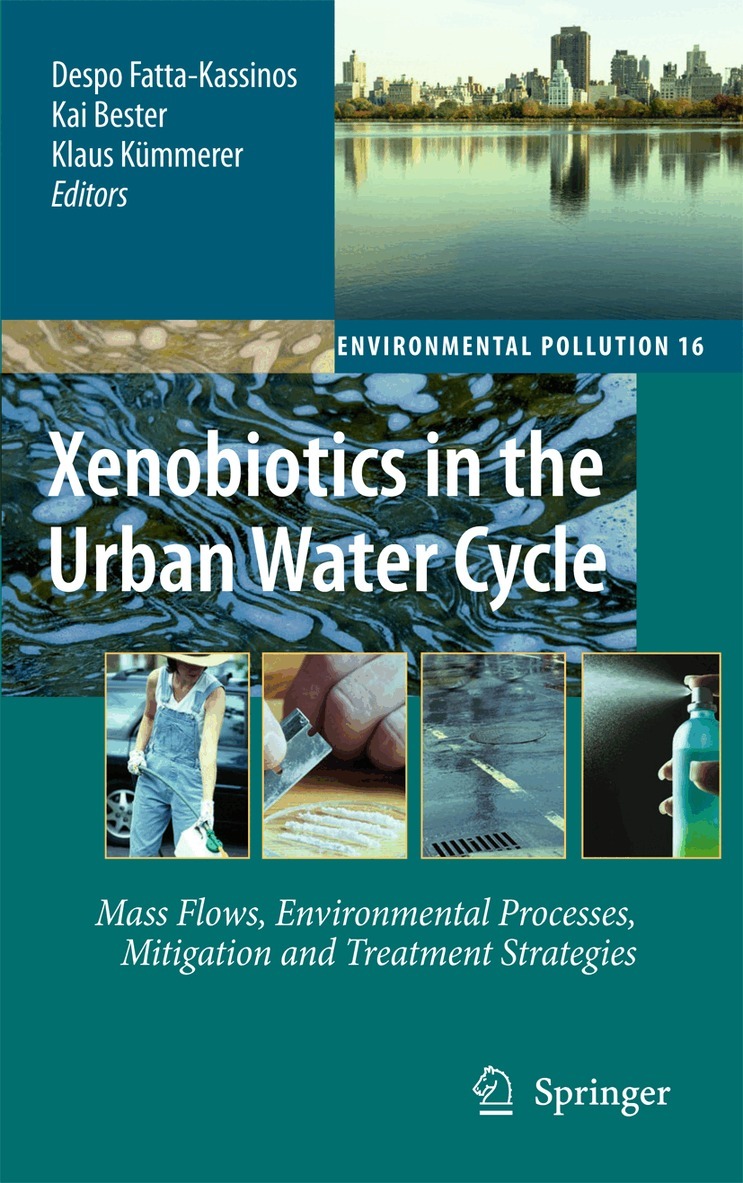
Xenobiotics in the Urban Water Cycle
Mass Flows, Environmental Processes, Mitigation and Treatment Strategies
Inbunden, Engelska, 2010
3 147 kr
Skickas inom 10-15 vardagar
In many cases such as scents, detergents, textile chemicals, surface disinfectants, pesticides and others it is unavoidable that these chemicals are released into the environment according to their intended use.
Xenobiotics in the Urban Water Cycle
Mass Flows, Environmental Processes, Mitigation and Treatment Strategies
Häftad, Engelska, 2012
3 147 kr
Skickas inom 10-15 vardagar
The history of chemistry and pharmaceutical sciences is an impressive success story. The products of chemical and pharmaceutical industries are present eve- where in our everyday life. They help to pursue the modern way of living and they contribute to our high standard of living and safety, mobility, communication te- nologies, food, health, textiles and drinking water treatment, among many others. These products are labeled under the categories: pharmaceuticals, pesticides, det- gents, fertilizers, dyes, paints, preservatives, food additives and personal care pr- ucts, to name a few. Within these categories, groups of chemicals with similar structures can be found. However, often groups of chemicals with very different structures belong to the same category. For a long time the production of chemicals and pharmaceuticals, their usage and application was connected with the heavy pollution of the environment and serious health effects. At the end of the last century, it was realised that the products of che- cal and pharmaceutical industries are presenting a new type of environmental pol- tion that may also pose a health risk to the consumer. Most chemicals are used in so-called open applications in excessive amounts e. g. for personal care, hygiene, plant protection, health and in textiles. In many cases such as scents, detergents, textile chemicals, surface disinfectants, pesticides and others it is unavoidable that these chemicals are released into the environment according to their intended use.