K.S. Fu - Böcker
Visar alla böcker från författaren K.S. Fu. Handla med fri frakt och snabb leverans.
4 produkter
4 produkter
391 kr
Skickas inom 10-15 vardagar
Del 13 - Springer Series in Information Sciences
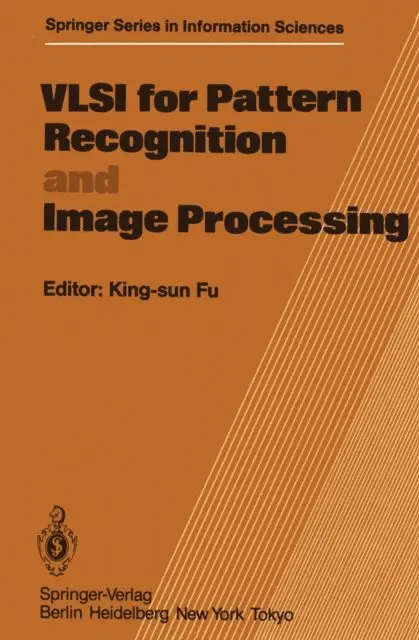
VLSI for Pattern Recognition and Image Processing
Häftad, Engelska, 2012
540 kr
Skickas inom 10-15 vardagar
During the past two decades there has been a considerable growth in interest in problems of pattern recognition and image processing (PRIP). This inter est has created an increasing need for methods and techniques for the design of PRIP systems. PRIP involves analysis, classification and interpretation of data. Practical applications of PRIP include character recognition, re mote sensing, analysis of medical signals and images, fingerprint and face identification, target recognition and speech understanding. One difficulty in making PRIP systems practically feasible, and hence, more popularly used, is the requirement of computer time and storage. This situation is particularly serious when the patterns to be analyzed are quite complex. Thus it is of the utmost importance to investigate special comput er architectures and their implementations for PRIP. Since the advent of VLSI technology, it is possible to put thousands of components on one chip. This reduces the cost of processors and increases the processing speed. VLSI algorithms and their implementations have been recently developed for PRIP. This book is intended to document the recent major progress in VLSI system design for PRIP applications.
1 073 kr
Skickas inom 10-15 vardagar
The many different mathematical techniques used to solve pattem recognition problems may be grouped into two general approaches: the decision-theoretic (or discriminant) approach and the syntactic (or structural) approach. In the decision-theoretic approach, aset of characteristic measurements, called features, are extracted from the pattems. Each pattem is represented by a feature vector, and the recognition of each pattem is usually made by partitioning the feature space. Applications of decision-theoretic approach indude character recognition, medical diagnosis, remote sensing, reliability and socio-economics. A relatively new approach is the syntactic approach. In the syntactic approach, ea ch pattem is expressed in terms of a composition of its components. The recognition of a pattem is usually made by analyzing the pattem structure according to a given set of rules. Earlier applications of the syntactic approach indude chromosome dassification, English character recognition and identification of bubble and spark chamber events. The purpose of this monograph is to provide a summary of the major reeent applications of syntactic pattem recognition. After a brief introduction of syntactic pattem recognition in Chapter 1, the nin e mai n chapters (Chapters 2-10) can be divided into three parts. The first three chapters concem with the analysis of waveforms using syntactic methods. Specific application examples indude peak detection and interpretation of electro cardiograms and the recognition of speech pattems. The next five chapters deal with the syntactic recognition of two-dimensional pictorial pattems.
1 105 kr
Skickas inom 10-15 vardagar
This book seeks to elucidate picture engineering as a new discipline for hand- ling the entire scope of picture processing in a systematic manner. Picture engineering as a discipline has three aspects, the first of which is methodo- logical, technical, and architectural. The second consists of pattern ana- lysis and recognition of pictorial input, picture database management, inclu- ding picture data structure and data representation for picture storage and transformation, and computer graphics for picture output and display. Ver- satile applications such as computer-aided design, manufacturing and testing (CAD/CAM/CAT), office automation (GA), robotics, and fancy computer arts com- prise the third aspect. This book covers all three aspects in original papers by leading experts in the discipline. The book is divided into six parts. Part I covers the central topic of pictorial database management in three papers. The first, by Yamaguchi and Kunii, presents a data model for designing a picture database computer. The second, by Klinger, discusses the organization of computers for handling pic- torial data.In the third paper, Shi-Kuo Chang treats the indexing and enco- ding of pictorial data. Part II is devoted to picture representation. First, a general approach to picture analysis using both syntactic (structural) and semantic information is described by Fu. This is followed by an in-depth explanation of various 3-D shape representation methods by Ikebe and Miyamoto. Schumaker elaborates polar spline representation of 3-D objects, and finally,Enomoto, Yonezaki and Watanabe describe a unique method of characterizing 3-D surfaces by struc- ture lines.