• Fri frakt över 249 kr
  • •
  • Snabba leveranser
  • •
  • Billiga böcker
Kundservice

Du är på sajten för privatpersoner.

Företag, bibliotek eller offentlig verksamhet?

Du handlar på classic.bokus.com, där alla dina funktioner finns intakta.
Till classic.bokus.com
Bokus logotyp. Gå till startsidan.
  • Erbjudanden
  • Nyheter
  • Student
  • Topplistor
  • Barn & ungdom
  • Bokus Play
  • E-böcker
  • Pocketböcker
  • Spel & pussel

10% rabatt på allt med kod: NYSTART10 →

Sidfot

Mina sidor

    Hjälp

    • Kundservice
    • Vanliga frågor och svar
    • Frakt och leverans
    • Retur vid ångerrätt
    • Reklamera vara
    • Betalning
    • Köpvillkor
    • Allmänna villkor
    • Information om webbplatsens tillgänglighet

    Om Bokus

    • Om oss
    • Pressrum
    • För studenter
    • För företag
    • För bibliotek och offentlig verksamhet
    • För leverantörer
    • Hållbarhet

    Populärt

    • Aktuella erbjudanden
    • Presentkort
    • Studentlitteratur
    • Nya böcker
    • Topplistor
    • Signerade böcker
    • Engelska böcker

    Inspiration

    • Boktips
    • BookTok
    • Populära bokserier
    • Barnbokskaraktärer
    • Populära författare
    Logotyp för Bokus
    Följ oss på Facebook (extern länk)Följ oss på Instagram (extern länk)Följ oss på YouTube (extern länk)Följ oss på TikTok (extern länk)
    bokus @ CookiesAnpassa cookiesIntegritetspolicyKöpvillkor
    Till Citymail hemsida (extern länk)Till Budbee hemsida (extern länk)Till Postnord hemsida (extern länk)Till Schenker hemsida (extern länk)Till Early Bird hemsida (extern länk)Till Walleys hemsida (extern länk)
    1. Data och IT
    2. Systemvetenskap och AI

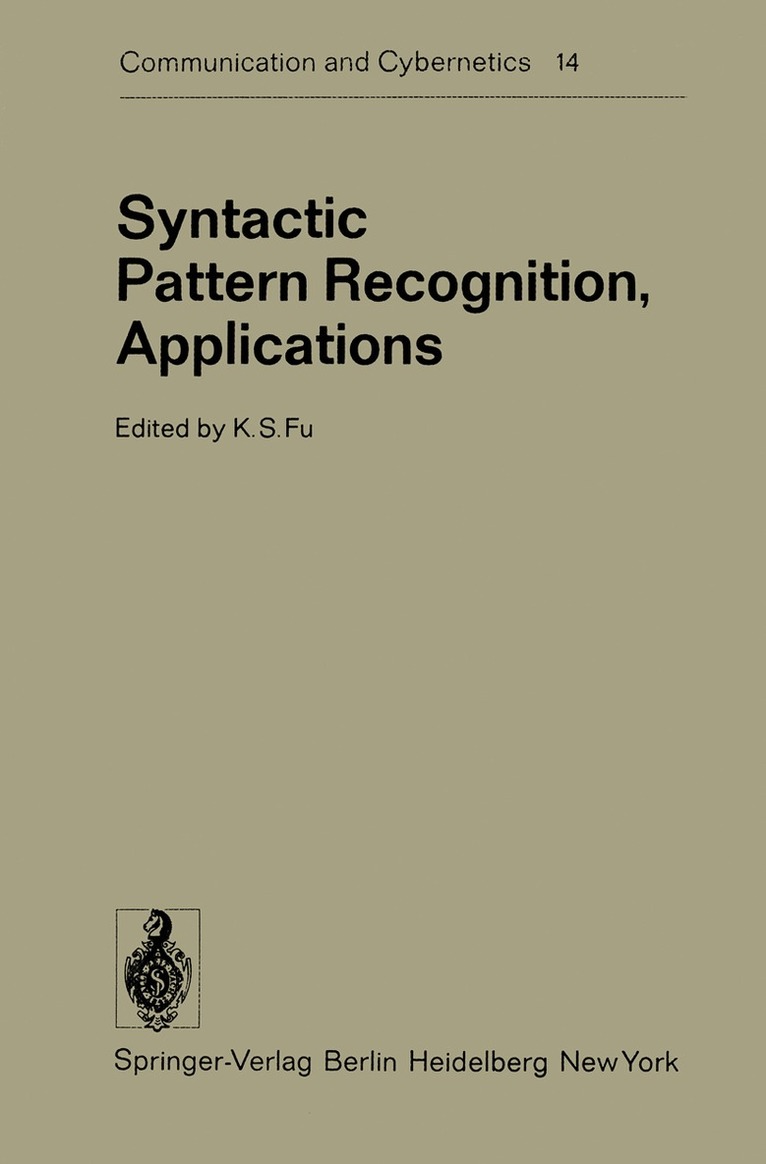
    Syntactic Pattern Recognition, Applications

    AvK.S. Fu

    Häftad, Engelska, 2011

    Del i serien Communication and Cybernetics

    1 086 kr

    Beställningsvara. Skickas inom 10-15 vardagar. Fri frakt över 249 kr.

    Beskrivning

    The many different mathematical techniques used to solve pattem recognition problems may be grouped into two general approaches: the decision-theoretic (or discriminant) approach and the syntactic (or structural) approach. In the decision-theoretic approach, aset of characteristic measurements, called features, are extracted from the pattems. Each pattem is represented by a feature vector, and the recognition of each pattem is usually made by partitioning the feature space. Applications of decision-theoretic approach indude character recognition, medical diagnosis, remote sensing, reliability and socio-economics. A relatively new approach is the syntactic approach. In the syntactic approach, ea ch pattem is expressed in terms of a composition of its components. The recognition of a pattem is usually made by analyzing the pattem structure according to a given set of rules. Earlier applications of the syntactic approach indude chromosome dassification, English character recognition and identification of bubble and spark chamber events. The purpose of this monograph is to provide a summary of the major reeent applications of syntactic pattem recognition. After a brief introduction of syntactic pattem recognition in Chapter 1, the nin e mai n chapters (Chapters 2-10) can be divided into three parts. The first three chapters concem with the analysis of waveforms using syntactic methods. Specific application examples indude peak detection and interpretation of electro­ cardiograms and the recognition of speech pattems. The next five chapters deal with the syntactic recognition of two-dimensional pictorial pattems.

    Produktinformation

    • Utgivningsdatum:2011-12-16
    • Mått:170 x 244 x 16 mm
    • Vikt:502 g
    • Format:Häftad
    • Språk:Engelska
    • Serie:Communication and Cybernetics
    • Antal sidor:272
    • Förlag:Springer-Verlag Berlin and Heidelberg GmbH & Co. KG
    • ISBN:9783642664403

    Utforska kategorier

    • Systemvetenskap och AI inom Data och IT
    • Tillämpad matematik inom Naturvetenskap och teknik

    Innehållsförteckning

    • 1. Introduction to Syntactic Pattern Recognition..- 1.1 Syntactic (Structural) Approach to Pattern Recognition.- 1.2 Syntactic Pattern Recognition System.- 1.3 Selection of Pattern Primitives.- 1.4 Pattern Grammar.- 1.5 High-Dimensional Pattern Grammars.- 1.6 Syntax Analysis as Recognition Procedure.- 1.7 Concluding Remarks.- References.- 2. Peak Recognition in Waveforms..- 2.1 What is a Peak?.- 2.2 Practical Peak Recognition.- 2.3 Application to Electrocardiography.- 2.4 Concluding Remarks.- References.- 3. Electrocardiogram Interpretation Using a Stochastic Finite State Model..- 3.1 The Interpretation Problem.- 3.2 A Solution to the Interpretation Problem.- 3.3 A Simple Example.- 3.4 Application to Analog Signal Processing.- 3.5 An Example Application.- 3.6 The Solution to the Clock Signal Interpretation Problem.- 3.7 A Sample Clock Signal Search Tree.- 3.8 Conclusion.- References.- 4. Syntactic Recognition of Speech Patterns..- 4.1 Background.- 4.2 Preprocessing and Feature Extraction.- 4.3 Syntax-Controlled Segmentation of Continuous Speech.- 4.4 Syntactic Recognition of Syllables and Words.- 4.5 Linguistic Interpretation of Speech Patterns.- 4.6 Automatic Learning of Speech Patterns.- 4.7 Conclusions.- References.- 5. Chinese Character Recognition..- 5.1 Historical.- 5.2 The Morphology of Chinese Characters.- 5.3 Recognition of Chinese Characters.- References.- 6. Shape Discrimination..- 6.1 Basic Considerations.- 6.2 Description of Contours in Terms of Polygons.- 6.3 Description of the Shape of Polygons.- 6.4 Fundamentals of Decomposition.- 6.5 Further Decomposition and Shape Description.- 6.6 Decomposition of Polygons with Holes.- 6.7 Implementation of the Decomposition Algorithm.- 6.8 Discussion of the Methodology.- References.- 7. Two-Dimensional Mathematical Notation..- 7.1 Mathematics Notation.- 7.2 Coordinate Grammars.- 7.3 A Syntax-Directed Recognition Algorithm.- 7.4 Scope of Recognition Capability.- 7.5 Implementation and Efficiency.- 7.6 Summary.- Appendix 7.A.- Appendix 7.B.- References.- 8. Fingerprint Classification..- 8.1 Historical Background.- 8.2 Syntactic Approach.- 8.3 Tree Grammar Approach to Fingerprint Pattern Recognition.- 8.4 Summary.- References.- 9. Modeling of Earth Resources Satellite Data..- 9.1 The Satellite Data.- 9.2 The Model.- 9.3 Details of the Analysis.- 9.4 Inferring a Grammar for the Highways.- 9.5 Summary.- References.- 10. Industrial Objects and Machine Parts Recognition..- 10.1 A Short Review of Leading Ideas.- 10.2 Levels of Knowledge.- 10.3 Hardware.- 10.4 Software.- 10.5 Pattern Recognition.- 10.6 Conclusions.- References.