
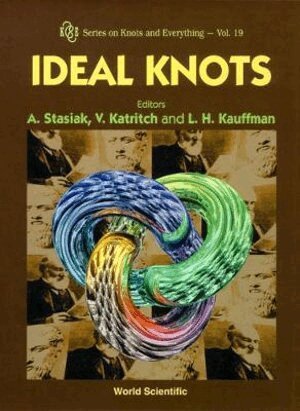
In this book, experts in different fields of mathematics, physics, chemistry and biology present unique forms of knots which satisfy certain preassigned criteria relevant to a given field. They discuss the shapes of knotted magnetic flux lines, the forms of knotted arrangements of bistable chemical systems, the trajectories of knotted solitons, and the shapes of knots which can be tied using the shortest piece of elastic rope with a constant diameter.
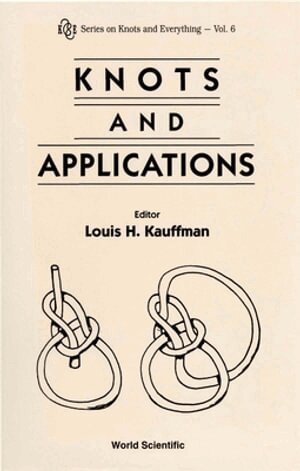
This volume is a collection of research papers devoted to the study of relationships between knot theory and the foundations of mathematics, physics, chemistry, biology and psychology. Included are reprints of the work of Lord Kelvin (Sir William Thomson) on the 19th century theory of vortex atoms, reprints of modern papers on knotted flux in physics and in fluid dynamics and knotted wormholes in general relativity. It also includes papers on Witten's approach to knots via quantum field theory and applications of this approach to quantum gravity and the Ising model in three dimensions. Other papers discuss the topology of RNA folding in relation to invariants of graphs and Vassiliev invariants, the entanglement structures of polymers, the synthesis of molecular Mobius strips and knotted molecules. The book begins with an article on the applications of knot theory to the foundations of mathematics and ends with an article on topology and visual perception. This volume will be of immense interest to all workers interested in new possibilities in the uses of knots and knot theory.
In this book, experts in different fields of mathematics, physics, chemistry and biology present unique forms of knots which satisfy certain preassigned criteria relevant to a given field. They discuss the shapes of knotted magnetic flux lines, the forms of knotted arrangements of bistable chemical systems, the trajectories of knotted solitons, and the shapes of knots which can be tied using the shortest piece of elastic rope with a constant diameter.
This volume is a collection of research papers devoted to the study of relationships between knot theory and the foundations of mathematics, physics, chemistry, biology and psychology. Included are reprints of the work of Lord Kelvin (Sir William Thomson) on the 19th century theory of vortex atoms, reprints of modern papers on knotted flux in physics and in fluid dynamics and knotted wormholes in general relativity. It also includes papers on Witten's approach to knots via quantum field theory and applications of this approach to quantum gravity and the Ising model in three dimensions. Other papers discuss the topology of RNA folding in relation to invariants of graphs and Vassiliev invariants, the entanglement structures of polymers, the synthesis of molecular Mobius strips and knotted molecules. The book begins with an article on the applications of knot theory to the foundations of mathematics and ends with an article on topology and visual perception. This volume will be of immense interest to all workers interested in new possibilities in the uses of knots and knot theory.