L. L. Green – författare
Visar alla böcker från författaren L. L. Green. Handla med fri frakt och snabb leverans.
4 produkter
4 produkter
E-bok
PDF, Engelska, 2013756 kr
Läs direkt efter köp
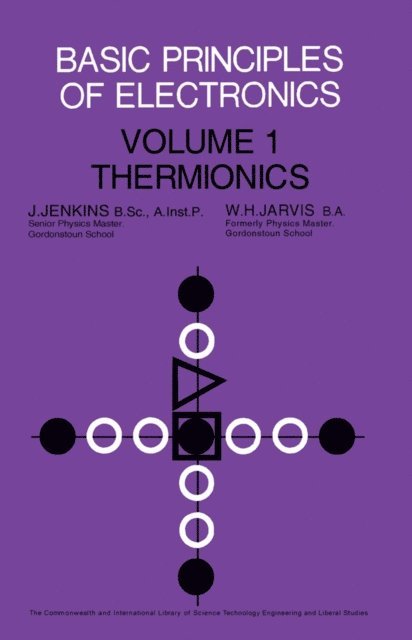
Basic Principles of Electronics, Volume I : Thermionics serves as a textbook for students in physics. It focuses on thermionic devices. The book covers topics on electron dynamics, electron emission, and the themionic vacuum diode and triode. Power amplifiers, oscillators, and electronic measuring equipment are studied as well. The text will be of great use to physics and electronics students, and inventors.
E-bok
PDF, Engelska, 2013344 kr
Läs direkt efter köp
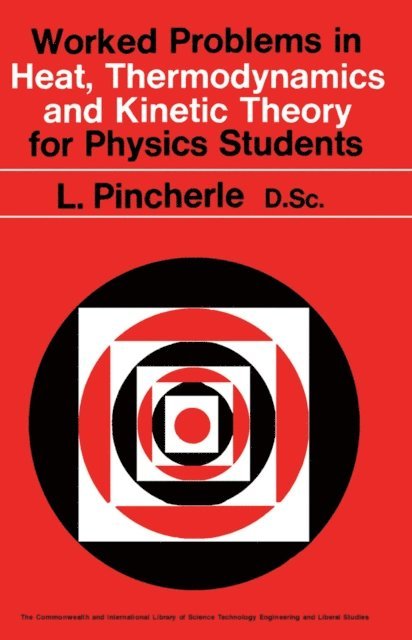
Worked Problems in Heat, Thermodynamics and Kinetic Theory for Physics Students is a complementary to textbooks in physics. This book is a collection of exercise problems that have been part of tutorial classes in heat and thermodynamics at the University of London. This collection of exercise problems, with answers that are fully worked out, deals with various topics. This book poses problems covering the definition of temperature such as calculating the assigned value of the temperature of boiling water under specific conditions. This text also gives example of problems dealing with the first law of thermodynamics and with the definition of thermal capacities. Some practical questions such as problems dealing with thermal engines are presented. This book then discusses problems using the energy equation, as well as asking the student to derive a general equation of state of a material satisfying a specific condition. This text challenges the student to use a T-S diagram to calculate the efficiency of a reversible cycle under certain conditions. Several other problems concern the Joule and Joule-Kelvin effects, low temperature physics, and heat conduction. This review material can be helpful for students of physics, thermodynamics, and related subjects. It can also be used by teachers of physics.
E-bok
PDF, Engelska, 2017344 kr
Läs direkt efter köp
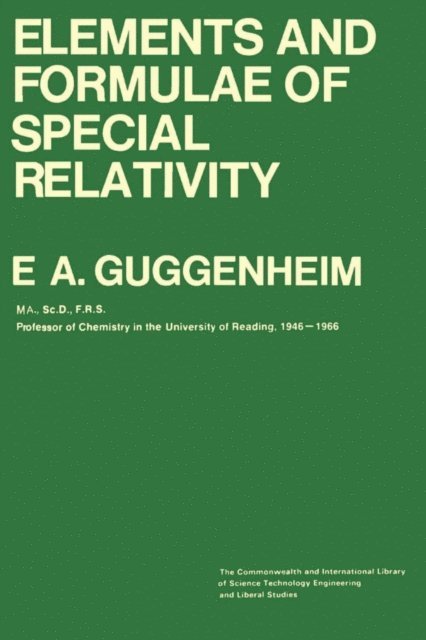
Elements and Formulae of Special Relativity presents elements and formulas of the theory of special relativity and covers topics ranging from kinematics and propagation of light to mechanics of single bodies, hydrodynamics, and thermodynamics. Vector operators, electromagnetic fields, electrodynamics, and statistical mechanics are also explored. This book is comprised of 13 chapters and begins by introducing the reader to the kinematics of special relativity, paying particular attention to formulas required for transformations between two frames of reference. Attention then turns to the propagation of light, the Doppler effect, the mechanics of single bodies, and the more general and more powerful approach to relativistic mechanics due to Lagrange and to Hamilton. The chapters that follow focus on formulas for a fluid maintained at a constant uniform pressure; relativistic formulas for thermodynamics; and representation of M-vectors with real components by cartesian 4-vectors with imaginary components. This book also considers the equations for an electromagnetic field in a vacuum and a gaseous phase composed of one or several perfect monatomic gases. A brief historical synopsis is given in the last chapter. This monograph will be useful to chemical physicists and other not-too-theoretical physicists.
E-bok
PDF, Engelska, 2013344 kr
Läs direkt efter köp
Diffraction: Coherence in Optics presents a detailed account of the course on Fraunhofer diffraction phenomena, studied at the Faculty of Science in Paris. The publication first elaborates on Huygens'' principle and diffraction phenomena for a monochromatic point source and diffraction by an aperture of simple form. Discussions focus on diffraction at infinity and at a finite distance, simplified expressions for the field, calculation of the path difference, diffraction by a rectangular aperture, narrow slit, and circular aperture, and distribution of luminous flux in the airy spot. The book then examines Fourier transformation and diffraction by several apertures. The manuscript takes a look at extended luminous sources and objects and diffraction phenomena in perfect optical instruments. Topics include diffraction gratings, phase contrast, apodization, filtering spatial frequencies, relation between the length of wave trains and the spectral width of the emitted radiations, successive wave trains emitted by an atom, and vibrations with different frequencies from a single atom. The manuscript also reviews diffraction phenomena in real optical instruments, including diffraction in the case of a spherical wave and diffraction spot in the presence of aberrations. The publication is a dependable reference for readers interested in diffraction phenomena.