Larbi Safaa – författare
Visar alla böcker från författaren Larbi Safaa. Handla med fri frakt och snabb leverans.
3 produkter
3 produkter
2 328 kr
Skickas inom 10-15 vardagar
This book brings together multidisciplinary contributions from various academic and professional backgrounds, addressing the challenges and opportunities of sustainable tourism.
Tourism, Sustainability and Innovation: Low-Tech Roots and High-Tech Horizons
Inbunden, Engelska, 2026
2 262 kr
Skickas inom 11-20 vardagar
Today, tourism offers a privileged perspective to explore the relationships between sustainability, innovation, and inclusion. This volume, Tourism, Sustainability and Innovation: Low-Tech Roots and High-Tech Horizons (part of the World Sustainability Series), includes contributions from scholars with 23 different nationalities (Belgium, Bulgaria, Cameroon, China, Finland, France, Germany, Hungary, Japan, Kazakhstan, Latvia, Lithuania, Morocco, Poland, Portugal, Qatar, Saudi Arabia, Spain, Taiwan, Tunisia, Turkey, Ukraine, United Kingdom). This diversity reflects the richness of perspectives included in the book, encompassing around fifteen different case studies and country contexts, analyzed through a variety of cultural, economic, and institutional lenses. Collectively, the chapters open a dialogue on how to reconcile practices deeply rooted in local territories with the emerging horizons shaped by new technologies. Central to the theme of Tourism, Sustainability and Innovation: Low-Tech Roots and High-Tech Horizons is a creative tension: how do we embrace the authenticity of local practices, traditional “know-how” and cultural resources, often carriers of resilience and ‘low-tech’ sustainability, while purposely bringing in the digital, intelligent, automated solutions that are transforming tourism today? The difficulty is not to play past against future, but to think about how innovation can keep hold of tourism’s human, social and territorial roots, and at the same time, open new possibilities. From this point of view, notably, we can ask: How can tourism experiences be meaningfully inclusive? How can digital transformation add to our focus on sustainability? And how can technology be deployed not for itself alone, but as a lever for destinations, communities, and stakeholders across the industry?This book is important because it redefines innovation in tourism beyond just high-tech solutions. It promotes a balanced approach that values basic "low-tech" sustainable practices, like community-based models and resource conservation. At the same time, it shows the rôle of advanced "high-tech" tools, such as AI and big data. By connecting this often-neglected range, it offers a complete and practical framework for building a truly sustainable tourism sector. It serves as a necessary guide to ensure that innovation supports the larger goals of environmental responsibility, social fairness, and lasting resilience.The book is structured around six main sections, each reflecting a key thematic axis of contemporary tourism research. The first section, Vulnerability, Rights and Sustainable Pathways in Tourism, highlights institutional transitions, multi-level governance, legal protections, and the need for more equitable and resilient destinations. The second section, New Trends in Technology, Digitalization and Innovation in Tourism, examines neuro-tourism, smart technologies, digital platforms such as Booking.com and Instagram, public digitalization, logistics optimization, and issues related to data protection, privacy and ethics. The third section, Tourism Destinations: Image, Perceptions, and Governance, explores destination image, emotional connections, social media dynamics, urban environments, and the e-reputation of cities including Essaouira, Marrakech, Makkah and Jeddah. The fourth section, Tourism, Heritage and Cultural Resources, focuses on cultural and intangible heritage, creative and art tourism, gastronomy, value systems in online reviews, and legal perspectives on medical tourism. The fifth section, Entrepreneurship, Career Dynamics and Organizational Transformation in Tourism, addresses community participation, professional trajectories in the hotel sector, digital transformation in organizations, and legal dimensions of transportation and accommodation. Finally, the sixth section, Tourist Experiences and Behavioral Perspectives, examines rural tourism experiences, tourist expenditures, senior well-being, urban mobility, leisure infrastructures, and issues of personal data protection in the age of artificial intelligence.
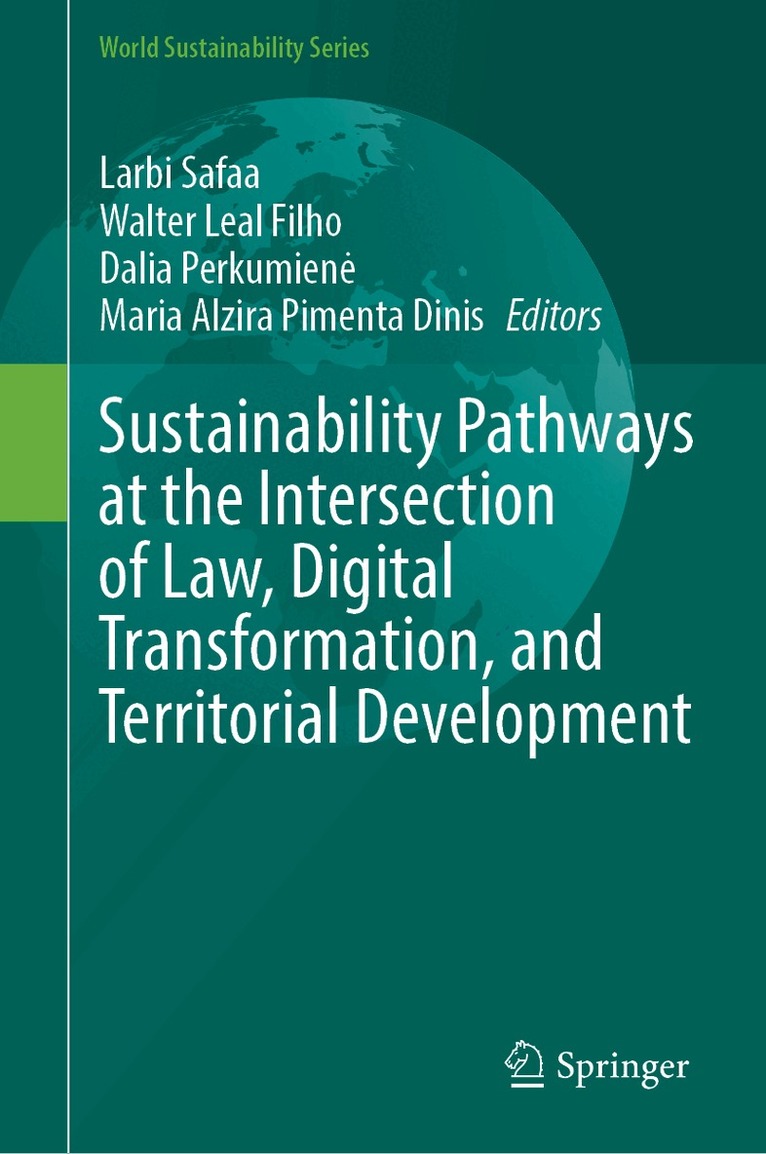
Sustainability Pathways at the Intersection of Law, Digital Transformation, and Territorial Development
Inbunden, Engelska, 2026
2 666 kr
Kommande
This editorial team brings together internationally recognized scholars in sustainability, tourism, and heritage. Safaa Larbi (Cadi Ayyad University, Morocco) specializes in resources, mobility, and territorial attractiveness within tourism studies. Walter Leal Filho (Hamburg University of Applied Sciences, Germany) is a leading authority in sustainability and climate change research. Dalia Perkumienė (Lithuanian Engineering University of Applied Sciences, Lithuania) contributes expertise in landscape engineering and sustainable resource management, while Maria Alzira Pimenta Dinis (University Fernando Pessoa, Portugal) focuses on innovation and development in heritage and tourism. Together, they form a highly regarded academic team that has successfully coordinated a first Springer volume within the World Sustainability Series, under the theme Tourism and Heritage: Shaping Sustainable and Innovative Futures. Their collective expertise and international recognition position them as key contributors to advancing research and global dialogue in sustainable tourism and heritage studies.