Lars Hulgard – författare
648 kr
Skickas inom 10-15 vardagar
2 201 kr
Skickas inom 10-15 vardagar
730 kr
Läs direkt efter köp
In the past decades, social enterprise has been an emerging field of research. Its main frameworks have been provided by Occidental approaches. Mainly based on an organizational vision, they give little or no room to questions such as gender, race, colonialism, class, power relations and intertwined forms of inequality. However, a wide range of worldwide hidden, popular initiatives can be considered as another form of social enterprises based on solidarity, re-embedding the economy as well as broadening the political scope. This has been shown in a previous book: Civil Society, the Third Sector, and Social Enterprise: Governance and Democracy.
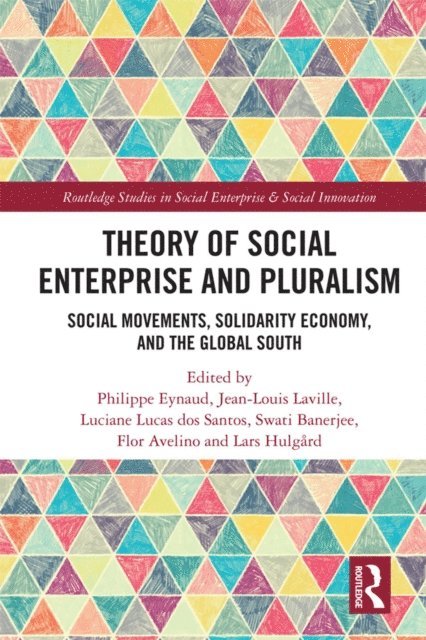
Thus, to be more than a fashion or a fictitious panacea, the concept of social enterprise needs to be debated. Southern realities cannot be only understood through imported categories and outside modeled guidelines. This book engages a multicontinental and pluridisciplinary discussion in order to provide a pluralist theory of social enterprise. The book will be of interest to researchers, academics and students in the fields of social entrepreneurship, social innovation, development studies, management studies and social work.
730 kr
Läs direkt efter köp
In the past decades, social enterprise has been an emerging field of research. Its main frameworks have been provided by Occidental approaches. Mainly based on an organizational vision, they give little or no room to questions such as gender, race, colonialism, class, power relations and intertwined forms of inequality. However, a wide range of worldwide hidden, popular initiatives can be considered as another form of social enterprises based on solidarity, re-embedding the economy as well as broadening the political scope. This has been shown in a previous book: Civil Society, the Third Sector, and Social Enterprise: Governance and Democracy.
Thus, to be more than a fashion or a fictitious panacea, the concept of social enterprise needs to be debated. Southern realities cannot be only understood through imported categories and outside modeled guidelines. This book engages a multicontinental and pluridisciplinary discussion in order to provide a pluralist theory of social enterprise. The book will be of interest to researchers, academics and students in the fields of social entrepreneurship, social innovation, development studies, management studies and social work.
986 kr
Läs direkt efter köp
The concepts of social enterprise and social entrepreneurship are rapidly attracting increased attention in academic spheres and from policy-makers, as well as field workers who are setting up new initiatives or reshaping their organizations. These concepts are perceived as defining innovative and dynamic responses to major global challenges in today’s societies.
The debate about social enterprise is now world-wide, with lively exchanges between American and European scholars. However, the research and landscapes still differ significantly in different regions, and diversity also exists within specific regions such as Europe. This book presents the most comprehensive set of contributions reflecting the European-wide debate, but with frequent connections to developments in other parts of the world. This book is a result of work carried out by members of the EMES International Research Network, which is a pioneer in this field.
Social Enterprise and the Third Sector will appeal to all researchers who focus on the third sector, social economy and social enterprise, to MBA and postgraduate students, as well as to intellectual social enterprise leaders and practitioners. It will soon become a key reference for all those who want to explore the full richness of these concepts and follow this important academic debate.
986 kr
Läs direkt efter köp
The concepts of social enterprise and social entrepreneurship are rapidly attracting increased attention in academic spheres and from policy-makers, as well as field workers who are setting up new initiatives or reshaping their organizations. These concepts are perceived as defining innovative and dynamic responses to major global challenges in today’s societies.
The debate about social enterprise is now world-wide, with lively exchanges between American and European scholars. However, the research and landscapes still differ significantly in different regions, and diversity also exists within specific regions such as Europe. This book presents the most comprehensive set of contributions reflecting the European-wide debate, but with frequent connections to developments in other parts of the world. This book is a result of work carried out by members of the EMES International Research Network, which is a pioneer in this field.
Social Enterprise and the Third Sector will appeal to all researchers who focus on the third sector, social economy and social enterprise, to MBA and postgraduate students, as well as to intellectual social enterprise leaders and practitioners. It will soon become a key reference for all those who want to explore the full richness of these concepts and follow this important academic debate.
752 kr
Läs direkt efter köp
Social Innovation is emerging as an alternate interdisciplinary development pathway of knowledge and practice that aims to understand and address contemporary complexities and multi – dimensional social realities. BEPA (2011) defines social innovation as, ‘innovations that are social in both their ends and means’. However, though Social Innovation is a widely-used term; its conceptual understanding and the specific relation to social change remains under explored.
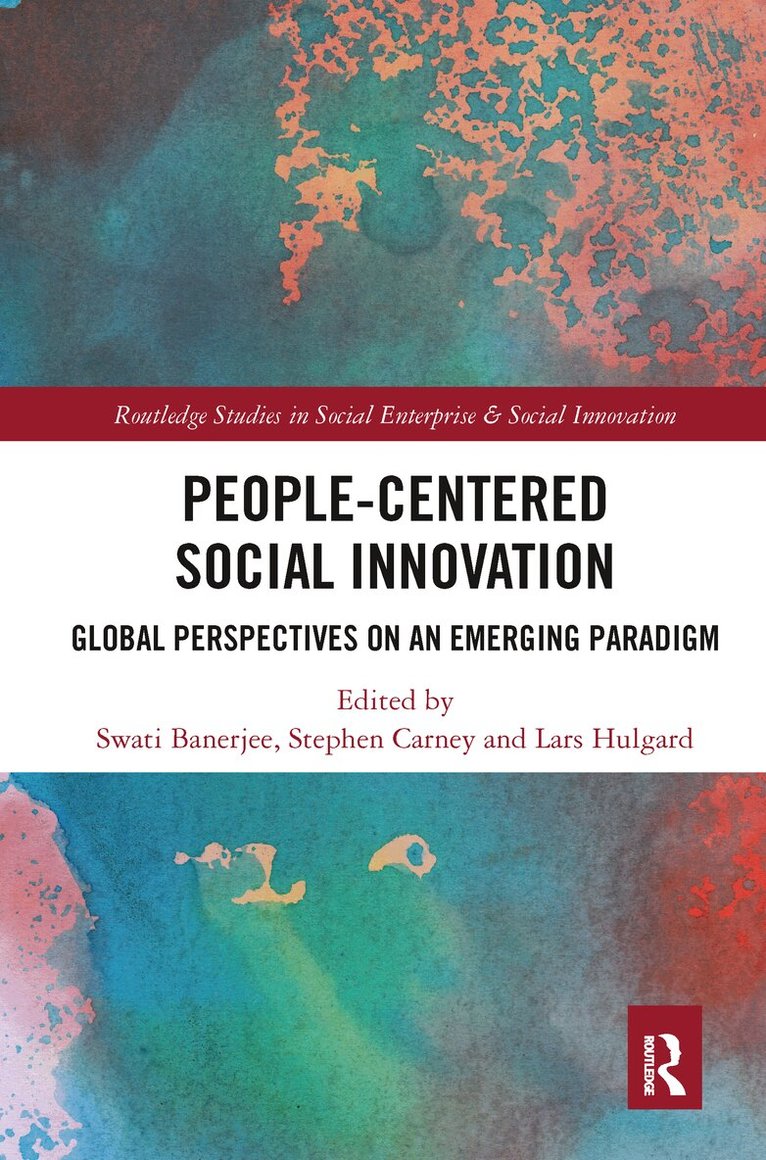
People Centered Social Innovation: Global perspectives on an Emerging Paradigm attempts to revisit and extend the existing understanding of Social Innovation in practice by focusing upon the lived realities of marginalized groups and communities. The emerging field of people-centered development is placed in dialogue with theory and concepts from the more established field of social innovation to create a new approach; one that adopts a global perspective, engaging with very different experiences of marginality across the global north and south. Theoretically, ‘People Centered Social Innovation: Global Perspectives on an Emerging Paradigm’ draws upon ‘northern’ understandings of change and improvement as well as ‘southern’ theory concerns for epistemological diversity and meaning making. The result is an experiment aimed at reimagining research and practice that seriously needs to center the actor in processes of social transformation.
752 kr
Läs direkt efter köp
Social Innovation is emerging as an alternate interdisciplinary development pathway of knowledge and practice that aims to understand and address contemporary complexities and multi – dimensional social realities. BEPA (2011) defines social innovation as, ‘innovations that are social in both their ends and means’. However, though Social Innovation is a widely-used term; its conceptual understanding and the specific relation to social change remains under explored.
People Centered Social Innovation: Global perspectives on an Emerging Paradigm attempts to revisit and extend the existing understanding of Social Innovation in practice by focusing upon the lived realities of marginalized groups and communities. The emerging field of people-centered development is placed in dialogue with theory and concepts from the more established field of social innovation to create a new approach; one that adopts a global perspective, engaging with very different experiences of marginality across the global north and south. Theoretically, ‘People Centered Social Innovation: Global Perspectives on an Emerging Paradigm’ draws upon ‘northern’ understandings of change and improvement as well as ‘southern’ theory concerns for epistemological diversity and meaning making. The result is an experiment aimed at reimagining research and practice that seriously needs to center the actor in processes of social transformation.