Laurent Loison – författare
Visar alla böcker från författaren Laurent Loison. Handla med fri frakt och snabb leverans.
8 produkter
Beyond Lamarckism
Plasticity in Darwinian Evolution, 1890-1970
Inbunden, 2024
2510 kr
Lägg i varukorg
Over the past 20 years, the role of phenotypic plasticity in Darwinian evolution has become a hotly debated topic among biologists and philosophers of science. For instance, in the Extended Evolutionary Synthesis, a new form of evolutionary theory that aims to include processes not taken into …
Beyond Lamarckism
Plasticity in Darwinian Evolution, 1890-1970
Häftad, 2025
705 kr
Lägg i varukorg
Over the past 20 years, the role of phenotypic plasticity in Darwinian evolution has become a hotly debated topic among biologists and philosophers of science. For instance, in the Extended Evolutionary Synthesis, a new form of evolutionary theory that aims to include processes not taken into …
Beyond Lamarckism
Plasticity in Darwinian Evolution, 1890-1970
E-bok, 2024
831 kr
Lägg i varukorg
Over the past 20 years, the role of phenotypic plasticity in Darwinian evolution has become a hotly debated topic among biologists and philosophers of science. For instance, in the Extended Evolutionary Synthesis, a new form of evolutionary theory that aims to include processes not taken into …
Beyond Lamarckism
Plasticity in Darwinian Evolution, 1890-1970
E-bok, 2024
805 kr
Lägg i varukorg
Over the past 20 years, the role of phenotypic plasticity in Darwinian evolution has become a hotly debated topic among biologists and philosophers of science. For instance, in the Extended Evolutionary Synthesis, a new form of evolutionary theory that aims to include processes not taken into …
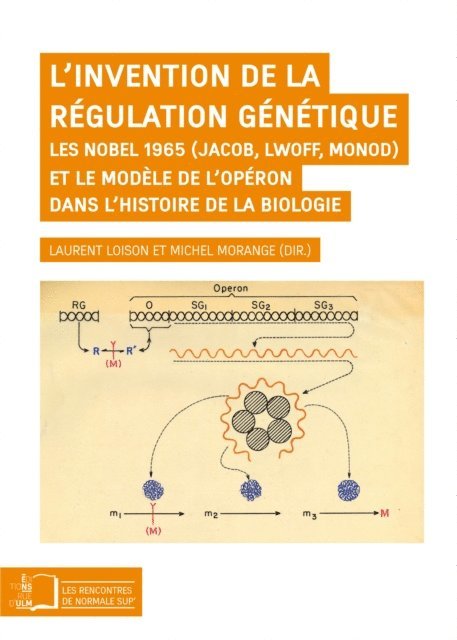
L'invention de la régulation génétique
Les Nobels 1965 (Jacob, Lwoff, Monod) et le modèle de l''opéron dans l''histoire de la biologie
Av Laurent Loison, Michel MORANGE
E-bok, 2017
173 kr
Lägg i varukorg
À travers l’exemple de l’opéron, ce livre s’attache à explorer le contexte théorique, philosophique et politique qui a accompagné l’essor de la biologie moléculaire française. L’élaboration du modèle de l’opéron lactose a marqué un tournant dans l’histoire des sciences de la vie. Cet évènement …
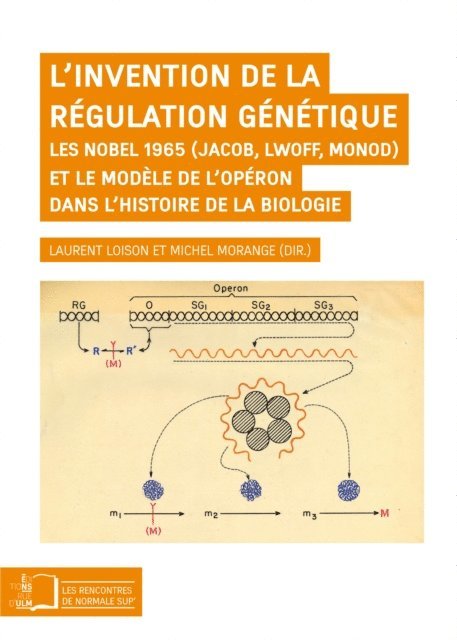
L'invention de la régulation génétique
Les Nobels 1965 (Jacob, Lwoff, Monod) et le modèle de l''opéron dans l''histoire de la biologie
Av Laurent Loison, Michel MORANGE
E-bok, 2017
173 kr
Lägg i varukorg
À travers l’exemple de l’opéron, ce livre s’attache à explorer le contexte théorique, philosophique et politique qui a accompagné l’essor de la biologie moléculaire française. L’élaboration du modèle de l’opéron lactose a marqué un tournant dans l’histoire des sciences de la vie. Cet évènement …
André Lwoff, une autobiographie
Itinéraire scientifique d''un prix Nobel
E-bok, 2017
433 kr
Lägg i varukorg
En 1965, après une longue période de disette, un prix Nobel venait enfin couronner la science française, en l’occurrence la biologie. Si les noms de Jacques Monod et François Jacob sont demeurés célèbres, celui du troisième lauréat, André Lwoff, a depuis retrouvé un certain anonymat. Pourtant, …
Le laboratoire CNRS de génétique évolutive de Gif
De part et d''autre de l''œuvre de Georges Teissier
E-bok, 2014
353 kr
Lägg i varukorg
Il est connu que la génétique ne s’est implantée que très difficilement en France. Alors que dans la plupart des pays occidentaux cette nouvelle science de l’hérédité allait connaître un développement important dès les premières années du XXe siècle, il fallut attendre 1945 pour que soit créée, …