Lee Heng - Böcker
Visar alla böcker från författaren Lee Heng. Handla med fri frakt och snabb leverans.
9 produkter
9 produkter
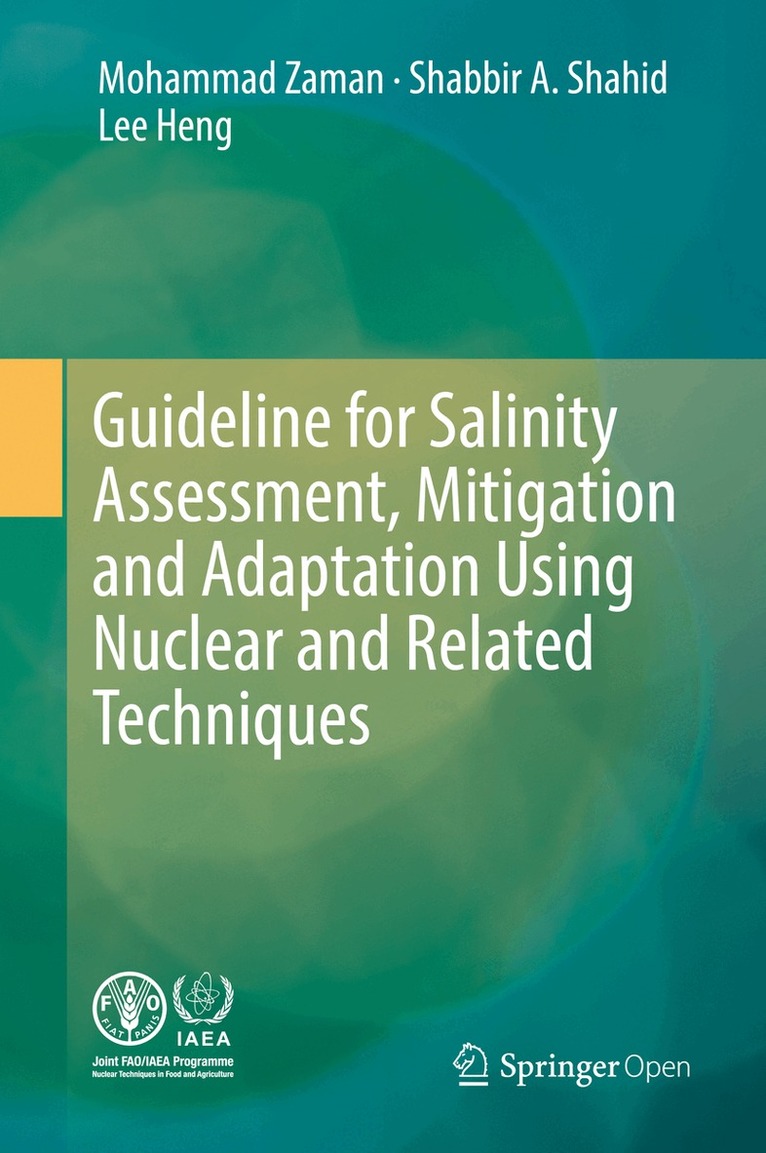
Guideline for Salinity Assessment, Mitigation and Adaptation Using Nuclear and Related Techniques
Häftad, Engelska, 2020
556 kr
Skickas inom 5-8 vardagar
Guideline for Salinity Assessment, Mitigation and Adaptation Using Nuclear and Related Techniques
Inbunden, Engelska, 2020
624 kr
Skickas inom 5-8 vardagar
Cosmic Ray Neutron Sensing: Estimation of Agricultural Crop Biomass Water Equivalent
Häftad, Engelska, 2019
538 kr
Skickas inom 10-15 vardagar
This open access book provides methods for the estimation of Biomass Water Equivalent (BEW), an essential step for improving the accuracy of area-wide soil moisture by cosmic-ray neutron sensors (CRNS).
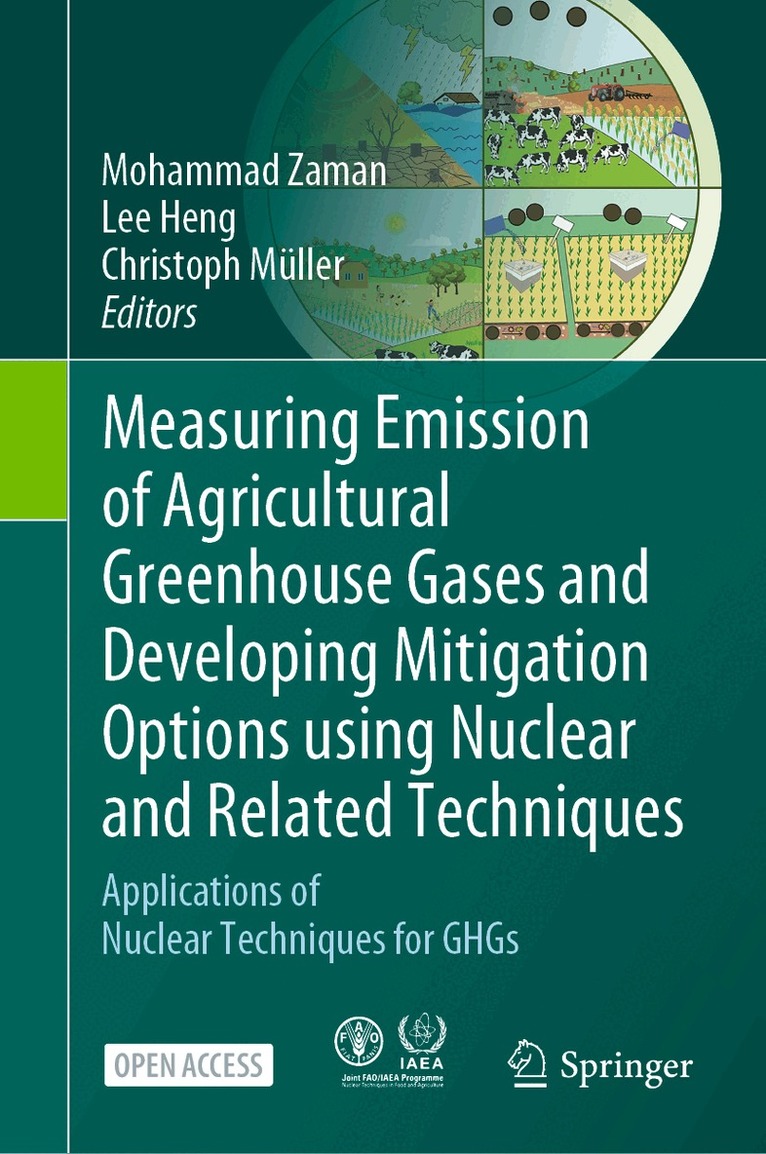
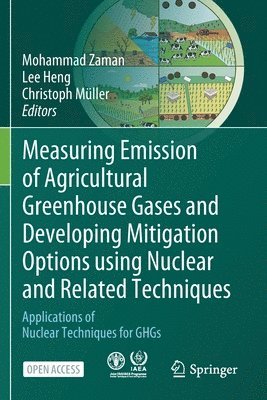
Measuring Emission of Agricultural Greenhouse Gases and Developing Mitigation Options using Nuclear and Related Techniques
Applications of Nuclear Techniques for GHGs
Inbunden, Engelska, 2021
538 kr
Skickas inom 10-15 vardagar
This open access book is an outcome of the collaboration between the Soil and Water Management & Crop Nutrition Section, Joint FAO/IAEA Division of Nuclear Techniques in Food and Agriculture, Department of Nuclear Sciences and Applications, International Atomic Energy Agency (IAEA), Vienna, Austria, and the German Science Foundation research unit DASIM (Denitrification in Agricultural Soils: Integrated control and Modelling at various scales) and other institutes. It presents protocols, methodologies and standard operating procedures (SOPs) for measuring GHGs from different agroecosystems and animals using isotopic and related techniques that can also be used to validate climate-smart agricultural practices to mitigate GHGs. The material featured is useful for beginners in the field wanting an overview of the current methodologies, but also for experts who need hands-on descriptions of said methodologies. The book is written in form of a monograph and consists of eight chapters.
Measuring Emission of Agricultural Greenhouse Gases and Developing Mitigation Options using Nuclear and Related Techniques
Applications of Nuclear Techniques for GHGs
Häftad, Engelska, 2021
1 069 kr
Skickas inom 10-15 vardagar
Tracing the Sources and Fate of Contaminants in Agroecosystems
Applications of Multi-stable Isotopes
Inbunden, Engelska, 2024
538 kr
Skickas inom 10-15 vardagar
The objective of this open access book is to present protocols, methodologies, and standard operating procedures (SOPs) used for the identification of sources, transport, and fate of agro-contaminants and illustrate them with several case studies of successful applications. The Soil and Water Management & Crop Nutrition (SWMCN) Subprogramme of the Joint Food and Agriculture Organization (FAO)/International Atomic Energy Agency (IAEA) Centre of Nuclear Techniques in Food and Agriculture, through a Coordinated Research Project (CRP) in partnership with national and international research institutes, developed and evaluated a set of analytical techniques (the toolbox). The toolbox integrates multiple isotope tracers that provide information on the origins and pathways of multiple pollutants through agro-ecosystems, thereby providing more accurate guidance on mitigations. However, land management strategies to address and control the transport of pollutants from soil to water bodies remain the shared responsibility of farm and aquaculture operators, agro-chemical manufacturers, and policymakers in food and agriculture as well as the mining sectors. This book is structured into eight chapters covering (i) an overview of the book’s content, (ii) guidelines for designing water sampling programmes, (iii) the use of mixing models applicable to tracers for water pollution studies, (iv) compound-specific isotope analyses to investigate pesticide degradation in agricultural catchments, (v) the use of stable oxygen isotope composition of phosphate to investigate phosphorous in soil-plant continuum, (vi) the use of stable sulphur isotopes to disentangle agro-pollutants from other contaminants, (vii) nuclear tools used in sediment source apportionment, and (viii) the conclusions and perspectives forward. The book offers up-to-date information, and we hope it is a great source of information for students, researchers, and policymakers. The SWMCN subprogramme thanks all the contributors involved in the preparation of this publication.
Tracing the Sources and Fate of Contaminants in Agroecosystems
Applications of Multi-stable Isotopes
Häftad, Engelska, 2025
432 kr
Skickas inom 10-15 vardagar
The objective of this open access book is to present protocols, methodologies, and standard operating procedures (SOPs) used for the identification of sources, transport, and fate of agro-contaminants and illustrate them with several case studies of successful applications. The Soil and Water Management & Crop Nutrition (SWMCN) Subprogramme of the Joint Food and Agriculture Organization (FAO)/International Atomic Energy Agency (IAEA) Centre of Nuclear Techniques in Food and Agriculture, through a Coordinated Research Project (CRP) in partnership with national and international research institutes, developed and evaluated a set of analytical techniques (the toolbox). The toolbox integrates multiple isotope tracers that provide information on the origins and pathways of multiple pollutants through agro-ecosystems, thereby providing more accurate guidance on mitigations. However, land management strategies to address and control the transport of pollutants from soil to water bodies remain the shared responsibility of farm and aquaculture operators, agro-chemical manufacturers, and policymakers in food and agriculture as well as the mining sectors. This book is structured into eight chapters covering (i) an overview of the book’s content, (ii) guidelines for designing water sampling programmes, (iii) the use of mixing models applicable to tracers for water pollution studies, (iv) compound-specific isotope analyses to investigate pesticide degradation in agricultural catchments, (v) the use of stable oxygen isotope composition of phosphate to investigate phosphorous in soil-plant continuum, (vi) the use of stable sulphur isotopes to disentangle agro-pollutants from other contaminants, (vii) nuclear tools used in sediment source apportionment, and (viii) the conclusions and perspectives forward. The book offers up-to-date information, and we hope it is a great source of information for students, researchers, and policymakers. The SWMCN subprogramme thanks all the contributors involved in the preparation of this publication.
Cosmic Ray Neutron Sensing: Estimation of Agricultural Crop Biomass Water Equivalent
Inbunden, Engelska, 2018
538 kr
Skickas inom 10-15 vardagar
This open access book provides methods for the estimation of Biomass Water Equivalent (BEW), an essential step for improving the accuracy of area-wide soil moisture by cosmic-ray neutron sensors (CRNS).
Guideline for Salinity Assessment, Mitigation and Adaptation Using Nuclear and Related Techniques
Inbunden, Engelska, 2018
538 kr
Skickas inom 10-15 vardagar
This open access book is an outcome of the collaboration between the Soil and Water Management & Crop Nutrition Section, Joint FAO/IAEA Division of Nuclear Techniques in Food and Agriculture, Department of Nuclear Sciences and Applications, International Atomic Energy Agency (IAEA), Vienna, Austria, and Dr. Shabbir A Shahid, Senior Salinity Management Expert, Freelancer based in United Arab Emirates.The objective of this book is to develop protocols for salinity and sodicity assessment and develop mitigation and adaptation measures to use saline and sodic soils sustainably. The focus is on important issues related to salinity and sodicity and to describe these in an easy and user friendly way. The information has been compiled from the latest published literature and from the authors’ publications specific to the subject matter. The book consists of six chapters. Chapter 1 introduces the terms salinity and sodicity and describes various salinity classification systems commonly used around the world. Chapter 2 reviews global distribution of salinization and socioeconomic aspects related to salinity and crop production. Chapters 3 covers comprehensively salinity and sodicity adaptation and mitigation options including physical, chemical, hydrological and biological methods. Chapter 4 discusses the efforts that have been made to demonstrate the development of soil salinity zones under different irrigation systems. Chapter 5 discusses the quality of irrigation water, boron toxicity and relative tolerance to boron, the effects of chlorides on crops. Chapter 6 introduces the role of nuclear techniques in saline agriculture.