Leiss Elisabeth Leiss – författare
Visar alla böcker från författaren Leiss Elisabeth Leiss. Handla med fri frakt och snabb leverans.
6 produkter
6 produkter
E-bok
PDF, Tyska, 2013995 kr
Läs direkt efter köp
E-bok
Engelska, 20201 305 kr
Läs direkt efter köp
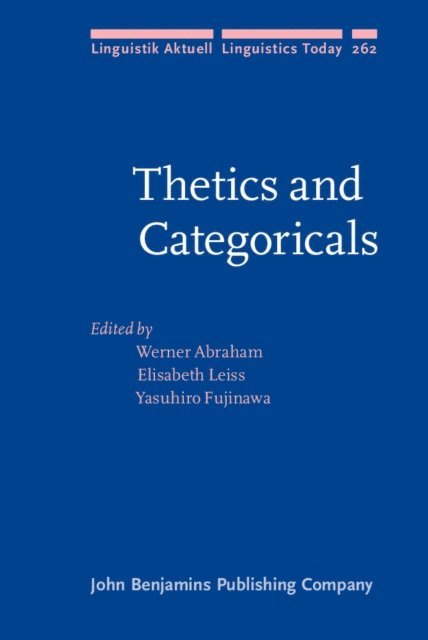
Thetics and Categoricals do not belong to the categories of German grammar. Thetics were introduced in logic as impersonal and broad focus constructions. They left profound and extensive traces in the logic of the late 19th century. For the class of thetic propositions, the criterion of textual exclusion plays the major role, i.e. the absence of any common grounds and of any anaphorism and background. In the foreground are sentences with subject inversion, subject suppression and detopicalization. These and only these are suitable for text beginnings, jokes, stage advertisements and solipsistic exclamatives, thus speech acts without communicative goals - free expressives in the true sense of the word. The contributions in this volume not only guide the reader through the history of philosophical logic and distributions of impersonals in contrast to Kantian categorical sentences, but also the correspondences in Japanese and Chinese which, in contrast to German and English, sport specific morphological markers for thetics as opposed to categoricals.
E-bok
PDF, Engelska, 20141 305 kr
Läs direkt efter köp
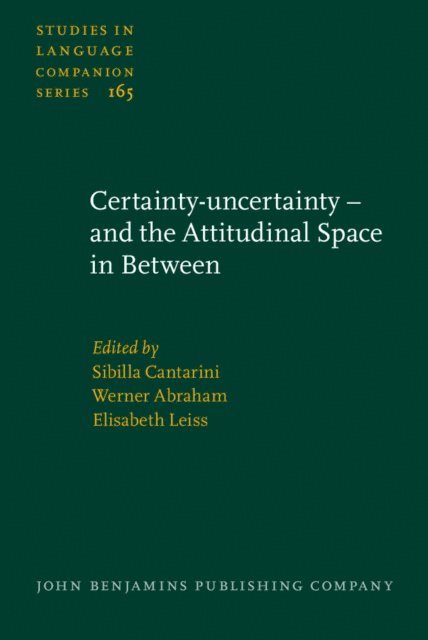
The selected papers of this volume cover five main topics, namely ‘Certainty: The conceptual differential’; ‘(Un)Certainty as attitudinality’; ‘Dialogical exchange and speech acts’; ‘Onomasiology’; and ‘Applications in exegesis and religious discourse’. By examining the general theme of the communication of certainty and uncertainty from different scientific fields, theoretical approaches and perspectives, this compendium of state-of-the-art research papers provides both an interdisciplinary comparison of the latest investigations, methods and findings, and new advances and theoretical insights with a common focus on human communication.
E-bok
PDF, Engelska, 20141 384 kr
Läs direkt efter köp
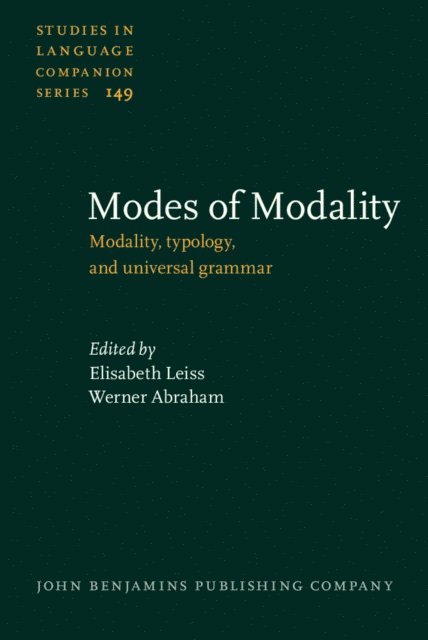
The volume aims at a universal definition of modality or “illocutionary/speaker’s perspective force” that is strong enough to capture the entire range of different subtypes and varieties of modalities in different languages. The central idea is that modality is all-pervasive in language. This perspective on modality allows for the integration of covert modality as well as peripheral instances of modality in neglected domains such as the modality of insufficieny, of attitudinality, or neglected domains such as modality and illocutionary force in finite vs. nonfinite and factive vs. non-factive subordinated clauses. In most languages, modality encompasses modal verbs both in their root and epistemic meanings, at least where these languages have the principled distribution between root and epistemic modality in the first place (which is one fundamentally restricted, in its strict qualitative and quantitative sense, to the Germanic languages). In addition, this volume discusses one other intricate and partially highly mysterious class of modality triggers: modal particles as they are sported in the Germanic languages (except for English). It is argued in the contributions and the languages discussed in this volume how modal verbs and adverbials, next to modal particles, are expressed, how they are interlinked with contextual factors such as aspect, definiteness, person, verbal factivity, and assertivity as opposed to other attitudinal types. An essential concept used and argued for is perspectivization (a sub-concept of possible world semantics). Language groups covered in detail and compared are Slavic, Germanic, and South East Asian. The volume will interest researchers in theoretical and applied linguistics, typology, the semantics/pragmatics interface, and language philosophy as it is part of a larger project developing an alternative approach to Universal Grammar that is compatible with functionalist approaches.
E-bok
PDF, Engelska, 20081 447 kr
Läs direkt efter köp
The main topics pursued in this volume are based on empirical insights derived from Germanic: logical and typological dispositions about aspect-modality links. These are probed in a variety of non-related languages. The logically establishable links are the following: Modal verbs are aspect sensitive in the selection of their infinitival complements – embedded infinitival perfectivity implies root modal reading, whereas embedded infinitival imperfectivity triggers epistemic readings. However, in marked contexts such as negated ones, the aspectual affinities of modal verbs are neutralized or even subject to markedness inversion. All of this suggests that languages that do not, or only partially, bestow upon full modal verb paradigms seek to express modal variations in terms of their aspect oppositions. This typological tenet is investigated in a variety of languages from Indo-European (German, Slavic, Armenian), African, Asian, Amerindian, and Creoles. Seeming deviations and idiosyncrasies in the interaction between aspect and modality turn out to be highly rule-based.
E-bok
PDF, Engelska, 20071 588 kr
Läs direkt efter köp
The following theoretical-empirical points on the DP are discussed: Article and its referential-anaphoric properties by Abraham (Determiners in Centering Theory); Bartra (On bare NPs in Old Spanish and Catalan); identification of all functional nominal categories by Stvan (Bare singular count nouns); Kupisch & Koops (Specificity and negation); Jäger (History of German indefinite determiners); typological comparison of the interaction of nominal and verbal determination by Abraham (Discourse-functional crystallization of the original demonstrative); Leiss (Covert (in)definiteness and aspect in Old Icelandic, Gothic, Old High German); Lohndal (Double definiteness during Old Norse); emergence of DP in ontogeny/phylogeny by Osawa (DP, TP and aspect in Old English and L1 acquisition); Bittner (Early functions of definites in L1 acquisition); Wood (Demonstratives and possessives emergent from Old English); Bauer ((in)definite articles in Indo-European) and Stark (Variation in nominal indefiniteness in Romance).