Abraham Werner Abraham – författare
Visar alla böcker från författaren Abraham Werner Abraham. Handla med fri frakt och snabb leverans.
19 produkter
19 produkter
E-bok
Engelska, 20201 305 kr
Läs direkt efter köp
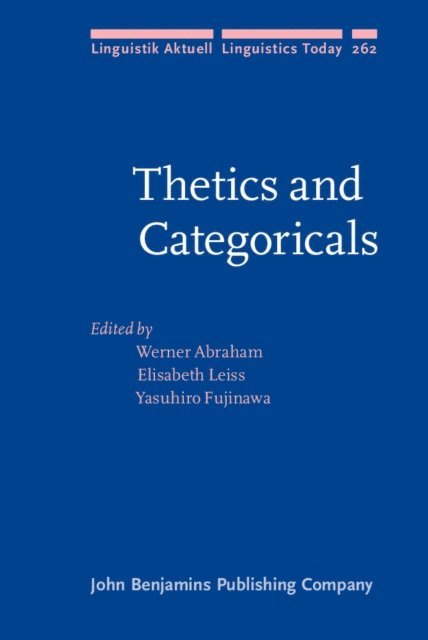
Thetics and Categoricals do not belong to the categories of German grammar. Thetics were introduced in logic as impersonal and broad focus constructions. They left profound and extensive traces in the logic of the late 19th century. For the class of thetic propositions, the criterion of textual exclusion plays the major role, i.e. the absence of any common grounds and of any anaphorism and background. In the foreground are sentences with subject inversion, subject suppression and detopicalization. These and only these are suitable for text beginnings, jokes, stage advertisements and solipsistic exclamatives, thus speech acts without communicative goals - free expressives in the true sense of the word. The contributions in this volume not only guide the reader through the history of philosophical logic and distributions of impersonals in contrast to Kantian categorical sentences, but also the correspondences in Japanese and Chinese which, in contrast to German and English, sport specific morphological markers for thetics as opposed to categoricals.
E-bok
PDF, Engelska, 20141 305 kr
Läs direkt efter köp
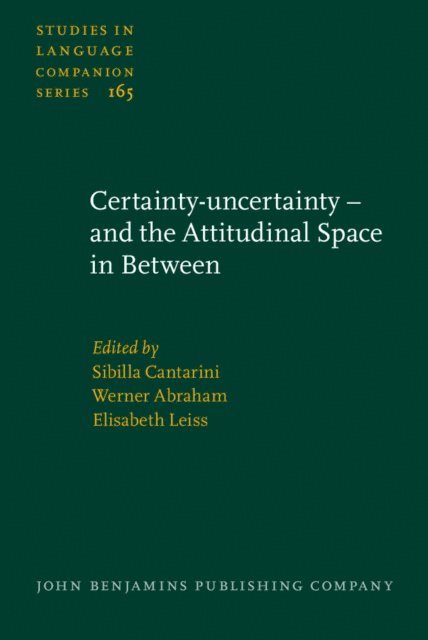
The selected papers of this volume cover five main topics, namely ‘Certainty: The conceptual differential’; ‘(Un)Certainty as attitudinality’; ‘Dialogical exchange and speech acts’; ‘Onomasiology’; and ‘Applications in exegesis and religious discourse’. By examining the general theme of the communication of certainty and uncertainty from different scientific fields, theoretical approaches and perspectives, this compendium of state-of-the-art research papers provides both an interdisciplinary comparison of the latest investigations, methods and findings, and new advances and theoretical insights with a common focus on human communication.
E-bok
PDF, Engelska, 20141 384 kr
Läs direkt efter köp
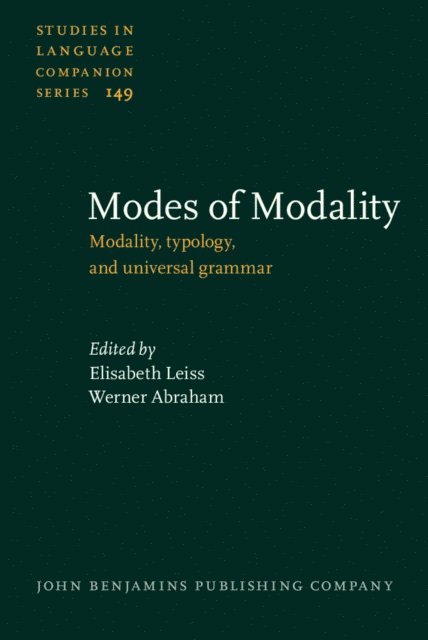
The volume aims at a universal definition of modality or “illocutionary/speaker’s perspective force” that is strong enough to capture the entire range of different subtypes and varieties of modalities in different languages. The central idea is that modality is all-pervasive in language. This perspective on modality allows for the integration of covert modality as well as peripheral instances of modality in neglected domains such as the modality of insufficieny, of attitudinality, or neglected domains such as modality and illocutionary force in finite vs. nonfinite and factive vs. non-factive subordinated clauses. In most languages, modality encompasses modal verbs both in their root and epistemic meanings, at least where these languages have the principled distribution between root and epistemic modality in the first place (which is one fundamentally restricted, in its strict qualitative and quantitative sense, to the Germanic languages). In addition, this volume discusses one other intricate and partially highly mysterious class of modality triggers: modal particles as they are sported in the Germanic languages (except for English). It is argued in the contributions and the languages discussed in this volume how modal verbs and adverbials, next to modal particles, are expressed, how they are interlinked with contextual factors such as aspect, definiteness, person, verbal factivity, and assertivity as opposed to other attitudinal types. An essential concept used and argued for is perspectivization (a sub-concept of possible world semantics). Language groups covered in detail and compared are Slavic, Germanic, and South East Asian. The volume will interest researchers in theoretical and applied linguistics, typology, the semantics/pragmatics interface, and language philosophy as it is part of a larger project developing an alternative approach to Universal Grammar that is compatible with functionalist approaches.
E-bok
PDF, Engelska, 19961 714 kr
Läs direkt efter köp
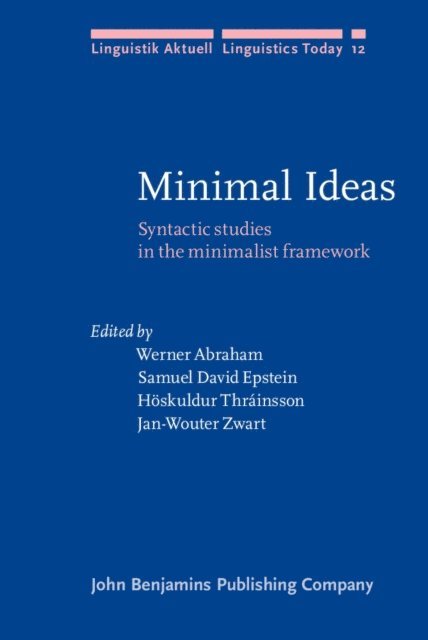
The articles in this volume are inspired by the Minimalist Program first outlined in Chomsky’s MIT Fall term class lectures of 1991 and in his seminal paper “A Minimalist Program for Linguistic Theory”. The articles seek to develop further some key idea in the Minimalist Program, sometimes in ways deviating from the course taken by Chomsky.The articles are preceded by a 40 page introduction into the minimalist framework. The introduction pays special attention to the question how the minimalist framework developed out of the Principles and Parameters (Government and Binding) framework. The introduction serves as a guide through the entire volume, presenting the issues to be discussed in the articles in detail, and offering a thematic overview over the volume as a whole.Most of the articles in this volume are concerned with issues raised in Chomsky’s first two minimalist papers, namely “A Minimalist Program for Linguistic Theory” (1993, first distributed in 1992) and “Bare Phrase Structure” (1995a, first distributed 1994). In acknowledgment of this, each article starts out with a quote from Chomsky (1993, 1995a). This quote also serves to highlight the particular grammatical or theoretical issue that is primarily discussed in the relevant article.Several articles relate issues raised in Chomsky’s first two minimalist papers to the basic ideas in Kayne’s book, The Antisymmetry of Syntax (1994, distributed in part in manuscript form in 1993). In many respects, therefore, these articles develop alternatives to ideas proposed in chapter 4, “Categories and Transformations,” of Chomsky’s most recent book, The Minimalist Program (1995b). Some of the articles contain references to chapter 4, and some comments on similarities and differences between ideas developed in these papers and in chapter 4 of Chomsky 1995b can also be found in the Introduction to this volume.
E-bok
PDF, Engelska, 19861 714 kr
Läs direkt efter köp
Some fundamental questions regarding sentence structure in linguistics concern whether all languages, at some level of abstraction, have the same structure, and what are the basic categories with which to describe sentence structure. The contributors of this volume are specialized in two quite different languages: Hungarian and German. Of the German papers three are mainly about focus (Abraham, Jacobs, and Stechow-Uhman), whereas the remaining ones (Haider and Scherpenisse) are mainly about V-second. The Hungarian papers are all about focus, of which those of Kálman, Kiefer, Marácz, and De Mey-Marácz are about focussing in the stricter sense. Hunyadi, Kenesei and É. Kiss focus on the pre-verbal area in general and the interpretation of operators in Hungarian in particular. The remaining papers (Horvath, Komlósy, and Szabolczi) are on the position of the PRE-V, the position immediately after the finite verb.
E-bok
PDF, Engelska, 19831 384 kr
Läs direkt efter köp
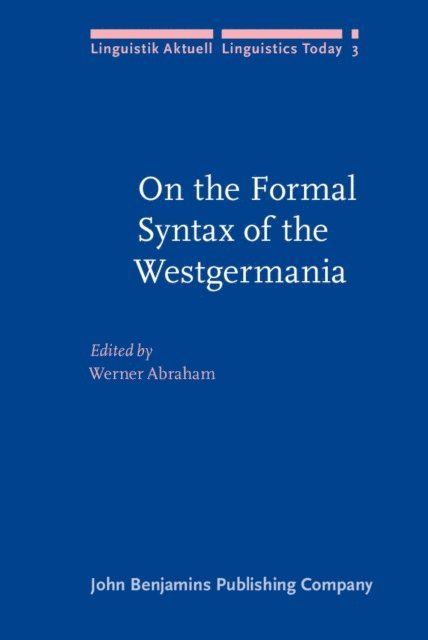
It has often been noted that Dutch (and Frisian) reflects a particular stage of development between German and English. Phonologically, syntactically and morphologically, Dutch and German are closely related languages. Yet, there remain sufficient morphosyntactic differences in terms of language development. The contributions of this collection focus on the relationships and differences of these neighbouring West Germanic languages.
E-bok
PDF, Tyska, 19801 588 kr
Läs direkt efter köp
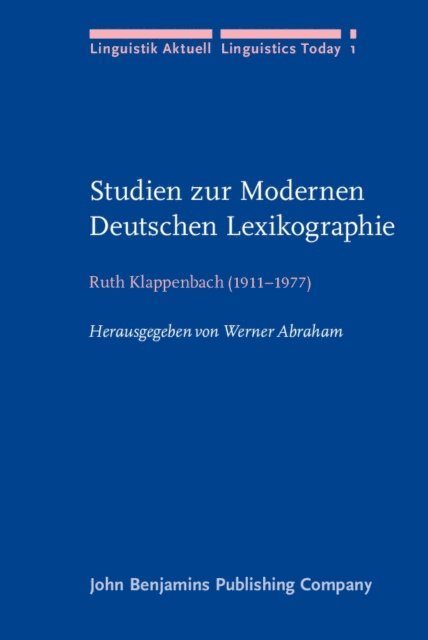
The book sketches the history and technical apparatus of dictionary writing, in detail Ruth Klappenbach’s Wörterbuch der deutschen Gegenwartssprache. Berlin: Akademieverlag 1956, a loner at its time and setting the pattern for the many other German dictionaries to come. The book’s main chapters are: structure of the single dictionary entry; meaning variants; validations of style; grammatical specifications; quotes; pronunciation; etymologies.
E-bok
PDF, Engelska, 19911 525 kr
Läs direkt efter köp
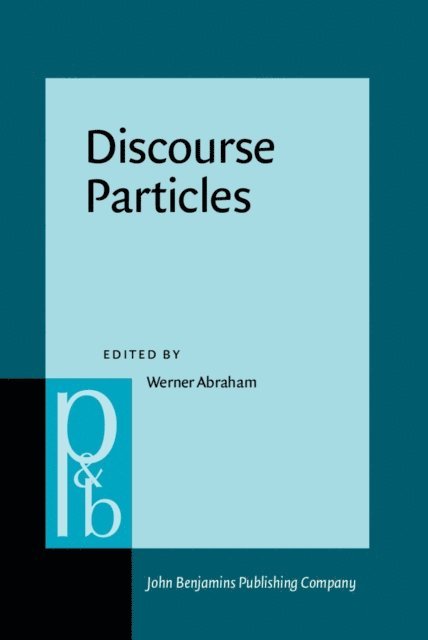
This book is about particles in the narrower sense of the word as opposed to the broader meaning covering all uninflected words of a language. In the narrower meaning of the linguistic term particles can be distinguished between logical, or scalar particles and modal, or pragmatic particles. The semantic, pragmatic and syntactic properties of modal particles differ vastly from those of the scalar particles, on the one hand, and their homonymic counterparts functioning in different syntactic categories, on the other hand. The contributions to this volume offer the latest research on the semantic, pragmatic and syntactic properties of particles in the English and German language.
E-bok
PDF, Engelska, 19951 588 kr
Läs direkt efter köp
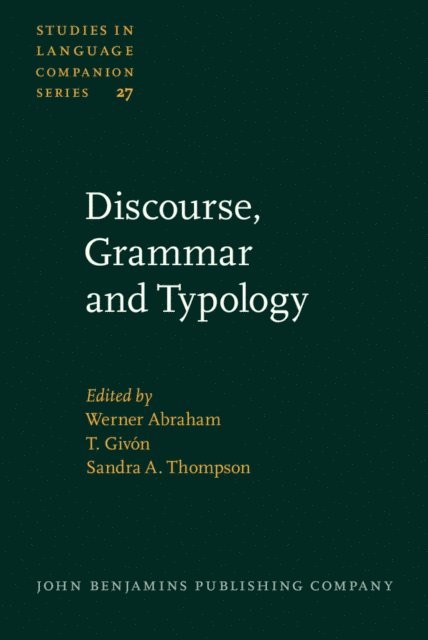
This volume combines papers selected for their affinity with work on discourse analysis and language typology. The methodological platform is the authors'' conviction that all linguistic work needs to be empirical in the sense that (1) generalizations are to be made on the basis of spoken texts in larger contexts, (2) generalizations are correct only as long as pertinent linguistic material does not contradict them, and (3) that linguistic categories and rules are of a temporal nature. In this sense, the contributions represent ''functional typological'' comparison, often of languages not frequently investigated.The papers are arranged in 5 groups: Transitivity and voice; Clausal modality; Typology and discourse categories; Language and Culture; Functionality.
E-bok
PDF, Engelska, 19781 651 kr
Läs direkt efter köp
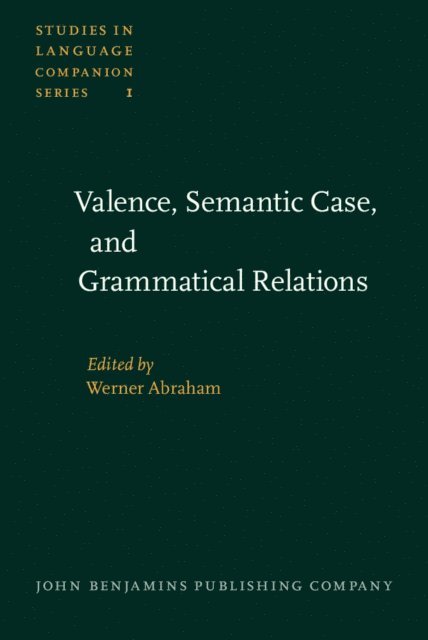
The papers in this volume have been grouped in three thematic parts: Valence which plays a key concept in the syntactic classification of verbs and adjectives, provides a necessary link for decoding and encoding grammatical relations, and is an important requisite for the evaluation of formal languages for the purpose of describing and explaining phenomena of natural language. The second group of papers concerns the notion of (deep) case and the implications of tracing a grammatical theory on semantic case. The final series of papers is distinguished by the degree of accent it puts on the link between linguistic surface phenomena, including semantic case, and grammatical relations, in the sense that it has been postulated by Universal Grammar.
E-bok
PDF, Engelska, 20081 447 kr
Läs direkt efter köp
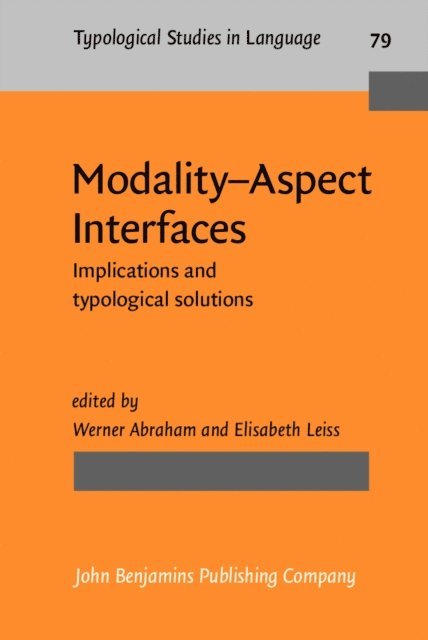
The main topics pursued in this volume are based on empirical insights derived from Germanic: logical and typological dispositions about aspect-modality links. These are probed in a variety of non-related languages. The logically establishable links are the following: Modal verbs are aspect sensitive in the selection of their infinitival complements – embedded infinitival perfectivity implies root modal reading, whereas embedded infinitival imperfectivity triggers epistemic readings. However, in marked contexts such as negated ones, the aspectual affinities of modal verbs are neutralized or even subject to markedness inversion. All of this suggests that languages that do not, or only partially, bestow upon full modal verb paradigms seek to express modal variations in terms of their aspect oppositions. This typological tenet is investigated in a variety of languages from Indo-European (German, Slavic, Armenian), African, Asian, Amerindian, and Creoles. Seeming deviations and idiosyncrasies in the interaction between aspect and modality turn out to be highly rule-based.
E-bok
PDF, Engelska, 20071 588 kr
Läs direkt efter köp
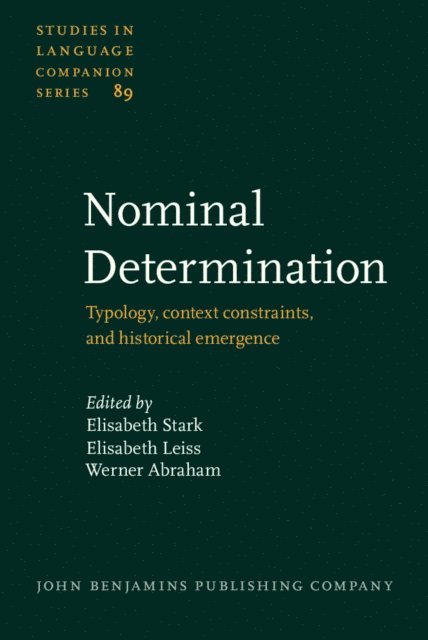
The following theoretical-empirical points on the DP are discussed: Article and its referential-anaphoric properties by Abraham (Determiners in Centering Theory); Bartra (On bare NPs in Old Spanish and Catalan); identification of all functional nominal categories by Stvan (Bare singular count nouns); Kupisch & Koops (Specificity and negation); Jäger (History of German indefinite determiners); typological comparison of the interaction of nominal and verbal determination by Abraham (Discourse-functional crystallization of the original demonstrative); Leiss (Covert (in)definiteness and aspect in Old Icelandic, Gothic, Old High German); Lohndal (Double definiteness during Old Norse); emergence of DP in ontogeny/phylogeny by Osawa (DP, TP and aspect in Old English and L1 acquisition); Bittner (Early functions of definites in L1 acquisition); Wood (Demonstratives and possessives emergent from Old English); Bauer ((in)definite articles in Indo-European) and Stark (Variation in nominal indefiniteness in Romance).
E-bok
PDF, Engelska, 20061 918 kr
Läs direkt efter köp
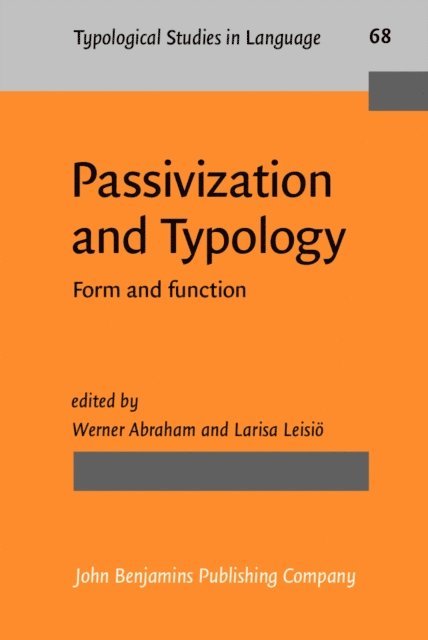
Is the passive a unified universal phenomenon? The claim derived from this volume is that the passive, if not universal, has become unified according to function. Language as a means of communication needs the passive, or passive-like constructions, and sooner or later develops them based on other voices (impersonal active, middle, reflexive), specific semantic meanings such as adversativity, or tense-aspect categories (stative,perfect, preterit). Certain contributors review the passives in various languages and language groups, including languages rarely discussed. Another group of contributors takes a novel theoretical approach toward passivization within a broad typological perspective. Among the languages discussed are Vedic, Irish, Mandarin Chinese, Thai, Lithuanian, Mordvin, and Nganasan, next to almost all European languages. Various theoretical frameworks such as Optimality Theory, Modern Structuralist Approaches, Role and Reference Grammar, Cognitive Semantics, Distributed Morphology, and Case Grammar have been applied by the different authors.
E-bok
PDF, Engelska, 20061 714 kr
Läs direkt efter köp
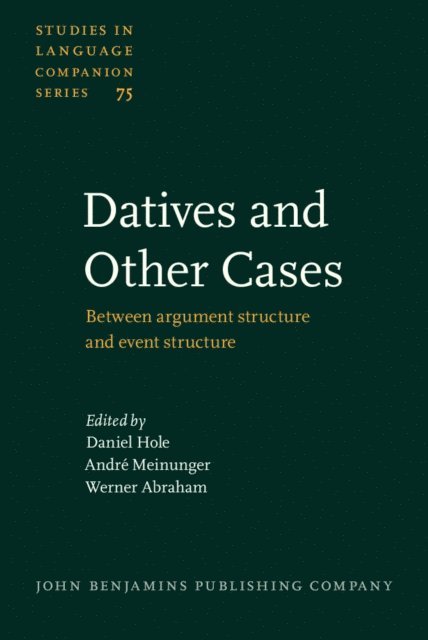
This volume provides a state-of-the-art account of research into datives and other morphological cases. The contributors, among them leading scholars in the field, present fresh insights into traditional issues such as the dichotomy between lexical and structural case, and open up fascinating new areas of research. A recurrent feature of the majority of contributions is their combined syntax-semantics perspective. Germanic varieties, Serbian, Albanian and other Balkan languages alongside Chinese, Japanese, Tagalog are discussed from various theoretical angles such as mainstream generativism, lexical-functional grammar, and functional typology. Despite the broad range of facts spanning the distance between acquisition data and dialectology, the papers are connected by a renewed interest in form-function correspondencies. This volume will be welcomed by theoretical linguists and typologists with an interest in argument and event structure, linguists studying the case systems of individual languages and researchers in search for up-to-date discussion of Germanic datives.
E-bok
PDF, Engelska, 20041 305 kr
Läs direkt efter köp
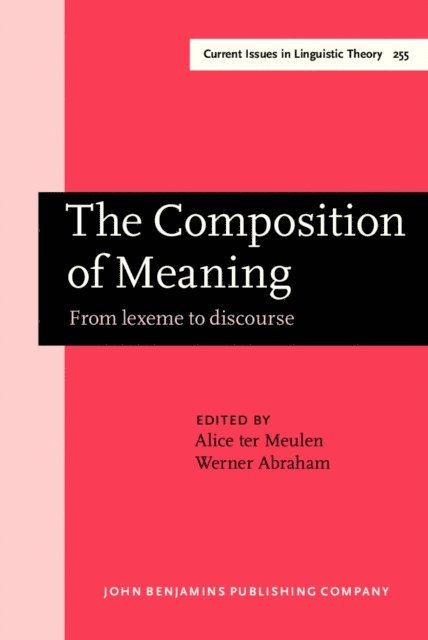
In the modular design of generative theory the syntax–semantics interface has accounted all along for meanings at the level of Logical Form. The syntax–pragmatics interface, on the other hand, is the result of what one may call the ‘pragmatic turn’ in the linguistic theory, where content is partitioned into given and new information. In other words, the structural division of the clause has been subjected to criteria of information, or discourse structure. Both interfaces require a structurally descriptive inventory whose specific shapes can be motivated on theory-internal grounds only. The present collection of original articles develops the concept of these interfaces further. The papers in the first section focus on the syntax–semantics interface, those in the second section on the syntax–pragmatics interface.
E-bok
PDF, Engelska, 20021 777 kr
Läs direkt efter köp
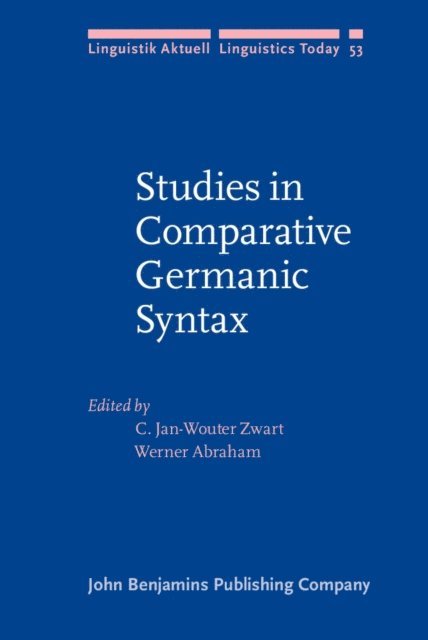
This volume presents a collection of articles reporting on new research carried out within the theoretical framework of generative grammar on the comparative syntax of the Germanic languages.Divided in four main sections, the book focuses on issues of subordination and complementation (with emphasis on German/Dutch and Danish), displacement phenomena discussed in relation with richness of morphology (with special attention to English, German/Dutch, and Norwegian, as well as presenting more general discussion of the issue), language variation and change (studying historical English syntax and Frisian contact dialects), and the syntax-semantics interface viewed from a Germanic perspective (addressing ellipsis, reflexivity, and the behavior of quantifiers).
E-bok
PDF, Engelska, 20021 714 kr
Läs direkt efter köp
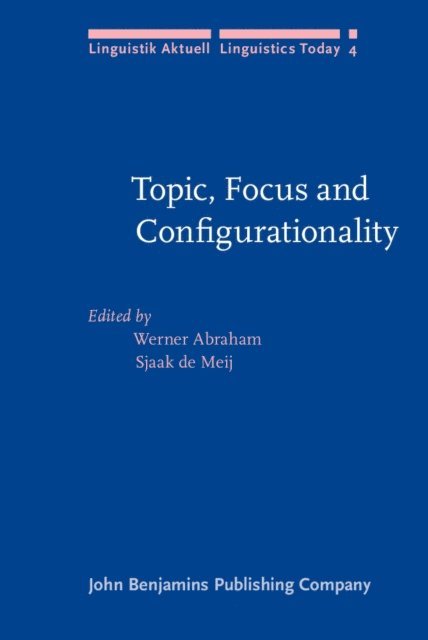
This book takes up a variety of general syntactic topics, which either yield different solutions in German, in particular, or which lead to different conclusions for theory formation. One of the main topics is the fact that languages that allow for extensive scrambling between the two verbal poles, V-2 and V-last, need to integrate discourse functions like thema and rhema into the grammatical description. This is attempted, in terms of Minimalism, thus extending the functional domain. Special attention is given to the asymmetrical scrambling behavior of indefinites vs. definites and their semantic interpretation. Related topics are: Transitive expletive sentences, types of existential sentences with either BE or HAVE, the that-trace phenomenon and its semantics, negative polarity items, ellipsis and gapping, passivization, double negation — all of which have extensive effects both on distributional behavior and semantic disambiguation, reaching far beyond effects observable in English with its rigid, ‘un-scrambable’ word order.
865 kr
Läs direkt efter köp
This work demonstrates that what is commonly called ‘preterite decay in Upper German’ (PS; cf. German Präteritumschwund) is in fact a phenomenon common to a great number of European languages, all of which are in areal con-tact. However, the conclusion that this is a phenomenon arising under areal influence appears clearly mistaken — not only so because it would no more than postpone the search for the real trigger of this development. It will be shown, first, that the preterite loss in the languages under inspection comes in different states of completion. It will be seen that the loss of the preterite, under this perspective, German is by no means a completed process. Second, and what is more, it will be argued that the trigger for this decay of the synthetic preterite and its replacement by analytic preterite forms is the specific criteria under which oral (as opposed to written) communication is executed. Counter to the rich, existing literature on the topic, a number of parsing principles will be claimed to be responsible for this diachronic development yielding different results due to a different execution of these principles.
E-bok
PDF, Engelska, 19991 588 kr
Läs direkt efter köp
This collection presents typological work on tense, aspect, and epistemic modality in a variety of languages and against the background of different schools of thinking, among which the St. Petersburg Typological School developed and so masterfully implemented by the Petersburg linguist, Vladimir Petrovich Nedjalkov. The volume honors this reputed scholar for his life work. It is in mainly this spirit (and the EUROTYPE spirit) that the following scholars have contributed to the volume: T. Tsunoda on Warrungu (Australian indigeneous language), L. Kulikov on Vedic, K. Kiryu on Japanese, Korean and Newari, N. Sumbatova on Svan (from the Kartvelian group), T.Bulygina & A. Shmelev on Russian, W. Boeder on Georgian, R. Thieroff on aorist and imperfect in European languages, Y. Poupynin on Russian, L. Johanson on Kipchak Turkic, I. Dolinina on Russian, N. Kozintseva on Old and Modern Eastern Armenian, Ch. Lee on Korean, W. Abraham on split ergative languages and German, G. Silnitsky on Russian, V. Plungian on Russian, E. Rakhilina on Russian, and K. Ebert on Kalmyk.