Leonard A. Rosenblum – författare
Visar alla böcker från författaren Leonard A. Rosenblum. Handla med fri frakt och snabb leverans.
9 produkter
9 produkter
E-bok
PDF, Engelska, 2013687 kr
Läs direkt efter köp
How are we to understand the complex forces that shape human behavior? A variety of diverse perspectives, drawing upon studies of human behavioral ontogeny, as well as humanity''s evolutionary heri tage, seem to provide the best likelihood of success. It is in the attempt to synthesize such potentially disparate approaches to human devel opment into an integrated whole that we undertake this series on the Genesis of Behavior. In many respects, the incredible burgeoning of research in child development over the last decade or two seems like a thousand lines of inquiry spreading outward in an incoherent starburst of effort. The need exists to provide, on an ongoing basis, an arena of discourse within which the threads of continuity between those diverse lines of research on human development can be woven into a fabric of meaning and understanding. Scientists, scholars, and those who attempt to translate their efforts into the practical realities of the care and guidance of infants and children are the audience that we seek to reach. Each requires the opportunity to see-to the degree that our knowledge in given areas permits-various aspects of development in a coherent, integrated fashion. It is hoped that this series, which will bring together research on infant biology, developing infant capacities, animal models, the impact of social, cultural, and familial forces on development, and the distorted products of such forces under certain circumstances, will serve these important social and scientific needs.
Del 3 - Genesis of Behavior
Uncommon Child
Häftad, Engelska, 2012
549 kr
Skickas inom 10-15 vardagar
How are we to understand the complex forces that shape human behavior? A variety of diverse perspectives, drawing upon studies of human behavioral ontogeny, as well as humanity's evolutionary heri tage, seem to provide the best likelihood of success. It is in the attempt to synthesize such potentially disparate approaches to human devel opment into an integrated whole that we undertake this series on the Genesis of Behavior. In many respects, the incredible burgeoning of research in child development over the last decade or two seems like a thousand lines of inquiry spreading outward in an incoherent starburst of effort. The need exists to provide, on an ongoing basis, an arena of discourse within which the threads of continuity between those diverse lines of research on human development can be woven into a fabric of meaning and understanding. Scientists, scholars, and those who attempt to translate their efforts into the practical realities of the care and guidance of infants and children are the audience that we seek to reach. Each requires the opportunity to see-to the degree that our knowledge in given areas permits-various aspects of development in a coherent, integrated fashion. It is hoped that this series, which will bring together research on infant biology, developing infant capacities, animal models, the impact of social, cultural, and familial forces on development, and the distorted products of such forces under certain circumstances, will serve these important social and scientific needs.
E-bok
PDF, Engelska, 20121 977 kr
Läs direkt efter köp
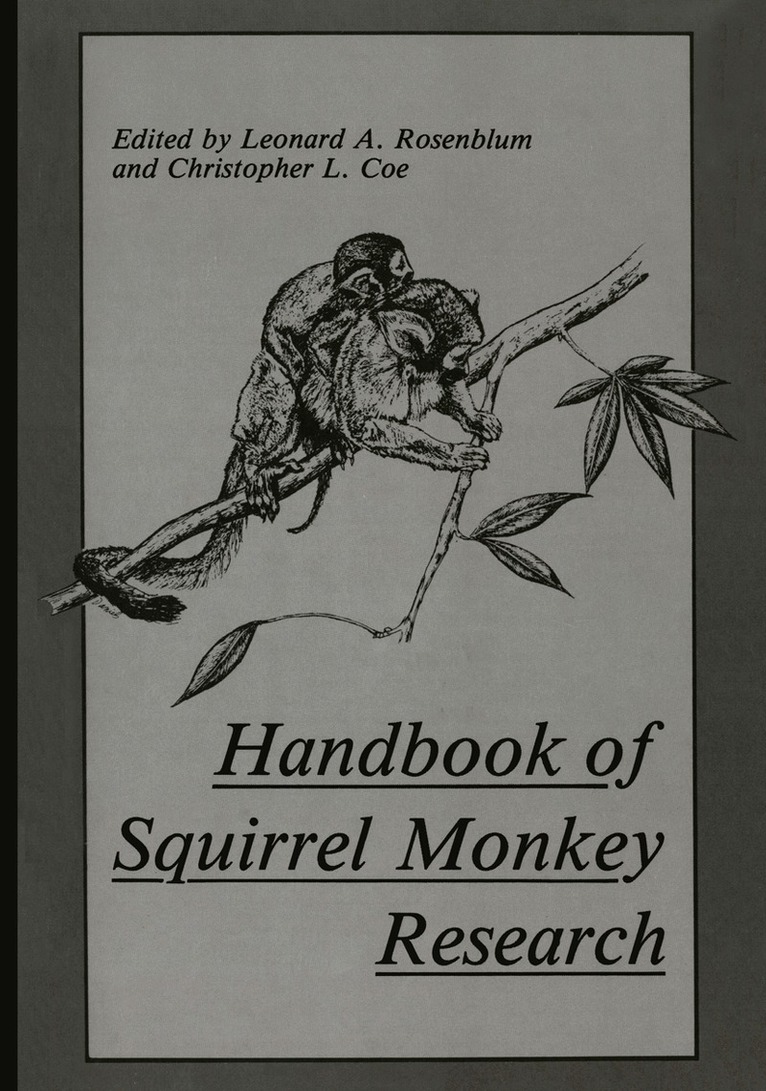
As the editors of the first book on the squirrel monkey prophesied in 1968,* there has been an incredible expansion in primate research during the past 16 years. Their projection that the squirrel monkey would play an increasingly important role in this research effort has also come to be true during the ensuing years. One inadvertent result of the rapid growth, however, is that it has become more and more difficult for investigators to keep track of new information, both in their own disciplines and in related fields. For scientists who study and use the squirrel monkey in research, this problem is particularly pronounced, because articles are often published in specialized and disparate journals. We felt that a new synthesis of the vast amount of information on Saimiri would resolve this problem and would provide an extremely valuable com panion volume to the first book. The idea grew out of a small symposium held at the IX Congress of the International Primatological Society in Atlanta, Geor gia, during August, 1982. Following the format of The Squirrel Monkey, ad ditional authors were invited to discuss advances in areas which had experi enced exceptional growth or to review basic information that would be of practical value to future researchers. Even with focused topics and synthetic reviews, the wealth of new data resulted in many long manuscripts. In response to the continuing problems with Saimiri nomenclature, Richard Thorington has provided us with a definitive statement on squirrel monkey taxonomy.
Häftad, Engelska, 2012
1 634 kr
Skickas inom 10-15 vardagar
As the editors of the first book on the squirrel monkey prophesied in 1968,* there has been an incredible expansion in primate research during the past 16 years. Their projection that the squirrel monkey would play an increasingly important role in this research effort has also come to be true during the ensuing years. One inadvertent result of the rapid growth, however, is that it has become more and more difficult for investigators to keep track of new information, both in their own disciplines and in related fields. For scientists who study and use the squirrel monkey in research, this problem is particularly pronounced, because articles are often published in specialized and disparate journals. We felt that a new synthesis of the vast amount of information on Saimiri would resolve this problem and would provide an extremely valuable com panion volume to the first book. The idea grew out of a small symposium held at the IX Congress of the International Primatological Society in Atlanta, Geor gia, during August, 1982. Following the format of The Squirrel Monkey, ad ditional authors were invited to discuss advances in areas which had experi enced exceptional growth or to review basic information that would be of practical value to future researchers. Even with focused topics and synthetic reviews, the wealth of new data resulted in many long manuscripts. In response to the continuing problems with Saimiri nomenclature, Richard Thorington has provided us with a definitive statement on squirrel monkey taxonomy.
E-bok
PDF, Engelska, 2014756 kr
Läs direkt efter köp
Primate Behavior: Developments in Field and Laboratory Research, Volume 3: Monkeys as Perceivers illustrates some general procedures for studying nonverbal perceiving in monkeys. This book takes into account the environment that was present when the monkeys were evolving their basic patterns of behavior in order to describe monkeys as perceivers. The topics include the general requirements for a description of nonverbal perception, inferences about attention, and complex conflicting cues of space. The interpretation of spatial discontiguity, alternative ways to measure detour performance, and methodological problems in specifying form are also described. This publication likewise covers the confusion errors in short-term memory and color perception. This volume is suitable for biologists and researchers interested in monkeys as perceivers.
E-bok
PDF, Engelska, 2013756 kr
Läs direkt efter köp
Primate Behavior: Developments in Field and Laboratory Research, Volume 2, features a collection of papers that points toward the significance and efficacy of the interspecific and interenvironmental comparative approaches to the study of primate behavior. Continuing the general theme of the series, this volume combines a number of papers varying in scope and focus, ranging from extensive individual studies to comprehensive review. It allows workers from a variety of biological disciplines to obtain a more substantial grasp of primate behavior. The book contains five chapters and begins with a study on the behavior of rhesus macaques in several locales in India, providing substantial new material on the behavior of these species in ecological context. This is followed by separate chapters that present comparative studies of the behavior of Callicebus and Saimiri in field and laboratory settings of varying types; experiments on communication of affect in monkeys; and a review of behavior involved in parturition throughout the primate order.
E-bok
PDF, Engelska, 2013756 kr
Läs direkt efter köp
Primate Behavior: Developments in Field and Laboratory Research, Volume 4 examines developments in field and laboratory research on primate behavior. Topics range from facial expressions in nonhuman primates to the behavior and malnutrition in the rhesus monkey. The population structure and dynamics of the Borneo orang-utan in relation to its ecology and reproductive strategy are also discussed, along with the social organization of Macaca fascicularis. Comprised of six chapters, this volume begins by discussing a field study that uses sound analysis to investigate the link between vocal pattern and social situation in the Japanese monkey (Macaca fuscata). The next chapter focuses on one particular and very important means of visual communication in nonhuman primates: facial expressions. The behavior of marmoset monkeys (Callithricidae) is then considered, with emphasis on their social structure and social organization as well as patterns of social and sexual communication. The remaining chapters explore feeding behavior and malnutrition in the rhesus monkey; the population structure and dynamics of the Borneo orang-utan in relation to its ecology and reproductive strategy; and the social organization and intergroup behavior of Macaca fascicularis. This book should be of interest to biologists and primatologists.
E-bok
PDF, Engelska, 2013756 kr
Läs direkt efter köp
Primate Behavior: Developments in Field and Laboratory Research, Volume 1, was created to fill the need for a publication series which can provide a continuing arena of discourse for all those scientists of varying disciplines concerned with the behavior of primates. It is expected that the participants in this new serial publication and those who will find interest and value in the material it contains will be drawn from a wide array of scientific disciplines, including psychology, anthropology, zoology, psychiatry, physiology, pharmacology, veterinary medicine, and space technology. The present volume contains six chapters and begins with a review of the far-ranging literature on learning in the several species of anthropoids. The next three chapters review current knowledge regarding the various dimensions of abnormal behavior in primates; analyze the multidimensional concept of dominance; and detail the diversity and communality of behavior patterns in a number of tree shrew species. The final two chapters develop a conceptual approach toward and the empirical foundations of the study of social attachments in monkeys, and presents an extensive field study on the Nilgiri langur in South India, respectively.
E-bok
PDF, Engelska, 2013763 kr
Läs direkt efter köp
The Squirrel Monkey is devoted to the common South American squirrel monkey, Saimiri sciureus. In light of the growing number of squirrel monkeys being established each year in many laboratories, there appeared the need to pool existing knowledge in concise form. The present volume, the first of its kind on any single primate, attempts to meet this need. The topics that have been selected cover thoroughly areas of research in which Saimiri has been utilized. This material ranges widely from taxonomy and behavioral studies through husbandry and clinical management of the species, to investigations in aerospace medicine and in a number of basic biological sciences. Since the problems encountered in the squirrel monkey, though sometimes taking a particular form, are not unique in principle, the authors have attempted to provide an appropriate phylogenetic context for their material. It is hoped as a result that this compendium may serve as a valuable source of information during various phases of work on other subjects of primatological and comparative biological investigation as well.