Leonard Besselink – författare
Visar alla böcker från författaren . Handla med fri frakt och snabb leverans.
2 produkter
2 produkter
E-bok
Tyska, 20171 207 kr
Läs direkt efter köp
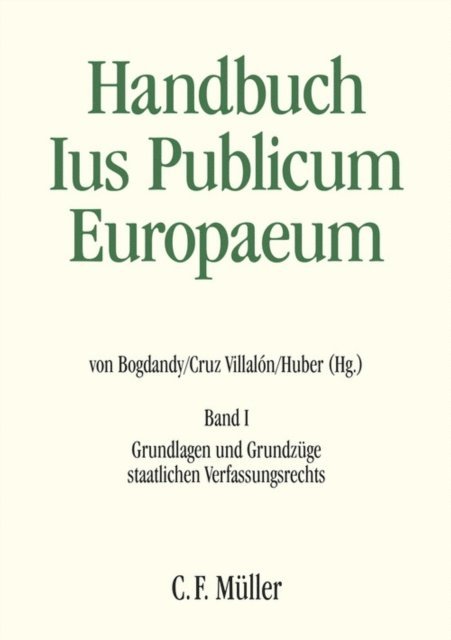
Die Edition "Ius Publicum Europaeum" behandelt das Verfassungsrecht nebst Verfassungsprozessrecht und das Verwaltungsrecht im Lichte des gemeinsamen europäischen Rechtsraums. Dargestellt werden die Grundstrukturen der nationalen Verfassungen und deren Wissenschaft in repräsentativ ausgewählten Mitgliedstaaten der Europäischen Union, darunter die Gründerstaaten Deutschland, Frankreich und Italien.Die Idee dieses Handbuchs ist es, die unter dem Einfluss des europäischen Rechts stehenden nationalen Rechtsordnungen einer rechtsvergleichenden Analyse zu unterziehen und dabei Gemeinsamkeiten und Unterschiede aufzuzeigen. Ausgangspunkt ist jeweils das nationale Recht. Die einzelnen Landesberichte sind nach einheitlichen Kriterien erstellt und erläutern die jeweiligen nationalen Grundlagen, so dass die Rechtsordnungen der einzelnen Staaten sehr gut miteinander vergleichbar sind. Führende Staats- und Verwaltungsrechtler aus ganz Europa wirken als Autoren an dieser Edition mit.In Band I werden die historischen Grundlagen und dogmatischen Grundzüge der Verfassungs- und Regierungssysteme untersucht sowie die ihre Identität prägenden Entscheidungen herausgearbeitet. Den Beiträgen liegt ein einheitliche Gliederung zugrunde, die alle relevanten rechtsvergleichenden Gesichtspunkte beinhaltet. Gemeinsamkeiten und Unterschiede werden analysiert, bedeutsame rechtsvergleichende Gesichtspunkte beleuchtet und ein Ausblick auf ein gemeinsames europäisches Verfassungsrecht formuliert.
E-bok
PDF, Engelska, 20101 892 kr
Läs direkt efter köp
Legality is a traditional normative concept to regulate the relationship between those in power and those subjected to that power. The principle of legality protects the citizen against the arbitrary use of power, or, more precisely, it demands a legal basis (which itself must be of a certain standard) to legitimize State action. Is legality under siege in Europe? The authors contributing to this provocative and important book answer this question in the affirmative. Twenty-one outstanding European legal scholars expose a spectrum of ways in which the traditional legality principle is under pressure because of the creation of new legal orders, including that of the EU, and the interaction between these new orders and that of the State, combined with such factors as expertise driven governance, difficulties of international organizations to meet their objectives due to a lack of adequate powers, and lack of parliamentary control. The question of whether the main functions of legality – legitimating, attributing and regulating the exercise of public authority – are still fulfilled in the context of the overlapping, interacting, and mutually dependent legal orders of the EU, the ECHR, and the Member States is at the background of all the essays in this volume. Recognizing that legality, if it is to survive, demands rigorous reconsideration of its scope and application, the authors interrogate not only such fundamental democratic issues as who has legitimate power to perform legislative acts and through these to exercise of public power over citizens, but also such urgent European problems as the following: ; the use of the precautionary principle in EU decision-making; the scope of the principle that the exercise of public authority must rest on an act of Parliament; the extent to which the EU can provide a legal basis for action of Member State authorities in the absence of such a basis within Member State legal orders; the constitutional position of independent ‘regulators’; the requirements that ECJ and ECHR case law impose on the exercise of public authority; whether legislative results are coherent in the sensitive area of equal treatment; transparency, legal certainty, enforceability, and implementation of EC Directives in the field of workers’ involvement; new instruments as the Open Method of Coordination and the involvement of social partners in decision-making; the de facto harmonization of national criminal justice systems; and the prominent role of the EU in the field of data protection. There can be little doubt that the issue of legality and to whom it applies – in a world in which the role of the modern State is changing profoundly – is a crucial one. It is highly important in the context of the ongoing discussion on the meaning of democracy and citizenship. This volume, with its clear message that reconsidering legality demands taking serious issue with the uncertainty engendered by the processes of globalization, will resonate profoundly among practitioners and policymakers in this time of momentous change.