Leora Batnitzky – författare
Visar alla böcker från författaren Leora Batnitzky. Handla med fri frakt och snabb leverans.
13 produkter
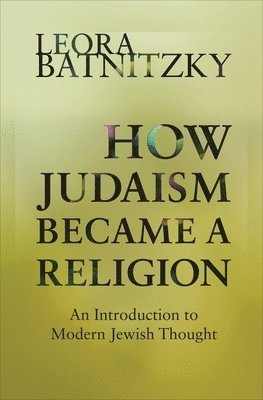
How Judaism Became a Religion
An Introduction to Modern Jewish Thought
Häftad, 2013
238 kr
Lägg i varukorg
Is Judaism a religion, a culture, a nationality--or a mixture of all of these? In How Judaism Became a Religion, Leora Batnitzky boldly argues that this question more than any other has driven modern Jewish thought since the eighteenth century. This wide-ranging and lucid introduction tells the …
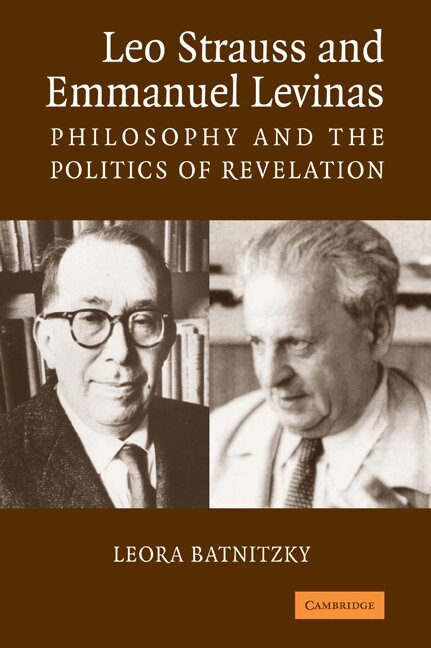
Leo Strauss and Emmanuel Levinas
Philosophy and the Politics of Revelation
Häftad, 2007
716 kr
Lägg i varukorg
Leo Strauss and Emmanuel Levinas, two twentieth-century Jewish philosophers and two extremely provocative thinkers whose reputations have grown considerably, are rarely studied together. This is due to the disparate interests of many of their intellectual heirs. Strauss has influenced political …
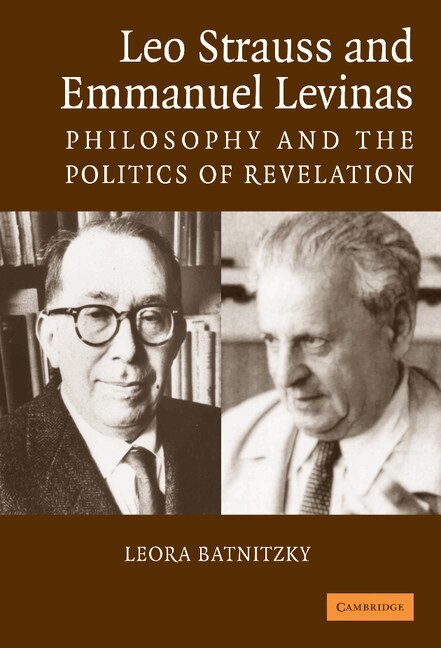
Leo Strauss and Emmanuel Levinas
Philosophy and the Politics of Revelation
Inbunden, 2006
1450 kr
Lägg i varukorg
Leo Strauss and Emmanuel Levinas, two twentieth-century Jewish philosophers and two extremely provocative thinkers whose reputations have grown considerably, are rarely studied together. This is due to the disparate interests of many of their intellectual heirs. Strauss has influenced political …
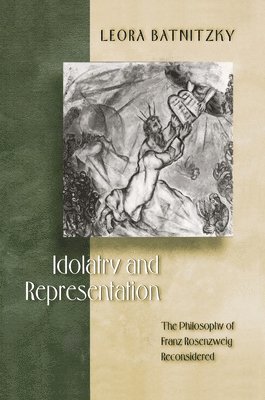
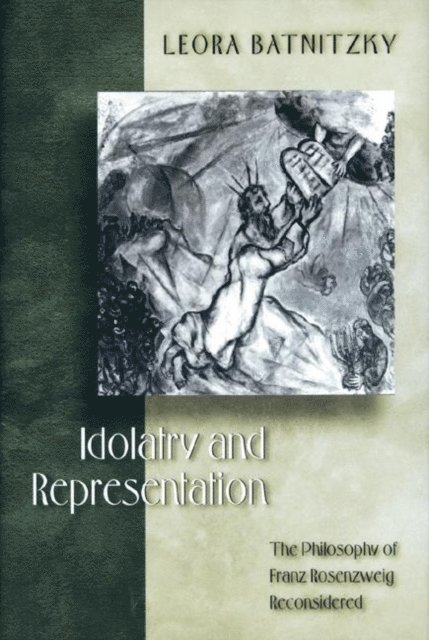
Idolatry and Representation
The Philosophy of Franz Rosenzweig Reconsidered
Häftad, 2009
654 kr
Lägg i varukorg
Although Franz Rosenzweig is arguably the most important Jewish philosopher of the twentieth century, his thought remains little understood. Here, Leora Batnitzky argues that Rosenzweig's redirection of German-Jewish ethical monotheism anticipates and challenges contemporary trends in religious …
Princeton Companion to Jewish Studies
Av Leora Batnitzky, Eve Krakowski m. fl.
Inbunden, 2025
436 kr
Lägg i varukorg
An authoritative guide to Jewish studies, reflecting the latest research in a diverse and flourishing field Jewish studies is a dynamic, interdisciplinary field that draws on the methods of the modern academy—historical research, anthropology, literary studies, philosophy, religious studies, …
Princeton Companion to Jewish Studies
Av Steven Weitzman, Eve Krakowski m. fl.
E-bok, 2025
578 kr
Lägg i varukorg
An authoritative guide to Jewish studies, reflecting the latest research in a diverse and flourishing field Jewish studies is a dynamic, interdisciplinary field that draws on the methods of the modern academy—historical research, anthropology, literary studies, philosophy, religious studies, …
Institutionalizing Rights and Religion
Competing Supremacies
Av Leora Batnitzky, Hanoch Dagan
Inbunden, 2017
1832 kr
Lägg i varukorg
Modern statesmen and political theorists have long struggled to design institutions that will simultaneously respect individual freedom of religion, nurture religion's capacity to be a force for civic good and human rights, and tame religion's illiberal tendencies. Moving past the usual focus on …
Institutionalizing Rights and Religion
Competing Supremacies
Av Leora Batnitzky, Hanoch Dagan
Häftad, 2018
557 kr
Lägg i varukorg
Modern statesmen and political theorists have long struggled to design institutions that will simultaneously respect individual freedom of religion, nurture religion's capacity to be a force for civic good and human rights, and tame religion's illiberal tendencies. Moving past the usual focus on …
Idolatry and Representation
The Philosophy of Franz Rosenzweig Reconsidered
E-bok, 2009
500 kr
Lägg i varukorg
Although Franz Rosenzweig is arguably the most important Jewish philosopher of the twentieth century, his thought remains little understood. Here, Leora Batnitzky argues that Rosenzweig''s redirection of German-Jewish ethical monotheism anticipates and challenges contemporary trends in religious …
How Judaism Became a Religion
An Introduction to Modern Jewish Thought
E-bok, 2011
314 kr
Lägg i varukorg
A new approach to understanding Jewish thought since the eighteenth century Is Judaism a religion, a culture, a nationality—or a mixture of all of these? In How Judaism Became a Religion , Leora Batnitzky boldly argues that this question more than any other has driven modern Jewish thought since …
Book of Job
Aesthetics, Ethics, Hermeneutics
Av Leora Batnitzky, Ilana Pardes
Inbunden, 2014
1617 kr
Lägg i varukorg
The Book of Job has held a central role in defining the project of modernity from the age of Enlightenment until today. The Book of Job: Aesthetics, Ethics and Hermeneutics offers new perspectives on the ways in which Job’s response to disaster has become an aesthetic and ethical touchstone for …
Book of Job
Aesthetics, Ethics, Hermeneutics
Av Leora Batnitzky, Ilana Pardes
Häftad, 2017
297 kr
Lägg i varukorg
The Book of Job has held a central role in defining the project of modernity from the age of Enlightenment until today. The Book of Job: Aesthetics, Ethics and Hermeneutics offers new perspectives on the ways in which Job’s response to disaster has become an aesthetic and ethical touchstone for …
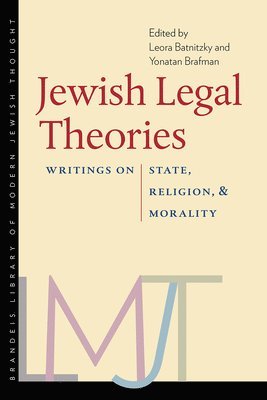
Jewish Legal Theories
Writings on State, Religion, and Morality
Av Leora Batnitzky, Yonatan Brafman
Häftad, 2018
229 kr
Tillfälligt slut
Contemporary arguments about Jewish law uniquely reflect both the story of Jewish modernity and a crucial premise of modern conceptions of law generally: the claim of autonomy for the intellectual subject and practical sphere of the law. Yet for all the interest in and importance of Jewish legal …