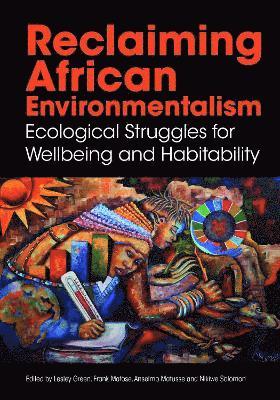
The authors of Reclaiming African Environmentalism make the case that the relationships that indigenous and other marginalized minorities have formed with the land must be the primary considerations when planning and protecting Africa's overall economic and ecological well-being._x000D__x000D_CONTENTS: Introduction—the Editors.PROPERTY AND THE COMMONS.Neoliberalism and Pastoralism: Two Competing Visions of the Same Land at a Time of Climate Crisis, Kenya—M. Mugambi.When Law and Policy Fail to Meet Reality: Exploring Environmental Conflicts in the Utilization and Management of Marlborough Wetland, Harare, Zimbabwe—E. Sigauke.Contested Forests: Claims and Meanings of Property Around Gwayi Forest, Zimbabwe—M. Malandu and F. Matose.Plantationocene in Lugela District: Reclaiming Nature, Relations and Personhood Amid Growing Neo-Extractive Capture in Contemporary Mozambique—A. Matusse.Forest Carbon Conflict in the Democratic Republic of Congo: Wildlife Works Carbon LLC vs. Ngongo Basengele Community—G. Dkamela.EXTRACTION AND WASTE.State, NGOs, and the Extractive Nature of the Conservation Industry in Zimbabwe—T. Mushonga.Land Transformation and Dispossession: The Case of Farming and Extractive Gold Mining in Western Ghana—K. Tumawu.Hacking Life: Electronic Waste Salvaging in Tanzania's Digital Age—S.M. Ntapanta.Windscapes: Frontiers of South Africa—M. Pressend.Fracturing Contested Landscapes: Resource Frontiers in the Kalahari, Botswana—P. du Plessis.GRIEVING, RECLAIMING, AND DEFENDING EARLY RELATIONS.The Water Healer with No Water—K. Sello.Restoring the Earth: Literary Narrative and African Environmental Struggles—B. Klein.“Technology Changes Everything”: Herbicides and Soil in the Eastern Cape, South Africa—N. Phakisi.The Battle for the Soul of Xholobeni Land, South Africa—S. Zukulu.The Paradox of Infrastructure: Technopolitics and Time on the Kuils River in Cape Town, South Africa—N. Solomon.Conclusion: Composing an African Environmental Humanities—the Editors.
In Rock Water Life Lesley Green examines the interwoven realities of inequality, racism, colonialism, and environmental destruction in South Africa, calling for environmental research and governance to transition to an ecopolitical approach that could address South Africa's history of racial oppression and environmental exploitation. Green analyzes conflicting accounts of nature in environmental sciences that claim neutrality amid ongoing struggles for land restitution and environmental justice. Offering in-depth studies of environmental conflict in contemporary South Africa, Green addresses the history of contested water access in Cape Town; struggles over natural gas fracking in the Karoo; debates about decolonizing science; the potential for a politics of soil in the call for land restitution; urban baboon management; and the consequences of sending sewage to urban oceans.
In Rock | Water | Life Lesley Green examines the interwoven realities of inequality, racism, colonialism, and environmental destruction in South Africa, calling for environmental research and governance to transition to an ecopolitical approach that could address South Africa''s history of racial oppression and environmental exploitation. Green analyzes conflicting accounts of nature in environmental sciences that claim neutrality amid ongoing struggles for land restitution and environmental justice. Offering in-depth studies of environmental conflict in contemporary South Africa, Green addresses the history of contested water access in Cape Town; struggles over natural gas fracking in the Karoo; debates about decolonizing science; the potential for a politics of soil in the call for land restitution; urban baboon management; and the consequences of sending sewage to urban oceans.