Leslie A. Viereck – författare
Visar alla böcker från författaren Leslie A. Viereck. Handla med fri frakt och snabb leverans.
3 produkter
3 produkter
E-bok
Engelska, 20061 127 kr
Läs direkt efter köp
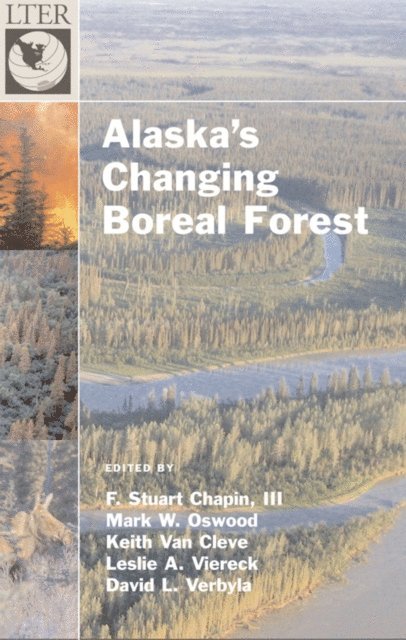
The boreal forest is the northern-most woodland biome, whose natural history is rooted in the influence of low temperature and high-latitude. Alaska''s boreal forest is now warming as rapidly as the rest of Earth, providing an unprecedented look at how this cold-adapted, fire-prone forest adjusts to change. This volume synthesizes current understanding of the ecology of Alaska''s boreal forests and describes their unique features in the context of circumpolar and global patterns. It tells how fire and climate contributed to the biome''s current dynamics. As climate warms and permafrost (permanently frozen ground) thaws, the boreal forest may be on the cusp of a major change in state. The editors have gathered a remarkable set of contributors to discuss this swift environmental and biotic transformation. Their chapters cover the properties of the forest, the changes it is undergoing, and the challenges these alterations present to boreal forest managers. In the first section, the reader can absorb the geographic and historical context for understanding the boreal forest. The book then delves into the dynamics of plant and animal communities inhabiting this forest, and the biogeochemical processes that link these organisms. In the last section the authors explore landscape phenomena that operate at larger temporal and spatial scales and integrates the processes described in earlier sections. Much of the research on which this book is based results from the Bonanza Creek Long-Term Ecological Research Program. Here is a synthesis of the substantial literature on Alaska''s boreal forest that should be accessible to professional ecologists, students, and the interested public.
Inbunden, Engelska, 2006
1 303 kr
Skickas inom 5-8 vardagar
The boreal forest is the northern-most woodland biome, whose natural history is rooted in the influence of low temperature and high-latitude. Alaska's boreal forest is now warming as rapidly as the rest of Earth, providing an unprecedented look at how this cold-adapted, fire-prone forest adjusts to change. This volume synthesizes current understanding of the ecology of Alaska's boreal forests and describes their unique features in the context of circumpolar and global patterns. It tells how fire and climate contributed to the biome's current dynamics. As climate warms and permafrost (permanently frozen ground) thaws, the boreal forest may be on the cusp of a major change in state. The editors have gathered a remarkable set of contributors to discuss this swift environmental and biotic transformation. Their chapters cover the properties of the forest, the changes it is undergoing, and the challenges these alterations present to boreal forest managers. In the first section, the reader can absorb the geographic and historical context for understanding the boreal forest. The book then delves into the dynamics of plant and animal communities inhabiting this forest, and the biogeochemical processes that link these organisms. In the last section the authors explore landscape phenomena that operate at larger temporal and spatial scales and integrates the processes described in earlier sections. Much of the research on which this book is based results from the Bonanza Creek Long-Term Ecological Research Program. Here is a synthesis of the substantial literature on Alaska's boreal forest that should be accessible to professional ecologists, students, and the interested public.
E-bok
PDF, Engelska, 20061 117 kr
Läs direkt efter köp
The boreal forest is the northern-most woodland biome, whose natural history is rooted in the influence of low temperature and high-latitude. Alaska''s boreal forest is now warming as rapidly as the rest of Earth, providing an unprecedented look at how this cold-adapted, fire-prone forest adjusts to change. This volume synthesizes current understanding of the ecology of Alaska''s boreal forests and describes their unique features in the context of circumpolar and global patterns. It tells how fire and climate contributed to the biome''s current dynamics. As climate warms and permafrost (permanently frozen ground) thaws, the boreal forest may be on the cusp of a major change in state. The editors have gathered a remarkable set of contributors to discuss this swift environmental and biotic transformation. Their chapters cover the properties of the forest, the changes it is undergoing, and the challenges these alterations present to boreal forest managers. In the first section, the reader can absorb the geographic and historical context for understanding the boreal forest. The book then delves into the dynamics of plant and animal communities inhabiting this forest, and the biogeochemical processes that link these organisms. In the last section the authors explore landscape phenomena that operate at larger temporal and spatial scales and integrates the processes described in earlier sections. Much of the research on which this book is based results from the Bonanza Creek Long-Term Ecological Research Program. Here is a synthesis of the substantial literature on Alaska''s boreal forest that should be accessible to professional ecologists, students, and the interested public.