Leston Havens – författare
Visar alla böcker från författaren . Handla med fri frakt och snabb leverans.
7 produkter
7 produkter
Häftad, Engelska, 1996
318 kr
Skickas inom 10-15 vardagar
Drawing on his rich experience within psychiatry, Leston Havens takes the reader on an extraordinary journey through the vast and changing landscape of psychotherapy and psychiatry today. Closely examining the dynamics of the doctor–patient exchange, he seeks to locate and describe the elusive therapeutic environment within which psychological healing most effectively takes place.
Inbunden, Engelska, 2000
809 kr
Skickas inom 10-15 vardagar
“All of us who have long done this work can look back at those happy times when the patient’s gain has also been, in part, our own. Thereby an extraordinary joy enters the work, for both parties, through this making of lives. Can there be better work to do in the world?”—from the Epilogue by Leston HavensManaged care has radically reshaped health care in the United States, and private long-term psychotherapy is increasingly a thing of the past. The corporatization of mental health care often puts therapists in professional quandaries. How can they do the therapeutic work they were trained to do with clients whom they may barely know, whose care is intruded upon by managed care administrators? With unrelenting pressure to substitute medications for therapy and standardized behavior protocols for individualized approaches, what becomes of the therapist–client relationship?Unflinchingly honest, The Real World Guide to Psychotherapy Practice offers both compelling stories and practical advice on maintaining one’s therapeutic integrity in the managed care era. Resisting a one-size-fits-all approach, the authors focus on the principles of forming relationships with patients, and especially patients likely to be under-served (e.g., the uninsured poor) or difficult to treat.The Real World Guide to Psychotherapy Practice gives voice to therapists’ frustrations with the administrative constraints under which they work. But it accepts the reality and offers guidance and inspiration to committed therapists everywhere.
Inbunden, Engelska, 1994
419 kr
Skickas inom 10-15 vardagar
To penetrate the opaque, to lift the weight and let the self escape its frozen image—this is the essence of psychotherapy, a process described with extraordinary grace and warmth in this book. In remarkably candid portraits of patients at odds with themselves, Leston Havens takes us through the wonders and rigors of psychological healing and shows us what it really means, in immediate, human terms, to come to life.We are all captives of the images we carry with us—and those we inspire—and therapy seeks to expose the relation of these images to a deeper psychological life, to free the captive from labels and crippling assumptions. Havens views this process through the multiple lenses of literature, art, and psychiatry. In rich clinical portraits, short on jargon and rigid techniques and long on empathy and wisdom, we encounter ordinary people struggling with the trials of their own existence: marriage and divorce, sexual identity and fulfillment, illness and death. We meet a woman imprisoned by eager responses to her beauty and helpfulness, a proud lawyer in thrall to conventional expectations, a dying man becoming more and more alive as he approaches death.Through these very personal stories, Havens explores the meaning of psychological health—how it can be recognized through the filter of images and ideas, protected from their distorting power, and encouraged to flourish. The result is a revealing and deeply moving explication of the process of self-discovery as it emerges from the life story that therapy can tell.
Häftad, Engelska, 1988
305 kr
Skickas inom 10-15 vardagar
Since 1955, moving from early work in psychopharmacology to studies of clinical method and the psychiatric schools, Leston Havens has been working toward a general theory of therapy. It often seems that twentieth-century psychiatry, sect-ridden, is a Tower of Babel, as Havens once characterized it. This book is the distillation of long years of thought and practice, a bold yet modest attempt to delineate an “integrated psychotherapy.”The boldness of this effort lies in its author’s willingness to recognize the best that each school has to offer, to describe it cogently, and to integrate it into a full response to today’s new kind of patient. Descriptive or medical psychiatry, psychoanalysis, interpersonal or behavioristic psychiatry, empathic or existential therapy-viewed in metaphors, respectively, of perceiving, thinking, managing, feeling-all have useful contributions to make to contemporary methods of treatment. But how? Havens’s modest answer is through appropriate language, and he demonstrates exactly what he means: when to ask questions, when to direct or draw back, when to sympathize.Practitioners now must deal with less dramatic, but more stubborn, problems of character and situation; lack of purpose, isolation, submissiveness, invasiveness, deep yet vague dissatisfaction. Some kind of human presence must be discovered in the patient, and Havens gives concrete, absorbing examples of ways of “speaking to absence,” of making contact. The emphasis is on verbal technique, but the underlying broad, humane intent is everywhere evident. It is no less than to transform passivity, by means of disciplined therapeutic concern, into a state of being Human.

Inbunden, Engelska, 2017
2 336 kr
Skickas inom 10-15 vardagar
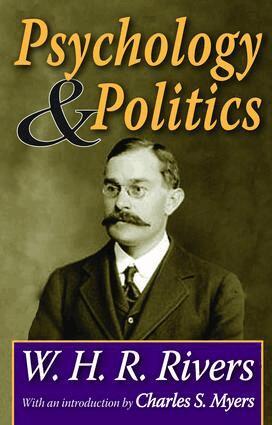
In applying psychology to the field of politics, the eminent British anthropologist and psychologist W.H.R. Rivers deals with social or collective psychology rather than with the psychology of the individual. This choice presents a number of problems. These include the relation between individual and collective psychology, the concept of a collective or group mind, and the question of how far society can be regarded as an organism. The choice also presents the need to explain the fact that when a number of individuals act together, the product of their combined activity is not the same as what might have emerged from the separate activity of individuals.Rivers' belief in the political process prompted him to deliver the lectures on psychological theory that are printed in this volume. Three other addresses are also included in this volume, one on socialism and human nature, another on education and mental hygiene, and a lecture on the aims of ethnography.Rivers considered the relation between psychology and sociology, putting forward the position that the formulation of an adequate science of social psychology lies in the observation of social conduct, including not merely the social conduct of everyday life, but still those forms of it which are subsumed under the headings of religion, economics, and politics, as well as the social institution of language. The social behavior of mankind is capable of being studied as a methodological principle, independently of the psychological basis of behavior.
E-bok
Engelska, 2017882 kr
Läs direkt efter köp
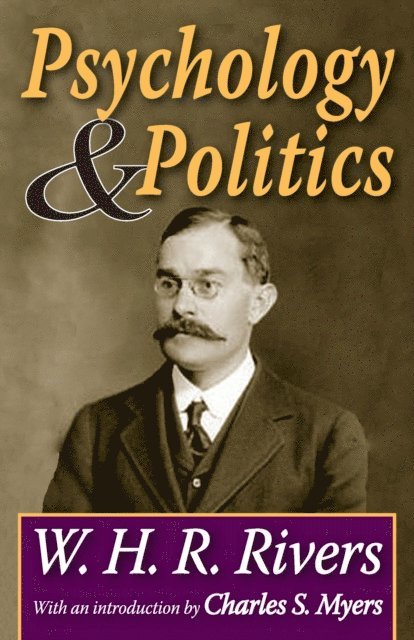
In applying psychology to the field of politics, the eminent British anthropologist and psychologist W.H.R. Rivers deals with social or collective psychology rather than with the psychology of the individual. This choice presents a number of problems. These include the relation between individual and collective psychology, the concept of a collective or group mind, and the question of how far society can be regarded as an organism. The choice also presents the need to explain the fact that when a number of individuals act together, the product of their combined activity is not the same as what might have emerged from the separate activity of individuals. Rivers'' belief in the political process prompted him to deliver the lectures on psychological theory that are printed in this volume. Three other addresses are also included in this volume, one on socialism and human nature, another on education and mental hygiene, and a lecture on the aims of ethnography. Rivers considered the relation between psychology and sociology, putting forward the position that the formulation of an adequate science of social psychology lies in the observation of social conduct, including not merely the social conduct of everyday life, but still those forms of it which are subsumed under the headings of religion, economics, and politics, as well as the social institution of language. The social behavior of mankind is capable of being studied as a methodological principle, independently of the psychological basis of behavior.
E-bok
PDF, Engelska, 2017882 kr
Läs direkt efter köp
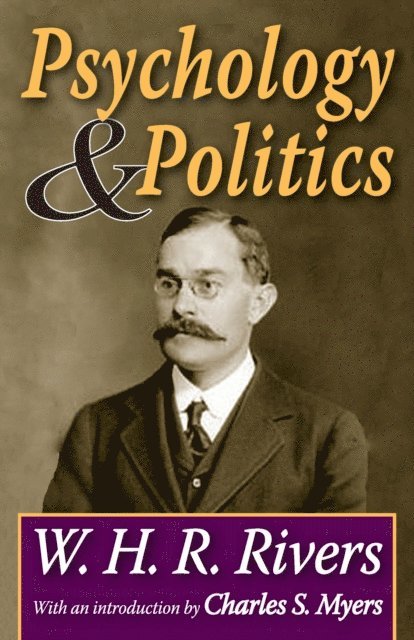
In applying psychology to the field of politics, the eminent British anthropologist and psychologist W.H.R. Rivers deals with social or collective psychology rather than with the psychology of the individual. This choice presents a number of problems. These include the relation between individual and collective psychology, the concept of a collective or group mind, and the question of how far society can be regarded as an organism. The choice also presents the need to explain the fact that when a number of individuals act together, the product of their combined activity is not the same as what might have emerged from the separate activity of individuals. Rivers'' belief in the political process prompted him to deliver the lectures on psychological theory that are printed in this volume. Three other addresses are also included in this volume, one on socialism and human nature, another on education and mental hygiene, and a lecture on the aims of ethnography. Rivers considered the relation between psychology and sociology, putting forward the position that the formulation of an adequate science of social psychology lies in the observation of social conduct, including not merely the social conduct of everyday life, but still those forms of it which are subsumed under the headings of religion, economics, and politics, as well as the social institution of language. The social behavior of mankind is capable of being studied as a methodological principle, independently of the psychological basis of behavior.