Linda Bushnell - Böcker
Visar alla böcker från författaren Linda Bushnell. Handla med fri frakt och snabb leverans.
3 produkter
3 produkter
Del 11199 - Lecture Notes in Computer Science
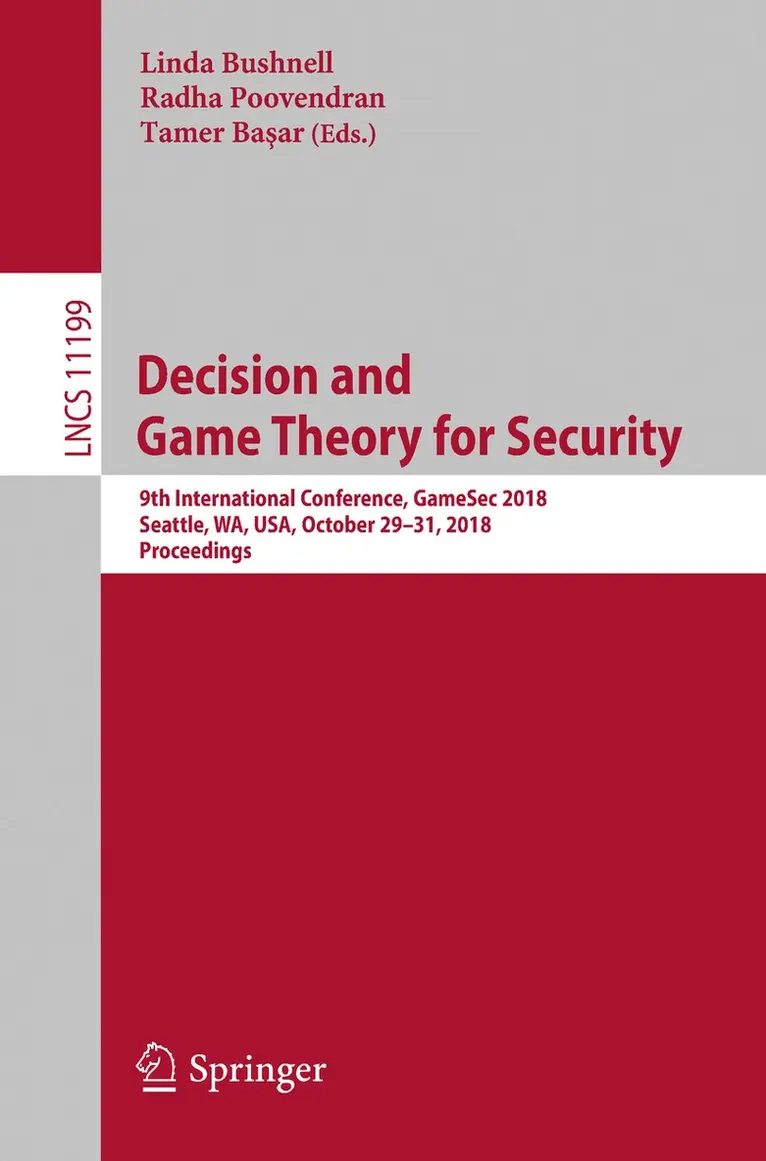
Decision and Game Theory for Security
9th International Conference, GameSec 2018, Seattle, WA, USA, October 29–31, 2018, Proceedings
Häftad, Engelska, 2018
554 kr
Skickas inom 10-15 vardagar
The 28 revised full papers presented together with 8 short papers were carefully reviewed and selected from 44 submissions.Among the topical areas covered were: use of game theory; control theory; and mechanism design for security and privacy; decision making for cybersecurity and security requirements engineering; security and privacy for the Internet-of-Things; cyber-physical systems; cloud computing; resilient control systems, and critical infrastructure; pricing; economic incentives; security investments, and cyber insurance for dependable and secure systems; risk assessment and security risk management; security and privacy of wireless and mobile communications, including user location privacy; sociotechnological and behavioral approaches to security; deceptive technologies in cybersecurity and privacy; empirical and experimental studies with game, control, or optimization theory-based analysis for security and privacy; and adversarial machine learning and crowdsourcing, and the role of artificial intelligence in system security.
1 069 kr
Skickas inom 10-15 vardagar
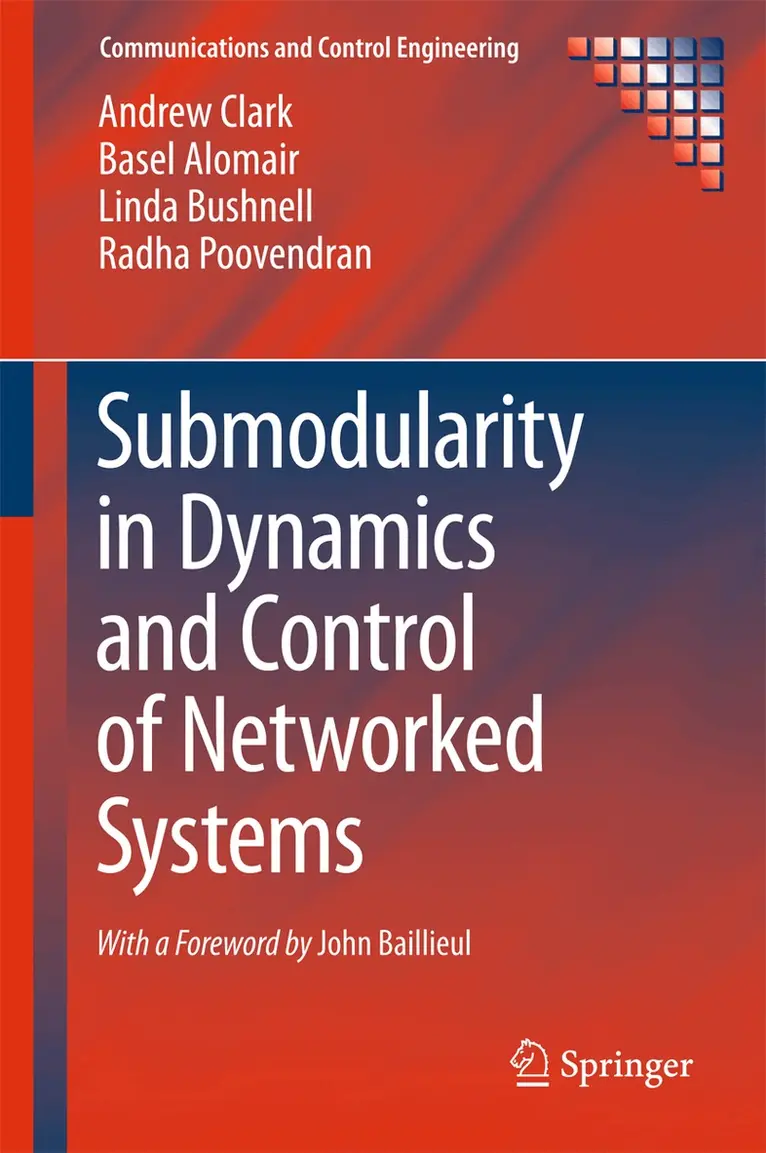
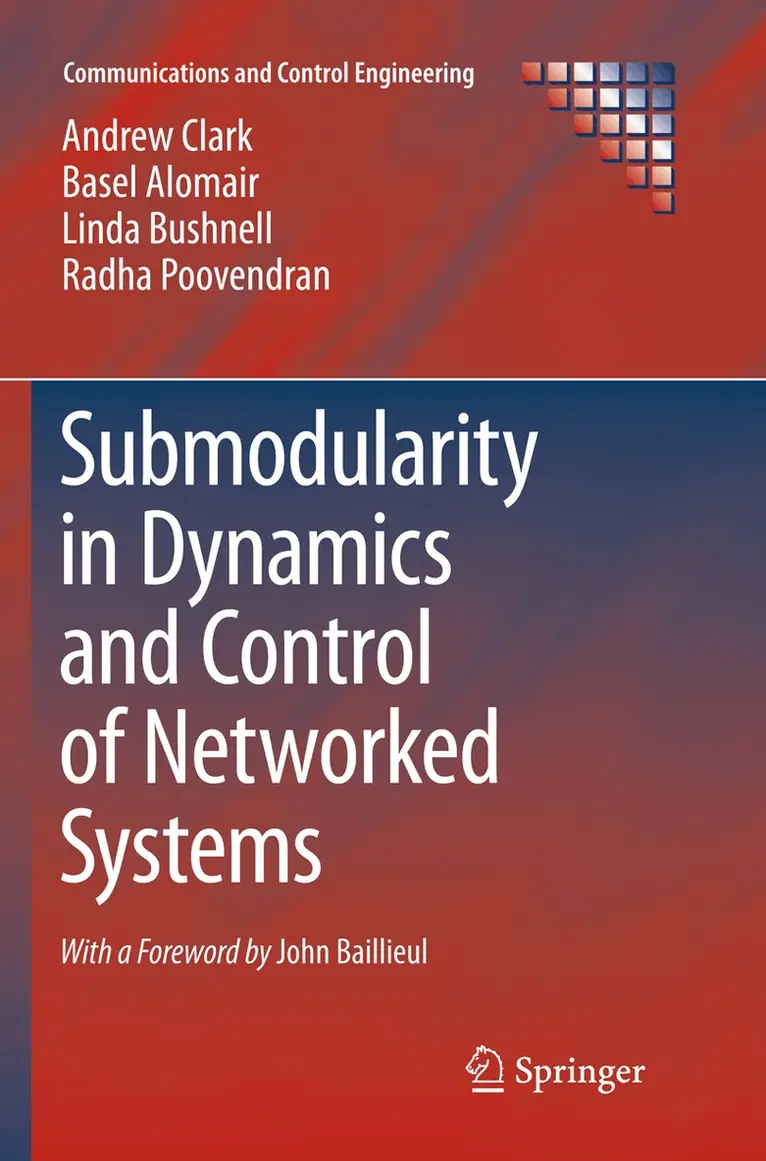
This book presents a framework for the control of networked systems utilizing submodular optimization techniques. The main focus is on selecting input nodes for the control of networked systems, an inherently discrete optimization problem with applications in power system stability, social influence dynamics, and the control of vehicle formations. The first part of the book is devoted to background information on submodular functions, matroids, and submodular optimization, and presents algorithms for distributed submodular optimization that are scalable to large networked systems.In turn, the second part develops a unifying submodular optimization approach to controlling networked systems based on multiple performance and controllability criteria. Techniques are introduced for selecting input nodes to ensure smooth convergence, synchronization, and robustness to environmental and adversarial noise. Submodular optimization is the first unifying approach towards guaranteeing both performance and controllability with provable optimality bounds in static as well as time-varying networks. Throughout the text, the submodular framework is illustrated with the help of numerical examples and application-based case studies in biological, energy and vehicular systems.The book effectively combines two areas of growing interest, and will be especially useful for researchers in control theory, applied mathematics, networking or machine learning with experience in submodular optimization but who are less familiar with the problems and tools available for networked systems (or vice versa). It will also benefit graduate students, offering consistent terminology and notation that greatly reduces the initial effort associated with beginning a course of study in a new area.
1 069 kr
Skickas inom 10-15 vardagar
This book presents a framework for the control of networked systems utilizing submodular optimization techniques. The main focus is on selecting input nodes for the control of networked systems, an inherently discrete optimization problem with applications in power system stability, social influence dynamics, and the control of vehicle formations. The first part of the book is devoted to background information on submodular functions, matroids, and submodular optimization, and presents algorithms for distributed submodular optimization that are scalable to large networked systems.In turn, the second part develops a unifying submodular optimization approach to controlling networked systems based on multiple performance and controllability criteria. Techniques are introduced for selecting input nodes to ensure smooth convergence, synchronization, and robustness to environmental and adversarial noise. Submodular optimization is the first unifying approach towards guaranteeing both performance and controllability with provable optimality bounds in static as well as time-varying networks. Throughout the text, the submodular framework is illustrated with the help of numerical examples and application-based case studies in biological, energy and vehicular systems.The book effectively combines two areas of growing interest, and will be especially useful for researchers in control theory, applied mathematics, networking or machine learning with experience in submodular optimization but who are less familiar with the problems and tools available for networked systems (or vice versa). It will also benefit graduate students, offering consistent terminology and notation that greatly reduces the initial effort associated with beginning a course of study in a new area.