Lisa M. Lynch – författare
Visar alla böcker från författaren Lisa M. Lynch. Handla med fri frakt och snabb leverans.
5 produkter
5 produkter
E-bok
PDF, Engelska, 20071 648 kr
Läs direkt efter köp
How can today''s workforce keep pace with an increasingly competitive global economy? As new technologies rapidly transform the workplace, employee requirements are changing and workers must adapt to different working conditions. This volume compares new evidence on the returns from worker training in the United States, Germany, France, Britain, Japan, Norway, and the Netherlands. The authors focus on Germany''s widespread, formal apprenticeship programs; the U.S. system of learning-by-doing; Japan''s low employee turnover and extensive company training; and Britain''s government-led and school-based training schemes. The evidence shows that, overall, training in the workplace is more effective than training in schools. Moreover, even when U.S. firms spend as much on training as other countries do, their employees may still be less skilled than workers in Europe or Japan. Training and the Private Sector points to training programs in Germany, Japan, and other developed countries as models for creating a workforce in the United States that can compete more successfully in today''s economy.
Häftad, Engelska, 2007
762 kr
Skickas inom 3-6 vardagar
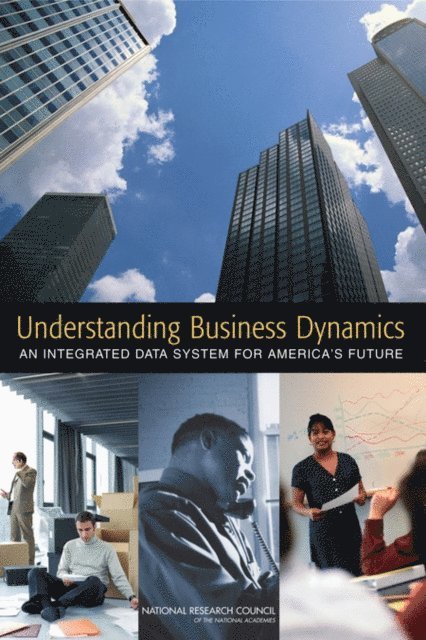
The U.S. economy is highly dynamic: businesses open and close, workers switch jobs and start new enterprises, and innovative technologies redefine the workplace and enhance productivity. With globalization markets have also become more interconnected. Measuring business activity in this rapidly evolving environment increasingly requires tracking complex interactions among firms, establishments, employers, and employees. Understanding Business Dynamics presents strategies for improving the accuracy, timeliness, coverage, and integration of data that are used in constructing aggregate economic statistics, as well as in microlevel analyses of topics ranging from job creation and destruction and firm entry and exit to innovation and productivity. This book offers recommendations that could be enacted by federal statistical agencies to modernize the measurement of business dynamics, particularly the production of information on small and young firms that can have a disproportionately large impact in rapidly expanding economic sectors.It also outlines the need for effective coordination of existing survey and administrative data sources, which is essential to improving the depth and coverage of business data.
673 kr
Läs direkt efter köp
The U.S. economy is highly dynamic: businesses open and close, workers switch jobs and start new enterprises, and innovative technologies redefine the workplace and enhance productivity. With globalization markets have also become more interconnected. Measuring business activity in this rapidly evolving environment increasingly requires tracking complex interactions among firms, establishments, employers, and employees. Understanding Business Dynamics presents strategies for improving the accuracy, timeliness, coverage, and integration of data that are used in constructing aggregate economic statistics, as well as in microlevel analyses of topics ranging from job creation and destruction and firm entry and exit to innovation and productivity. This book offers recommendations that could be enacted by federal statistical agencies to modernize the measurement of business dynamics, particularly the production of information on small and young firms that can have a disproportionately large impact in rapidly expanding economic sectors. It also outlines the need for effective coordination of existing survey and administrative data sources, which is essential to improving the depth and coverage of business data.
E-bok
PDF, Engelska, 2007471 kr
Läs direkt efter köp
The U.S. economy is highly dynamic: businesses open and close, workers switch jobs and start new enterprises, and innovative technologies redefine the workplace and enhance productivity. With globalization markets have also become more interconnected. Measuring business activity in this rapidly evolving environment increasingly requires tracking complex interactions among firms, establishments, employers, and employees. Understanding Business Dynamics presents strategies for improving the accuracy, timeliness, coverage, and integration of data that are used in constructing aggregate economic statistics, as well as in microlevel analyses of topics ranging from job creation and destruction and firm entry and exit to innovation and productivity. This book offers recommendations that could be enacted by federal statistical agencies to modernize the measurement of business dynamics, particularly the production of information on small and young firms that can have a disproportionately large impact in rapidly expanding economic sectors. It also outlines the need for effective coordination of existing survey and administrative data sources, which is essential to improving the depth and coverage of business data.
Häftad, Engelska, 2018
255 kr
Skickas inom 3-6 vardagar