Liza Mydin – författare
Visar alla böcker från författaren Liza Mydin. Handla med fri frakt och snabb leverans.
5 produkter
5 produkter
Del 1 - Economic, Political and Social Institutions in Islam
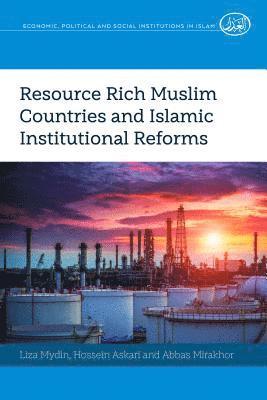
Resource Rich Muslim Countries and Islamic Institutional Reforms
Inbunden, Engelska, 2018
1 100 kr
Skickas inom 5-8 vardagar
Resource Rich Muslim Countries and Islamic Institutional Reforms explores the "resource curse," a condition in which a country’s abundance of natural resources is negatively linked with the country’s development and economic growth, in resource rich Muslim countries. The resource curse puzzle has been studied for over twenty years, with prior researchers looking to prove its existence and explore its causes. Recent studies have begun to indicate institutional failure as a likely cause of the curse, as wealth of resources tends to cause counterproductive behaviors such as rent-seeking, patronage and corruption. The subpar economic performance of resource rich Muslim countries in the Organization of the Islamic Cooperation (OIC) could be attributed to the manifestation of a resource curse. Collectively, the member countries of the OIC contribute over 9% of the world’s total GDP with 22.8% of the world’s population. Saudi Arabia and the United Arab Emirates alone contribute about 17% of world oil production. Resource rich Muslim countries should be at the forefront of economic performance and growth, yet we see the opposite when we compare the performance of these countries to countries that are not resource rich (such as Spain, France, Hong Kong and Japan). Through an analysis of sample countries, the authors have discovered that natural resources exert a drag on the countries’ economic growth, thereby indicating the presence of the resource curse. Their research also found weaknesses in the quality of institutions as the cause of the curse. To counteract the negative effects of the resource curse in resource rich Muslim countries, the authors provide a number of Islamic institutional reforms.
E-bok
Engelska, 201257 kr
Läs direkt efter köp
Nine-year-olds Youssef, Zayyed, and Omar have never travelled outside their little community of Al-Haidar, so when Youssef suggests that they do some exploring, the friends eagerly set off, each intending to visit a nearby village and report back to the others. What the boys discover is that although all the villages are within walking distance, they are distinctly different from one another and from their own Al-Haidar.Zayyed is puzzled to see that everyone in the village he visits seems angry and gruff, occupied with making weapons. In the crowded marketplace of the second village, Omar cant help but notice that some people are very prosperous, whereas the others are miserable. Meanwhile, in the third village, Youssef is struck by the sight of a big school where children are happily learning and playing, as well as the first hospital he has ever seen.In this charming tale, childrens natural curiosity leads them to learn about justice, kindness, and fairness. Al-Haidars resident old wise man helps them not only to understand the circumstances of each village, but also to see that the lessons each one embodies about values and leadership are universal, no matter what the context. Set in the desert sands of Arabia, this is the first in a series of adventure stories in which cultural awareness, surprising discoveries, and learning about ethical behaviour go hand in hand.
Inbunden, Engelska, 2017
1 091 kr
Skickas inom 10-15 vardagar
This book explores how the recent development of Muslim countries as a group has fallen far short of non-Muslim countries, which, some have concluded, may be a result of Islamic teachings. The authors examine Muslim countries over time, viewing their progression on the Islamicity scale. They assess why some countries have done better than others, and to derive useful policy recommendations to improve political, social, human, governance and economic performance.
1 367 kr
Läs direkt efter köp
This book explores how the recent development of Muslim countries as a group has fallen far short of non-Muslim countries, which, some have concluded, may be a result of Islamic teachings. The authors examine Muslim countries over time, viewing their progression on the Islamicity scale. They assess why some countries have done better than others, and to derive useful policy recommendations to improve political, social, human, governance and economic performance.
Häftad, Engelska, 2018
1 091 kr
Skickas inom 10-15 vardagar
This book explores how the recent development of Muslim countries as a group has fallen far short of non-Muslim countries, which, some have concluded, may be a result of Islamic teachings. The authors examine Muslim countries over time, viewing their progression on the Islamicity scale. They assess why some countries have done better than others, and to derive useful policy recommendations to improve political, social, human, governance and economic performance.