Lodi Nauta – författare
Visar alla böcker från författaren Lodi Nauta. Handla med fri frakt och snabb leverans.
5 produkter
5 produkter
Del 1 - I Tatti Studies in Italian Renaissance History
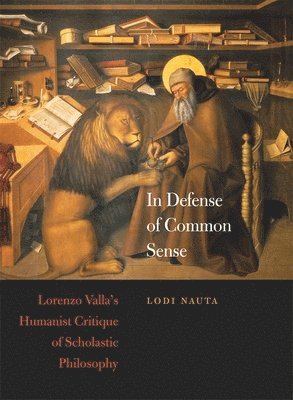
In Defense of Common Sense
Lorenzo Valla's Humanist Critique of Scholastic Philosophy
Inbunden, Engelska, 2009
488 kr
Skickas inom 5-8 vardagar
One of the leading humanists of Quattrocento Italy, Lorenzo Valla (ca. 1406–1457) has been praised as a brilliant debunker of medieval scholastic philosophy. In this book Lodi Nauta seeks a more balanced assessment, presenting us with the first comprehensive analysis of the humanist’s attempt at radical reform of Aristotelian scholasticism.This study examines Valla’s attack on major tenets of Aristotelian metaphysics, showing how Valla employed common sense and linguistic usage as his guides. It then explicates Valla’s critique of Aristotelian psychology and natural philosophy and discusses his moral and religious views, including Valla’s notorious identification of Christian beatitude with Epicurean pleasure and his daring views on the Trinity. Finally, it takes up Valla’s humanist dialectic, which seeks to transform logic into a practical tool measured by persuasiveness and effectiveness.Nauta firmly places Valla’s arguments and ideas within the contexts of ancient and medieval philosophical traditions as well as renewed interest in ancient rhetoric in the Renaissance. He also demonstrates the relevance of Valla’s conviction that the philosophical problems of the scholastics are rooted in a misunderstanding of language. Combining philosophical exegesis and historical scholarship, this book offers a new approach to a major Renaissance thinker.
Del 49 - I Tatti Renaissance Library
Dialectical Disputations
Book I
Inbunden, Engelska, 2012
287 kr
Skickas inom 5-8 vardagar
Lorenzo Valla (1407–1457) ranks among the greatest scholars and thinkers of the Renaissance. He secured lasting fame for his brilliant critical skills, most famously in his exposure of the “Donation of Constantine,” the forged document upon which the papacy based claims to political power. Lesser known in the English-speaking world is Valla’s work in the philosophy of language—the basis of his reputation as the greatest philosopher of the humanist movement.Dialectical Disputations, translated here for the first time into any modern language, is his principal contribution to the philosophy of language and logic. With this savage attack on the scholastic tradition of Aristotelian logic, Valla aimed to supersede it with a new logic based on the actual historical usage of classical Latin and on a commonsense approach to semantics and argument. Valla provides a logic that could be used by lawyers, preachers, statesmen, and others who needed to succeed in public debate—one that was stylistically correct and rhetorically elegant, and thus could dispense with the technical language of the scholastics, a “tribe of Peripatetics, perverters of natural meanings.” Valla’s reformed dialectic became a milestone in the development of humanist logic and contains startling anticipations of modern theories of semantics and language.Volume 1 contains Book I, in which Valla refutes Aristotle’s logical works on the categories, transcendentals, and predicables, with excursions into natural and moral philosophy and theology.
Inbunden, Engelska, 2021
479 kr
Skickas inom 7-10 vardagar
Which language should philosophers use: technical or common language? In a book as important for intellectual historians as it is for philosophers, Lodi Nauta addresses a vital question which still has resonance today: is the discipline of philosophy assisted or disadvantaged by employing a special vocabulary? By the Middle Ages philosophy had become a highly technical discipline, with its own lexicon and methods. The Renaissance humanist critique of this specialised language has been dismissed as philosophically superficial, but the author demonstrates that it makes a crucial point: it is through the misuse of language that philosophical problems arise. He charts the influence of this critique on early modern philosophers, including Hobbes and Locke, and shows how it led to the downfall of medieval Aristotelianism and the gradual democratization of language and knowledge. His book will be essential reading for anyone interested in the transition from medieval to modern philosophy.
Häftad, Engelska, 2024
255 kr
Skickas inom 7-10 vardagar
Which language should philosophers use: technical or common language? In a book as important for intellectual historians as it is for philosophers, Lodi Nauta addresses a vital question which still has resonance today: is the discipline of philosophy assisted or disadvantaged by employing a special vocabulary? By the Middle Ages philosophy had become a highly technical discipline, with its own lexicon and methods. The Renaissance humanist critique of this specialised language has been dismissed as philosophically superficial, but the author demonstrates that it makes a crucial point: it is through the misuse of language that philosophical problems arise. He charts the influence of this critique on early modern philosophers, including Hobbes and Locke, and shows how it led to the downfall of medieval Aristotelianism and the gradual democratization of language and knowledge. His book will be essential reading for anyone interested in the transition from medieval to modern philosophy.
Del 96 - Brill's Studies in Intellectual History
Between Demonstration and Imagination
Essays in the History of Science and Philosophy Presented to John D. North
Inbunden, Engelska, 1999
2 430 kr
Skickas inom 3-6 vardagar
The essays in this volume reflect the wide-ranging interests of John D. North, distinguished historian of science and philosophy.Section One has papers on horoscopes, astrolabes and time-reckoning, and it includes an edition of a twelfth-century treatise on the astrolabe and surveys of astrolabes. Section Two is devoted to the study of the medieval cosmos. These contributions discuss Calcidian astronomy, astronomy in the Spanish Jewish community, the role of God in scholastic natural philosophy, and other themes. New information is presented about previously unknown scholars such as Abd al-Masīḥ of Winchester and Simon Bredon. Section Three contains essays on philosophy and scholarship in the early modern period, including pieces about commentaries on Boethius’s Consolatio Philosophiae in the Northern Renaissance, Spinozistic philosophy, and the early modern concept of substance.These essays take up the various themes to which John D. North has made important contributions: the development of scientific knowledge and methodology, the style of scientific and philosophical thought, and the uses of scientific knowledge in the making of instruments or the casting of horoscopes: this book will be of much interest to all historians of science and philosophy.Contributors include: Charles Burnett, Bruce S. Eastwood, Owen Gingerich, Bernard R. Goldstein, Edward Grant, Keith Hutchison, David A. King, Richard Lorch, F.R. Maddison, Lodi Nauta, Detlev Pätzold, J.A. van Ruler, Julio Samsó, Keith Snedegar, A.J. Turner, Arjo Vanderjagt, and G. Frederici Vescovini.