Longinus – författare
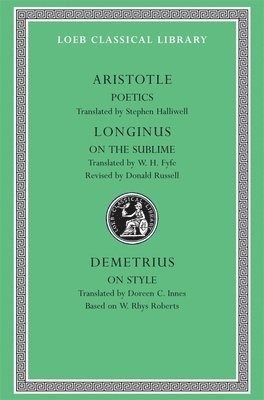
Poetics. Longinus: On the Sublime. Demetrius: On Style
362 kr
Skickas inom 5-8 vardagar
171 kr
Skickas
398 kr
Skickas inom 5-8 vardagar
462 kr
Skickas inom 5-8 vardagar
223 kr
Skickas inom 5-8 vardagar
335 kr
Skickas inom 5-8 vardagar
398 kr
Skickas inom 5-8 vardagar
207 kr
Skickas inom 5-8 vardagar
243 kr
Skickas inom 5-8 vardagar
236 kr
Skickas inom 5-8 vardagar
360 kr
Skickas inom 5-8 vardagar
348 kr
Skickas inom 5-8 vardagar
16 kr
Läs direkt efter köp
According to Wikipedia: "Longinus is the conventional name of the author of the treatise On the Sublime, a work which focuses on the effect of good writing. Longinus, sometimes referred to as Pseudo-Longinus because his real name is unknown, was a Greek teacher of rhetoric or a literary critic who may have lived in the 1st or 3rd century AD. Longinus is known only for On the Sublime."
560 kr
Skickas inom 3-6 vardagar
15 kr
Läs direkt efter köp
Longinus, also called Dionysius Longinus or Pseudo-Longinus, (flourished 1st century ad), name sometimes assigned to the author of On the Sublime (Greek Peri Hypsous), one of the great seminal works of literary criticism. The earliest surviving manuscript, from the 10th century, first printed in 1554, ascribes it to Dionysius Longinus. Later it was noticed that the index to the manuscript read “Dionysius or Longinus.” The problem of authorship embroiled scholars for centuries, attempts being made to identify him with Dionysius of Halicarnassus, Cassius Longinus, Plutarch, and others. The solution has been to name him Pseudo-Longinus.
On the Sublime apparently dates from the 1st century ad, because it was a response to a work of that period by Caecilius of Calacte, a Sicilian rhetorician. About a third of the manuscript is lost. Longinus defines sublimity (Greek hypsos) in literature as “the echo of greatness of spirit,” that is, the moral and imaginative power of the writer that pervades a work. Thus, for the first time greatness in literature is ascribed to qualities innate in the writer rather than in the art.
The author suggests that greatness of thought, if not inborn, may be acquired by emulating great authors such as his models (chief among them Homer, Demosthenes, and Plato). Quotations that were chosen to illustrate the sublime and its opposite occasionally also preserve work that would otherwise now be lost—e.g., one of Sappho’s odes. Longinus is one of the first Greeks to cite a passage from the Bible (Genesis 1:3–9). See also sublime.