Louis Lyons - Böcker
Visar alla böcker från författaren Louis Lyons. Handla med fri frakt och snabb leverans.
9 produkter
9 produkter
479 kr
Skickas inom 5-8 vardagar
This book, written by a non-statistician for non-statisticians, emphasises the practical approach to those problems in statistics that arise regularly in data analysis situations in nuclear and high-energy physics experiments. Rather than concentrating on formal proofs of theorems, an abundant use of simple examples illustrates the general ideas that are presented, showing the reader how to obtain the maximum information from the data in the simplest manner. Possible difficulties with the various techniques, and pitfalls to be avoided, are also discussed. Based on a series of lectures given by the author to both students and staff at Oxford, this common-sense approach to statistics will enable nuclear physicists to understand better how to do justice to their data in both analysis and interpretation. This title is also available as open access on Cambridge Core.
1 084 kr
Skickas inom 7-10 vardagar
It is usually straightforward to calculate the result of a practical experiment in the laboratory. Estimating the accuracy of that result is often regarded by students as an obscure and tedious routine, involving much arithmetic. An estimate of the error is, however, an integral part of the presentation of the results of experiments. This textbook is intended for undergraduates who are carrying out laboratory experiments in the physical sciences for the first time. It is a practical guide on how to analyse data and estimate errors. The necessary formulas for performing calculations are given, and the ideas behind them are explained, although this is not a formal text on statistics. Specific examples are worked through step by step in the text. Emphasis is placed on the need to think about whether a calculated error is sensible. At first students should take this book with them to the laboratory, and the format is intended to make this convenient. The book will provide the necessary understanding of what is involved, should inspire confidence in the method of estimating errors, and enable numerical calculations without too much effort. The author's aim is to make practical classes more enjoyable. Students who use this book will be able to complete their calculations quickly and confidently, leaving time to appreciate the basic physical ideas involved in the experiments.
422 kr
Skickas inom 7-10 vardagar
It is usually straightforward to calculate the result of a practical experiment in the laboratory. Estimating the accuracy of that result is often regarded by students as an obscure and tedious routine, involving much arithmetic. An estimate of the error is, however, an integral part of the presentation of the results of experiments. This textbook is intended for undergraduates who are carrying out laboratory experiments in the physical sciences for the first time. It is a practical guide on how to analyse data and estimate errors. The necessary formulas for performing calculations are given, and the ideas behind them are explained, although this is not a formal text on statistics. Specific examples are worked through step by step in the text. Emphasis is placed on the need to think about whether a calculated error is sensible. At first students should take this book with them to the laboratory, and the format is intended to make this convenient. The book will provide the necessary understanding of what is involved, should inspire confidence in the method of estimating errors, and enable numerical calculations without too much effort. The author's aim is to make practical classes more enjoyable. Students who use this book will be able to complete their calculations quickly and confidently, leaving time to appreciate the basic physical ideas involved in the experiments.
All You Wanted to Know about Mathematics but Were Afraid to Ask: Volume 1
Mathematics Applied to Science
Inbunden, Engelska, 1995
1 304 kr
Skickas inom 7-10 vardagar
Why is the square root of minus one relevant to electrical circuits? Can geometry be used to solve problems in the physical sciences? How could you help a being on a distant planet distinguish left and right? With a clear understanding of mathematics, these questions can be solved. But in many textbooks, mathematical proofs and techniques cloud the issue of understanding the physical principles. This book shows why particular techniques are useful by providing clear and full explanations. The aim is to convey a deeper appreciation of mathematical methods that are applicable to physics and engineering. A wide range of real physical problems are discussed. The author has thirty years experience of teaching mathematics to undergraduates. This book is based on the explanations he has found to be most successful in teaching.
All You Wanted to Know about Mathematics but Were Afraid to Ask: Volume 2
Mathematics for Science Students
Inbunden, Engelska, 1998
1 356 kr
Skickas inom 7-10 vardagar
This book, first published in 1998, is the second in a two volume work and introduces integral and differential calculus, waves, matrices, and eigenvectors for undergraduates in physics and engineering. Together, the two volumes cover all the mathematics needed for an introductory course in the physical sciences. The approach taken is to learn through understanding real examples, showing mathematics as a tool for understanding physical systems and their behaviour. The aim is to make the student feel at home with real problems by creating a toolkit through a wide range of examples. The traditional approach of teaching theory for its own sake is not used in this course. Dr. Lyons brings a wealth of teaching experience to this refreshing textbook on the fundamentals of mathematics for physics and engineering.
All You Wanted to Know about Mathematics but Were Afraid to Ask
Mathematics Applied to Science
Häftad, Engelska, 1995
617 kr
Skickas inom 7-10 vardagar
Why is the square root of minus one relevant to electrical circuits? Can geometry be used to solve problems in the physical sciences? How could you help a being on a distant planet distinguish left and right? With a clear understanding of mathematics, these questions can be solved. But in many textbooks, mathematical proofs and techniques cloud the issue of understanding the physical principles. This book shows why particular techniques are useful by providing clear and full explanations. The aim is to convey a deeper appreciation of mathematical methods that are applicable to physics and engineering. A wide range of real physical problems are discussed. The author has thirty years experience of teaching mathematics to undergraduates. This book is based on the explanations he has found to be most successful in teaching.
All You Wanted to Know about Mathematics but Were Afraid to Ask
Mathematics for Science Students
Häftad, Engelska, 1998
617 kr
Skickas inom 7-10 vardagar
This book, first published in 1998, is the second in a two volume work and introduces integral and differential calculus, waves, matrices, and eigenvectors for undergraduates in physics and engineering. Together, the two volumes cover all the mathematics needed for an introductory course in the physical sciences. The approach taken is to learn through understanding real examples, showing mathematics as a tool for understanding physical systems and their behaviour. The aim is to make the student feel at home with real problems by creating a toolkit through a wide range of examples. The traditional approach of teaching theory for its own sake is not used in this course. Dr. Lyons brings a wealth of teaching experience to this refreshing textbook on the fundamentals of mathematics for physics and engineering.
399 kr
Skickas inom 3-6 vardagar
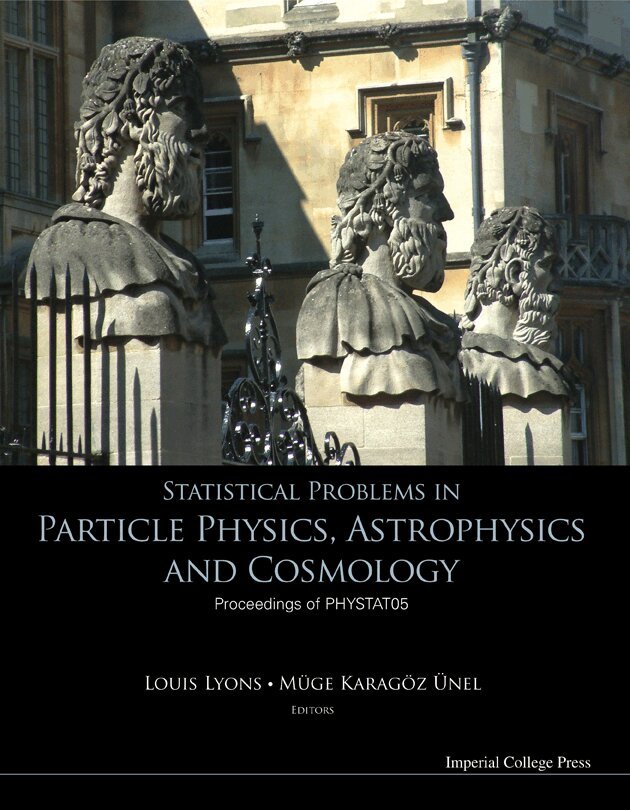
Statistical Problems In Particle Physics, Astrophysics And Cosmology - Proceedings Of Phystat05
Inbunden, Engelska, 2006
2 216 kr
Tillfälligt slut
These proceedings comprise current statistical issues in analyzing data in particle physics, astrophysics and cosmology, as discussed at the PHYSTAT05 conference in Oxford. This is a continuation of the popular PHYSTAT series; previous meetings were held at CERN (2000), Fermilab (2000), Durham (2002) and Stanford (2003).In-depth discussions on topical issues are presented by leading statisticians and research workers in their relevant fields. Included are invited reviews and contributed research papers presenting the latest, state-of-the-art techniques.