Lucian C. Staicu - Böcker
Visar alla böcker från författaren Lucian C. Staicu. Handla med fri frakt och snabb leverans.
4 produkter
4 produkter
Production of Colloidal Biogenic Selenium and Removal by Different Coagulation-Flocculation Approaches
Häftad, Engelska, 2015
508 kr
Skickas inom 10-15 vardagar
Selenium (Se) is a chemical element of concern due to its toxicity and increasing anthropogenic release to the environment. Se oxyanions, selenite and selenate, are water-soluble, bioavailable and toxic, whereas elemental selenium, Se(0), is solid and less toxic. Nevertheless, Se(0) is potentially harmful as particulate Se(0) has been reported to be bioavailable to bivalves, to fish and also prone to re-oxidation. In the current work we investigated the reduction of selenite and selenate using pure and mixed microbial cultures. A novel strain of Pseudomonas moraviensis showing high Se tolerance was isolated, classified and characterized for the first time. Biogenic Se(0) shows colloidal properties due to its nanosize scale and negatively-charged biopolymer coating. To address the need for efficient solid-liquid separation of biogenic Se(0) prior to environmental discharge, we tested and compared several physical-chemical separation methods. Centrifugation and filtration can be efficiently used for Se(0) separation but they are not feasible at the industrial scale due to prohibitive costs. Alternatively, chemical coagulation by metal salts, e.g. aluminum sulfate and ferric chloride, resulted in high removal rates around 90%. Electrocoagulation reached the highest colloidal Se(0) removal efficiency of 97% when using iron electrodes. In conclusion, biogenic Se(0) must be removed in a biological post-treatment step and several approaches described in this work could be successfully used.
Production of Colloidal Biogenic Selenium and Removal by Different Coagulation-Flocculation Approaches
Inbunden, Engelska, 2018
1 050 kr
Skickas inom 10-15 vardagar
Selenium (Se) is a chemical element of concern due to its toxicity and increasing anthropogenic release to the environment. Se oxyanions, selenite and selenate, are water-soluble, bioavailable and toxic, whereas elemental selenium, Se(0), is solid and less toxic. Nevertheless, Se(0) is potentially harmful as particulate Se(0) has been reported to be bioavailable to bivalves, to fish and also prone to re-oxidation. In the current work we investigated the reduction of selenite and selenate using pure and mixed microbial cultures. A novel strain of Pseudomonas moraviensis showing high Se tolerance was isolated, classified and characterized for the first time. Biogenic Se(0) shows colloidal properties due to its nanosize scale and negatively-charged biopolymer coating. To address the need for efficient solid-liquid separation of biogenic Se(0) prior to environmental discharge, we tested and compared several physical-chemical separation methods. Centrifugation and filtration can be efficiently used for Se(0) separation but they are not feasible at the industrial scale due to prohibitive costs. Alternatively, chemical coagulation by metal salts, e.g. aluminum sulfate and ferric chloride, resulted in high removal rates around 90%. Electrocoagulation reached the highest colloidal Se(0) removal efficiency of 97% when using iron electrodes. In conclusion, biogenic Se(0) must be removed in a biological post-treatment step and several approaches described in this work could be successfully used.
2 101 kr
Skickas inom 10-15 vardagar
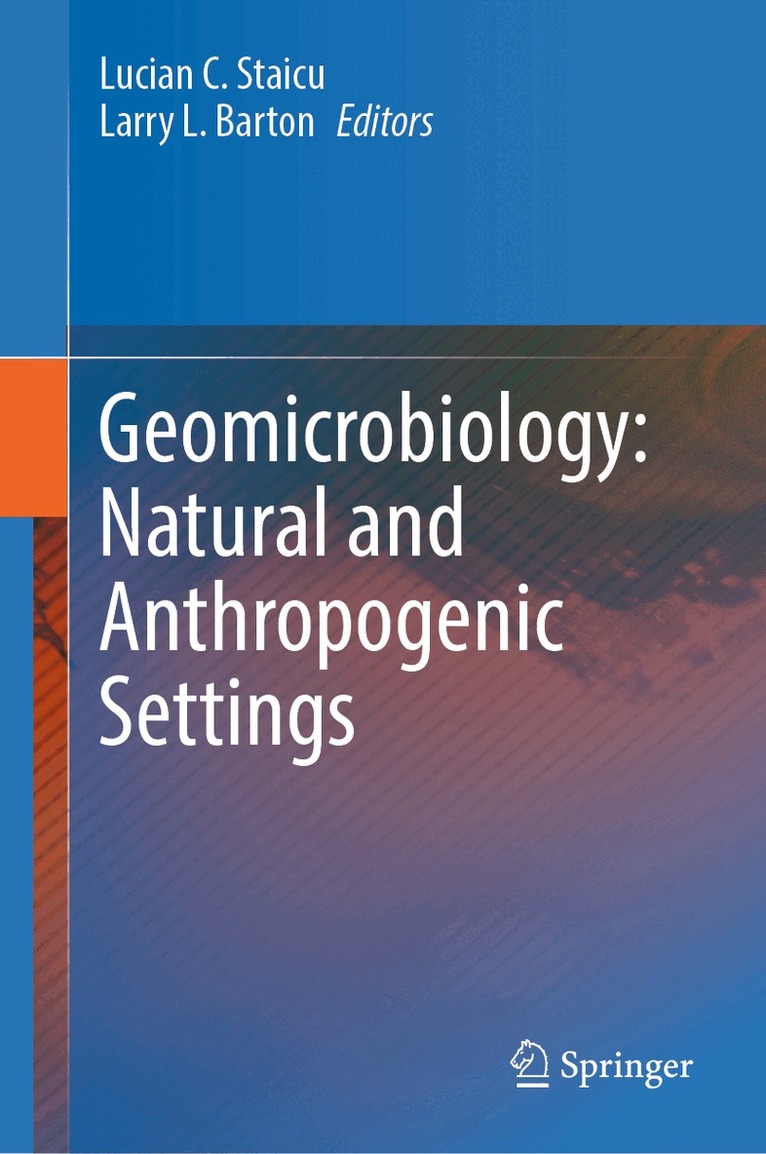
This volume brings together leading international experts to offer a unique and timely perspective on geomicrobiology through their latest research and findings. Chapters address interactions of marine and freshwater microorganisms contributing to geochemical cycles, including biochemical mechanisms for mineralization and transformation of solid minerals and dissolved metals. In addition, the resilience and physiological elasticity of specific bacteria in extreme environments is discussed, such as mechanisms of metal homeostasis and electrochemistry involving extracellular electron flow. Further coverage includes resource recovery (metals, minerals) using microbial-driven processes and technologies, with the aim to contribute to a better understanding of microbial potential within the framework of circular economy.This book is designed for professionals and students, including environmental engineers, microbiologists, and individuals studying the interaction of bacteria with metals and minerals in the environment. It is also a resource for students in academic programs or short courses focused on bacterial diversity in the environment, systems of bacterial energetics, resource recovery, and bacterial activities in extreme or nutrient-stressed environments..
2 101 kr
Skickas inom 10-15 vardagar
This volume brings together leading international experts to offer a unique and timely perspective on geomicrobiology through their latest research and findings. Chapters address interactions of marine and freshwater microorganisms contributing to geochemical cycles, including biochemical mechanisms for mineralization and transformation of solid minerals and dissolved metals. In addition, the resilience and physiological elasticity of specific bacteria in extreme environments is discussed, such as mechanisms of metal homeostasis and electrochemistry involving extracellular electron flow. Further coverage includes resource recovery (metals, minerals) using microbial-driven processes and technologies, with the aim to contribute to a better understanding of microbial potential within the framework of circular economy.This book is designed for professionals and students, including environmental engineers, microbiologists, and individuals studying the interaction of bacteria with metals and minerals in the environment. It is also a resource for students in academic programs or short courses focused on bacterial diversity in the environment, systems of bacterial energetics, resource recovery, and bacterial activities in extreme or nutrient-stressed environments..