Luraghi Silvia Luraghi – författare
Visar alla böcker från författaren Luraghi Silvia Luraghi. Handla med fri frakt och snabb leverans.
4 produkter
4 produkter
E-bok
Engelska, 20201 117 kr
Läs direkt efter köp
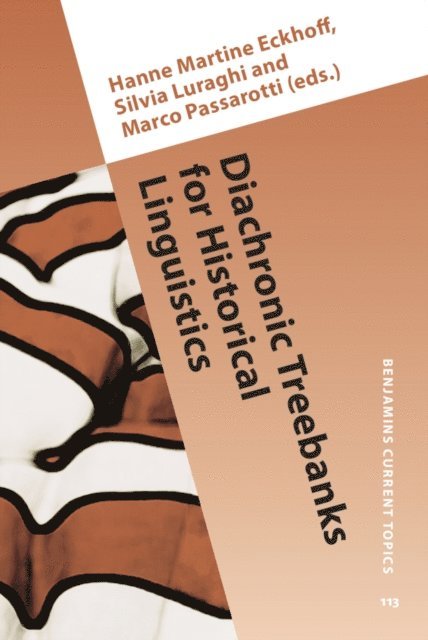
Over the last few decades, the widespread diffusion of digital technology has increased availability of primary textual sources, radically changing the everyday life of scholars in the humanities, who are now able to access, query and process a wealth of empirical evidence in ways not possible before.Also for ancient languages, corpora enhanced with increasingly complex layers of metalinguistic information, such as part-of-speech tagging and syntactic annotation (called ''treebanks'') are now available. In particular, diachronic treebanks, which provide data for a language across several historical stages of a given language, allow for a new approach to diachronic studies of syntactic phenomena where scholars previously had to content themselves with empirical work on a much smaller scale.This volume brings together a set of papers that report research on various diachronic matters supported by evidence from diachronic treebanks. The contents of the papers cover a wide range of languages, including English, French, Russian, Old Church Slavonic, Latin and Ancient Greek. Originally published as special issue of Diachronica 35:3 (2018).
E-bok
Engelska, 20171 305 kr
Läs direkt efter köp
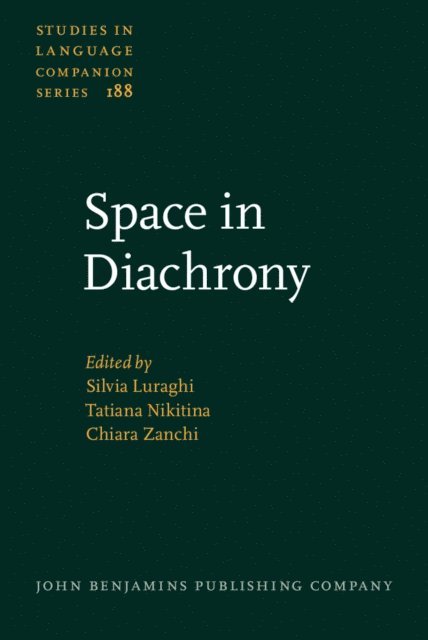
Space is a fundamental dimension of human life and is pervasive in human experience. Research on space has highlighted the possible asymmetrical nature of spatial relations. Differences in the encoding of goals and sources of motion are a case in point, and cross-linguistic coding tendencies show that path is less frequently flagged by a dedicated case than goal, source/origin, and (static) location (locative). Interestingly, such asymmetries may correlate with certain types of landmark, as in the case of toponyms or of animate entities. Even though these issues have been focused upon both in typological and psycholinguistic research, they remain largely open. The papers in this collection aim to show that a diachronic approach may shed light on the way in which asymmetries in the space domain come about over time, thus contributing to the clarification of synchronically puzzling facts.
E-bok
PDF, Engelska, 20141 305 kr
Läs direkt efter köp
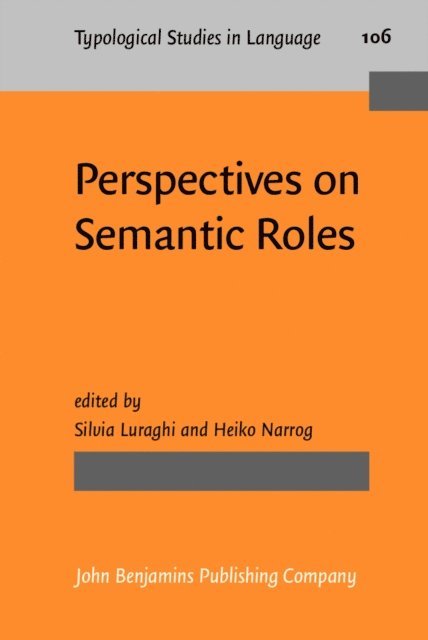
Semantic roles have continued to intrigue linguists for more than four decades now, starting with determining their kind and number, with their morphological expression, and with their interaction with argument structure and syntax. The focus in this volume is on typological and historical issues. The papers focus on the cross-linguistic identification of semantic-role equivalents, on the regularity of, and exceptions concerning change and grammaticalization in semantic roles, the variation of encoding the roles of direction and experiencer in specific languages, presenting evidence for identifying a new semantic role of speech addressee in Caucasian languages, on semantic roles in word formation, and finally a cross-linguistic comparison of the functions and the grammaticalization of the ethical dative in some Indo-European languages. The book will be of interest to anyone involved with case and semantic roles, with the syntax-semantics interface, and with semantic change and grammaticalization.
E-bok
PDF, Engelska, 20031 588 kr
Läs direkt efter köp
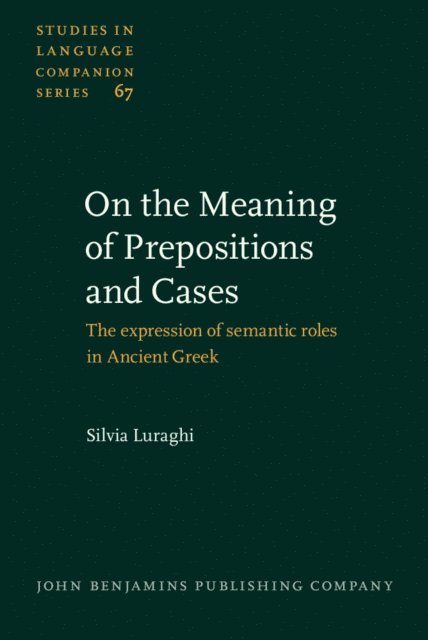
Prepositions and cases constitute a fruitful field of research for semantics. The historical development of their meaning can shed light on the relations among the semantic roles of participants and on the organization of conceptual space. Ancient Greek allows an in-depth study of such development. The book, based on a wide, diachronically ordered corpus, aims at providing a usage-based analysis of possible patterns of semantic extension, including the mapping of abstract domains onto the concrete domain of space. An analysis of the Greek data further highlights the interplay between specific spatial relations and the internal structure of the entities involved, and shows how case semantics may account for differences on the referential level, rather than merely express clause internal relations. The first chapter contains a typologically based discussion of semantic roles, which sets the language-specific analysis in a wider framework, showing its general relevance and applicability.