Zanchi Chiara Zanchi – författare
Visar alla böcker från författaren Zanchi Chiara Zanchi. Handla med fri frakt och snabb leverans.
2 produkter
2 produkter
E-bok
Engelska, 20241 622 kr
Läs direkt efter köp
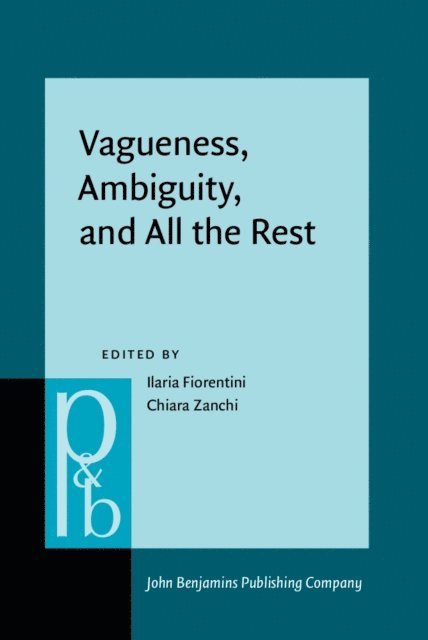
This book aims to address a gap in the existing literature on the relationship between vagueness and ambiguity, as well as on their differences and similarities, both in synchrony and diachrony, and taking into consideration their relation to language use. The book is divided into two parts, which address specific and broader research questions from different perspectives. The former part examines the differences between ambiguity and vagueness from a bird-eye perspective, with a particular focus on their respective functions and roles in language change. It also presents innovative linguistic resources and tools for the study of these phenomena. The second part contains case studies on vagueness and ambiguity in language change and use. It considers different strategies and languages, including English, French, German, Italian, Medieval Latin, and Old Italian. The readership for this volume is broad, encompassing scholars in a range of disciplines, including pragmatics, spoken discourse, conversation analysis, discourse genres (political, commercial, notarial discourse), corpus studies, language change, pragmaticalization, and language typology.
E-bok
Engelska, 20171 305 kr
Läs direkt efter köp
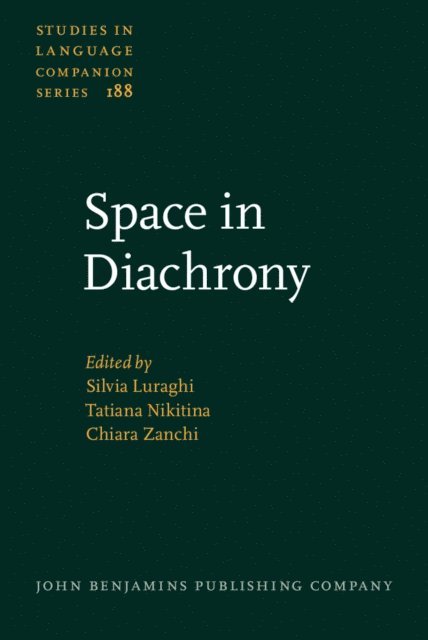
Space is a fundamental dimension of human life and is pervasive in human experience. Research on space has highlighted the possible asymmetrical nature of spatial relations. Differences in the encoding of goals and sources of motion are a case in point, and cross-linguistic coding tendencies show that path is less frequently flagged by a dedicated case than goal, source/origin, and (static) location (locative). Interestingly, such asymmetries may correlate with certain types of landmark, as in the case of toponyms or of animate entities. Even though these issues have been focused upon both in typological and psycholinguistic research, they remain largely open. The papers in this collection aim to show that a diachronic approach may shed light on the way in which asymmetries in the space domain come about over time, thus contributing to the clarification of synchronically puzzling facts.