M. Abercrombie – författare
Visar alla böcker från författaren M. Abercrombie. Handla med fri frakt och snabb leverans.
14 produkter
14 produkter
Häftad, Engelska, 2008
770 kr
Skickas inom 10-15 vardagar
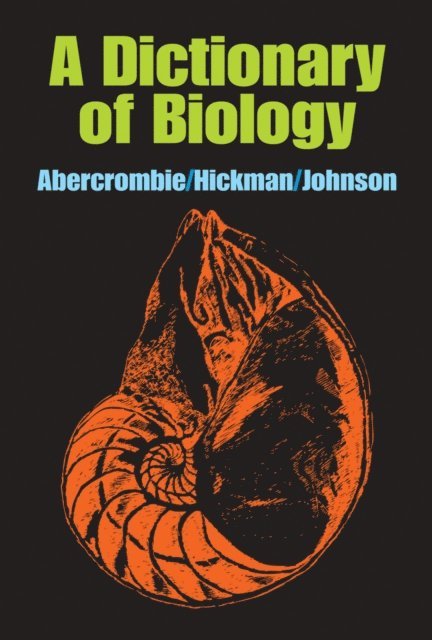
"A Dictionary of Biology" is an up-to-date reference work explains several thousand specialized words that allow for empirical approaches to the biological sciences. It includes more than bare definitions, including information about most of the things named so as to convey their significance in biological discussion. M. Abercrombie, C. J. Hickman, and M. L. Johnson in effect interpret this language as it is actually used, emphasizing customary usage rather than etymology.This comprehensive lexicon includes two thousand entries. Many unfamiliar terms, especially the rarer ones, are defined with the help of other technical terms, perhaps equally unfamiliar. This trick of dictionary-makers could only be avoided by giving a complete account of a large part of biology under each heading. Every biological technical term used in a definition is itself defined elsewhere in the dictionary; though some semi-technical terms, words that can be found in any English dictionary are omitted.The authors use codes throughout the dictionary to help the reader to interpret the use of a word such as whether it is used in relation to plants and animals only, whether the word is an adjective, and when a term is defined elsewhere and adds information to the current definition. The result is an invaluable guide for the layman, the student, and the scholar alike. It presents clear and authoritative explanations of the terms and will remain useful as a quick and concise source of reference.
Inbunden, Engelska, 2017
2 158 kr
Skickas inom 10-15 vardagar
"A Dictionary of Biology" is an up-to-date reference work explains several thousand specialized words that allow for empirical approaches to the biological sciences. It includes more than bare definitions, including information about most of the things named so as to convey their significance in biological discussion. M. Abercrombie, C. J. Hickman, and M. L. Johnson in effect interpret this language as it is actually used, emphasizing customary usage rather than etymology.This comprehensive lexicon includes two thousand entries. Many unfamiliar terms, especially the rarer ones, are defined with the help of other technical terms, perhaps equally unfamiliar. This trick of dictionary-makers could only be avoided by giving a complete account of a large part of biology under each heading. Every biological technical term used in a definition is itself defined elsewhere in the dictionary; though some semi-technical terms, words that can be found in any English dictionary are omitted.The authors use codes throughout the dictionary to help the reader to interpret the use of a word such as whether it is used in relation to plants and animals only, whether the word is an adjective, and when a term is defined elsewhere and adds information to the current definition. The result is an invaluable guide for the layman, the student, and the scholar alike. It presents clear and authoritative explanations of the terms and will remain useful as a quick and concise source of reference.
E-bok
Engelska, 2017892 kr
Läs direkt efter köp
"A Dictionary of Biology" is an up-to-date reference work explains several thousand specialized words that allow for empirical approaches to the biological sciences. It includes more than bare definitions, including information about most of the things named so as to convey their significance in biological discussion. M. Abercrombie, C. J. Hickman, and M. L. Johnson in effect interpret this language as it is actually used, emphasizing customary usage rather than etymology.This comprehensive lexicon includes two thousand entries. Many unfamiliar terms, especially the rarer ones, are defined with the help of other technical terms, perhaps equally unfamiliar. This trick of dictionary-makers could only be avoided by giving a complete account of a large part of biology under each heading. Every biological technical term used in a definition is itself defined elsewhere in the dictionary; though some semi-technical terms, words that can be found in any English dictionary are omitted.The authors use codes throughout the dictionary to help the reader to interpret the use of a word such as whether it is used in relation to plants and animals only, whether the word is an adjective, and when a term is defined elsewhere and adds information to the current definition. The result is an invaluable guide for the layman, the student, and the scholar alike. It presents clear and authoritative explanations of the terms and will remain useful as a quick and concise source of reference.
E-bok
PDF, Engelska, 2017892 kr
Läs direkt efter köp
"A Dictionary of Biology" is an up-to-date reference work explains several thousand specialized words that allow for empirical approaches to the biological sciences. It includes more than bare definitions, including information about most of the things named so as to convey their significance in biological discussion. M. Abercrombie, C. J. Hickman, and M. L. Johnson in effect interpret this language as it is actually used, emphasizing customary usage rather than etymology.This comprehensive lexicon includes two thousand entries. Many unfamiliar terms, especially the rarer ones, are defined with the help of other technical terms, perhaps equally unfamiliar. This trick of dictionary-makers could only be avoided by giving a complete account of a large part of biology under each heading. Every biological technical term used in a definition is itself defined elsewhere in the dictionary; though some semi-technical terms, words that can be found in any English dictionary are omitted.The authors use codes throughout the dictionary to help the reader to interpret the use of a word such as whether it is used in relation to plants and animals only, whether the word is an adjective, and when a term is defined elsewhere and adds information to the current definition. The result is an invaluable guide for the layman, the student, and the scholar alike. It presents clear and authoritative explanations of the terms and will remain useful as a quick and concise source of reference.
E-bok
PDF, Engelska, 2013756 kr
Läs direkt efter köp
Advances in Morphogenesis, Volume 8 covers the developments in the study of morphogenesis. The book discusses the morphogenetic aspects of acrosome formation and reaction; the migration and differentiation of neural crest cells; and the reaggregation of dissociated cells of sea urchin embryos. The text also describes the interacting genetic systems in Paramecium; genome transcription in fish development; as well as the biosynthesis of steroid hormones by the embryonic gonads of vertebrates. Biologists, molecular biologists, and medical students will find the book invaluable.
E-bok
Engelska, 2013763 kr
Läs direkt efter köp
Advances in Morphogenesis, Volume 9, provides an overview of the state of knowledge in morphogenesis. The book contains seven chapters and begins with a study of the interactions that occur in the morphogenesis of higher plants. This is followed by separate chapters on the regulatory mechanisms and cellular interactions in the development of annelids and mollusks; morphogenetic factors in limb ontogeny and limb regeneration; primary induction in birds; and the organogenesis and arrangement of cutaneous appendages in birds. Subsequent chapters deal with avian gastrulation and macromolecular syntheses and nucleocytoplasmic interactions in early development.
E-bok
Engelska, 2013756 kr
Läs direkt efter köp
Advances in Morphogenesis, Volume 10, provides an overview of the state of knowledge in morphogenesis. The book contains six chapters and opens with a discussion of the "organization center" of the amphibian embryo. This is followed by separate chapters on physiological gradients in development; molecular embryology of the sea urchin, mollusks, and other invertebrates; and changes in DNA, RNA, and protein during successive phases of embryonic development in vertebrates. Subsequent chapters deal with the control of growth in the filamentous prothalli and the causal factors promoting the transition to the two-dimensional gametophyte; and the development, inheritance, and origin of the plastid in Euglena.
E-bok
PDF, Engelska, 2013763 kr
Läs direkt efter köp
Advances in Morphogenesis, Volume 1 covers the significant advances in various aspects of morphogenesis. This book is composed of nine chapters that include discussion on cell growth, differentiation, and development. The opening chapter describes the complex process of embryonic organization, from the induction initiation to a number of differentiation processes, leading to formation of the essential part of the axial system of the embryo. The next chapters examine the basic aspects of embryology, the process of regeneration in vertebrate, the suppression of growth processes by morphostatic substances, and the role of proteases in tissue regeneration. These topics are followed by discussions on the factors that control plant cell growth and the morphological, physiological, and biochemical studies of normal pigment cell development and differentiation. The concluding chapters explore the development of limbs of tetrapod vertebrates, the morphogenesis of the vertebrate eye, and the particular phases of teleostean egg development. This book is directed toward developmental biologists.
E-bok
PDF, Engelska, 2013756 kr
Läs direkt efter köp
Advances in Morphogenesis, Volume 2 considers the significant advances in various aspects of morphogenesis. This book is composed of nine chapters that cover the morphological and biochemical aspects of cell growth and development. The opening chapter deals with the principles and phenomena of morphogenesis characteristic of ciliate protozoa Stentor. The succeeding chapters examine the phenomena of symmetrization in amphibian, birds, reptiles, and fish, and discuss comparative biochemical studies on amphibian and invertebrate. These topics are followed by surveys on the histochemical and morpholopgical studies of limb morphogenesis in vertebrates. Other chapters are devoted to embryonic and larval development, as well as the regeneration in certain group of animals. This book is directed primarily to developmental biologists.
E-bok
PDF, Engelska, 2013756 kr
Läs direkt efter köp
Advances in Morphogenesis, Volume 3 covers the significant advances in various aspects of morphogenesis. This volume is divided into nine chapters that specifically consider the histochemical, morphological, and biochemical aspects of cell growth and development in various animal groups. The opening chapter deals with the different mechanisms of determination in the development of the gastropods. The next chapters present the model system for biochemical of morphological differentiation, including non-filamentous aquatic fungi and sea urchin. These topics are followed by discussions of the results obtained from chick embryo erythrocyte during the entire prenatal period, with emphasis on the problems of autodifferentiation of chick embryo blood corpuscles. A chapter examines the role of DNA, RNA, and sulfhydryl groups in morphogenesis in amphibians and regeneration in the unicellular alga, Acetabularia mediterranea. The concluding chapters describe the relationship between cleavage, relative duration of developmental periods, and cell differentiation in stages of embryonic development. These chapters also look into the positive evidence concerning the morphogenetic role of the egg cortex of the amphibians. This book is directed primarily to developmental biologists.
E-bok
PDF, Engelska, 2013756 kr
Läs direkt efter köp
Advances in Morphogenesis, Volume 4 covers the significant advances in various aspects of morphogenesis. This volume is composed of six chapters that specifically consider the biological aspects of cell growth and development. The opening chapter describes the techniques for cell nuclei transplantation in different organisms. The next chapter surveys the features of the unicellular desmid genus Micrasterias and its application as a model system to delineate morphogenesis. Other chapters discuss the functional problems in corneal development and the regeneration in lower plants and annelids. The last chapter provides a summary of the biological aspects of the hen''s egg yolk embryogenesis. This book is directed primarily to developmental biologists.
E-bok
PDF, Engelska, 2013756 kr
Läs direkt efter köp
Advances in Morphogenesis, Volume 5 covers the significant advances in various aspects of morphogenesis. This volume contains six chapters that specifically consider the morphological aspects and model systems of cell growth and development. The opening chapter describes the features and various levels of patterns exhibited by feathers, with emphasis on their application as a model system to delineate morphogenesis in birds. The subsequent chapter examines the evidence concerning the control of cell differentiation organ initiation, and embryo development in organ and tissue culture. A chapter emphasizes the hypertrophic growth control to the liver and kidney. The discussion then shifts to the ultrastructural studies of the amphibian egg and its surrounding layers, which, which have clarified many aspects related to morphogenesis during the critical stages of development prior to fertilization. The final chapters examine the mechanisms for the establishment of specific connections between different sets of neurons. These chapters also look into the certain steps of macromolecular coordination that lead to the formation or transformation of the vitelline membrane, the cortical particles, the fertilization membrane, and the hyaline layer. This book is directed primarily toward developmental biologists.
E-bok
PDF, Engelska, 2013756 kr
Läs direkt efter köp
Advances in Morphogenesis, Volume 6 considers the significant advances in various aspects of morphogenesis. This volume is composed of seven chapters that specifically cover the biological, morphological, and embryological aspects of cell growth and development. The opening chapter deals with the classification, progression, genetic aspects, and experimental induction of teratomas. The next chapter focuses on insect morphogenesis, its formation of surface patterns, the gradient organization of the epidermis, and the three-dimensional patterns resulting from cycles of activity in time. A chapter discusses the factors that control the initiation of hemoglobin synthesis, with a particular emphasis on studies of the chick and amphibian embryo. These topics are followed by surveys on heteroblastic development in vascular plants, the ultrastructure of the nucleus, and the experimental alterations of the developmental cytogenetic mechanisms. The final chapter examines the epigenetic aspect of developments in sexual organogenesis. This book is directed primarily toward developmental biologists.
E-bok
PDF, Engelska, 2013756 kr
Läs direkt efter köp
Advances in morphogenesis, Volume 7 considers the significant advances in various aspects of morphogenesis. This volume is composed of eight chapters that specifically cover the concept of blastogenesis and tissue regeneration. The introductory chapter presents the evidence suggesting that the mechanism involved in the initiation of growth in compensatory hypertrophy may not be the same as that in wound healing. The succeeding two chapters deal with certain morphogenetic aspects of the crown gall problem and the development of the innervation of the tetrapod limb by combined observations of behavior with histological studies. These topics are followed by discussions on the synthesis of mRNA during embryonic development, aspects of blastogenesis, and phases of amphibian limb regeneration. The concluding chapters examine the main features of the induction of the development of kidney tubules in the metanephrogenic mesenchyme and the utilization of the developing Fucus egg as a prototype of the localization phenomenon. This book is directed primarily toward developmental biologists.