M. Cross – författare
Visar alla böcker från författaren M. Cross. Handla med fri frakt och snabb leverans.
11 produkter
11 produkter
Inbunden, Engelska, 2006
1 089 kr
Skickas inom 10-15 vardagar
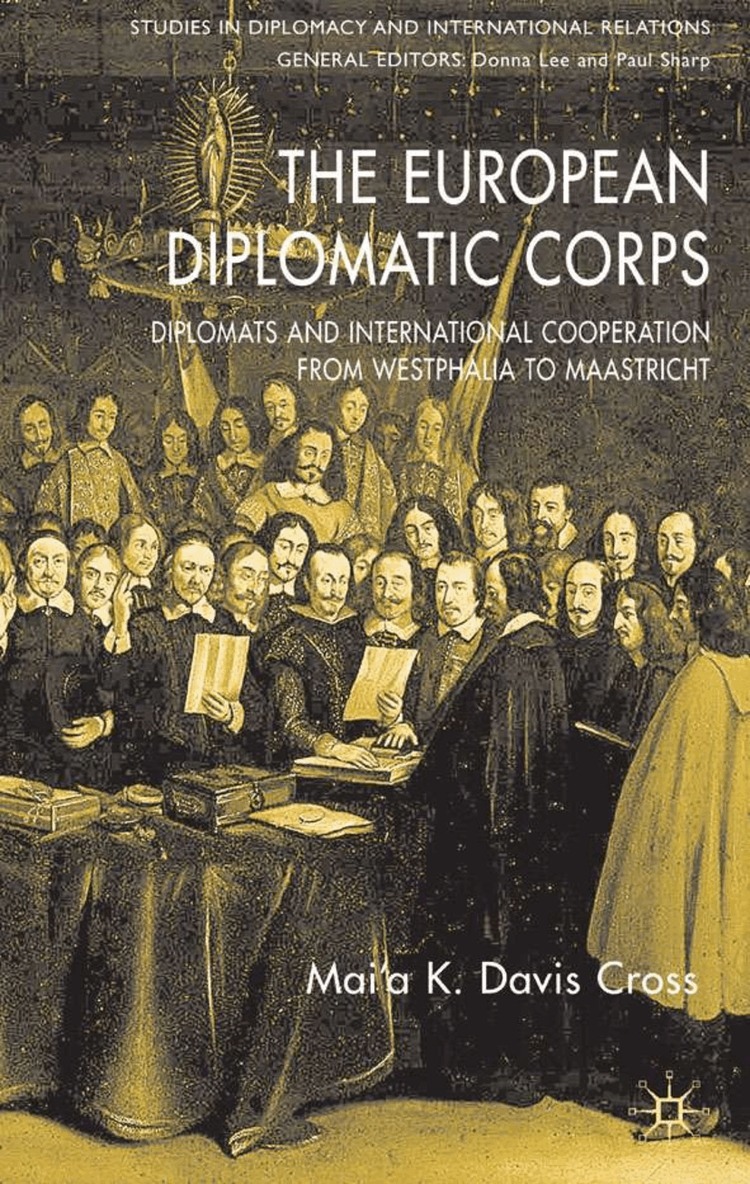
The European Diplomatic Corps argues that diplomats comprise a transnational network of experts or 'epistemic community' which has been critical in determining co-operation or non-co-operation among European states. The cases considered are the congresses of Westphalia (1648), Berlin (1878), Paris (1919) and Maastricht (1992).
Inbunden, Engelska, 2000
1 121 kr
Skickas inom 10-15 vardagar
Fourteen wide-ranging chapters by distinguished international scholars treat key aspects of the rapidly changing political and cultural scene in France from the First Republic, through the Consulate and Empire to the death of Louis XVIII in 1824.
Inbunden, Engelska, 2001
1 089 kr
Skickas inom 10-15 vardagar
The book presents the views of experts on both sides of the Atlantic on the changes to the social structure of cities as a result of recent migration. The contributors consider the link between globalization cities and existing zones of social exclusion, employment prospects for all residents and the likelihood of social mobility for recent arrivals. A particular feature of the book is the comparative focus of the chapters that seek to assess the importance of national institutional structures.
Häftad, Engelska, 2018
293 kr
Skickas inom 3-6 vardagar
Inbunden, Engelska, 2018
445 kr
Skickas inom 3-6 vardagar
Häftad, Engelska, 2000
1 121 kr
Skickas inom 10-15 vardagar
Fourteen wide-ranging chapters by distinguished international scholars treat key aspects of the rapidly changing political and cultural scene in France from the First Republic, through the Consulate and Empire to the death of Louis XVIII in 1824.
Häftad, Engelska, 2018
1 089 kr
Skickas inom 10-15 vardagar
The European Diplomatic Corps argues that diplomats comprise a transnational network of experts or 'epistemic community' which has been critical in determining co-operation or non-co-operation among European states. The cases considered are the congresses of Westphalia (1648), Berlin (1878), Paris (1919) and Maastricht (1992).
Häftad, Engelska, 2001
1 089 kr
Skickas inom 10-15 vardagar
The book presents the views of leading experts on both sides of the Atlantic on the changes to the social structure of cities as a result of recent migration.
E-bok
PDF, Engelska, 20001 408 kr
Läs direkt efter köp
Fourteen wide-ranging chapters by distinguished international scholars treat key aspects of the rapidly changing political and cultural scene in France from the First Republic, through the Consulate and Empire to the death of Louis XVIII in 1824. Falling into two interlinked parts, this collection of original essays explores new developments as well as continuities characterising the transition between the eighteenth century and the nineteenth. It includes chapters on feminism, politics and theatre, elections and plebiscites, revolution and counter-revolution, patronage, universities and education, medicine, music and science.
Häftad, Engelska, 1986
1 619 kr
Skickas inom 10-15 vardagar
Computational fluid flow is not an easy subject. Not only is the mathematical representation of physico-chemical hydrodynamics complex, but the accurate numerical solution of the resulting equations has challenged many numerate scientists and engineers over the past two decades. The modelling of physical phenomena and testing of new numerical schemes has been aided in the last 10 years or so by a number of basic fluid flow programs (MAC, TEACH, 2-E-FIX, GENMIX, etc). However, in 1981 a program (perhaps more precisely, a software product) called PHOENICS was released that was then (and still remains) arguably, the most powerful computational tool in the whole area of endeavour surrounding fluid dynamics. The aim of PHOENICS is to provide a framework for the modelling of complex processes involving fluid flow, heat transfer and chemical reactions. PHOENICS has now been is use for four years by a wide range of users across the world. It was thus perceived as useful to provide a forum for PHOENICS users to share their experiences in trying to address a wide range of problems. So it was that the First International PHOENICS Users Conference was conceived and planned for September 1985. The location, at the Dartford Campus of Thames Polytechnic, in the event, proved to be an ideal site, encouraging substantial interaction between the participants.
E-bok
PDF, Engelska, 20121 977 kr
Läs direkt efter köp
Computational fluid flow is not an easy subject. Not only is the mathematical representation of physico-chemical hydrodynamics complex, but the accurate numerical solution of the resulting equations has challenged many numerate scientists and engineers over the past two decades. The modelling of physical phenomena and testing of new numerical schemes has been aided in the last 10 years or so by a number of basic fluid flow programs (MAC, TEACH, 2-E-FIX, GENMIX, etc). However, in 1981 a program (perhaps more precisely, a software product) called PHOENICS was released that was then (and still remains) arguably, the most powerful computational tool in the whole area of endeavour surrounding fluid dynamics. The aim of PHOENICS is to provide a framework for the modelling of complex processes involving fluid flow, heat transfer and chemical reactions. PHOENICS has now been is use for four years by a wide range of users across the world. It was thus perceived as useful to provide a forum for PHOENICS users to share their experiences in trying to address a wide range of problems. So it was that the First International PHOENICS Users Conference was conceived and planned for September 1985. The location, at the Dartford Campus of Thames Polytechnic, in the event, proved to be an ideal site, encouraging substantial interaction between the participants.